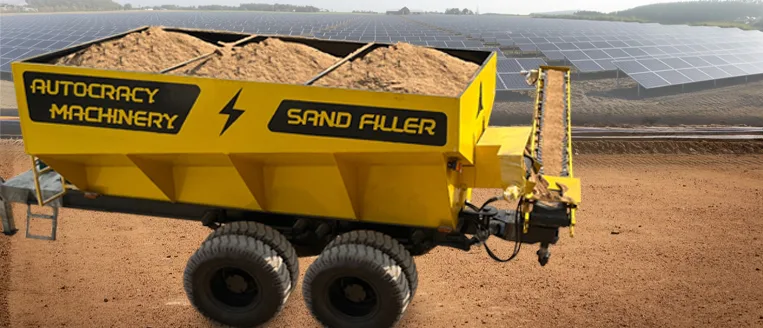
Sand Filler – Pipeline Padding Machine plays a crucial role in modern pipeline construction by ensuring safe and efficient backfilling around buried pipes. In infrastructure projects such as oil and gas pipelines, water supply systems, and underground utility installations, protecting pipes from damage is extremely important. Improper backfilling can lead to pipe cracks, corrosion, and long-term structural failures. To avoid these issues, specialized machinery is used to provide uniform and protective sand bedding around pipelines.
Traditionally, pipeline backfilling was done manually using labor and basic tools. This method was not only time-consuming but also inconsistent, often leaving gaps, uneven layers, and sharp stones around the pipe. These irregularities could cause serious damage over time due to soil movement or external pressure. With the introduction of mechanized solutions, construction companies can now achieve higher precision, better safety, and faster project completion.
A pipeline padding machine is designed to carefully place fine material such as sand or selected soil around the pipeline. This creates a cushioning layer that absorbs external pressure and prevents direct contact between the pipe and hard soil or rocks. This protective layer is essential for maintaining pipeline integrity, especially in long-distance underground installations where environmental conditions vary widely.
In the middle of advanced pipeline construction systems, the Sand Filler has become an essential machine for ensuring uniform sand distribution and proper trench filling. It works by collecting sand from a source, processing it if needed, and then accurately placing it around the pipeline without damaging the installed structure. This controlled method reduces human error and ensures consistent quality across the entire pipeline route. As a result, contractors can meet safety standards and project specifications more effectively.
One of the major advantages of using a pipeline padding machine is its ability to significantly reduce labor dependency. Instead of relying on manual workers to carry and spread sand, the machine performs the task quickly and efficiently. This not only reduces labor costs but also speeds up the construction process, allowing large-scale pipeline projects to be completed within tight deadlines.
Additionally, safety is greatly improved when using mechanized backfilling equipment. Manual backfilling in deep trenches can be risky for workers due to cave-ins, falling materials, and exposure to heavy machinery. By using automated or semi-automated padding systems, the need for workers to enter hazardous trench areas is minimized, reducing workplace accidents.
Another key benefit is consistency. Uniform sand padding ensures that the pipeline is evenly supported along its entire length. This prevents stress concentration at specific points, which could otherwise lead to pipe deformation or leakage. Consistent padding also improves long-term durability, reducing maintenance requirements and operational costs for pipeline operators.
In conclusion, the Sand Filler – Pipeline Padding Machine is a vital innovation in modern infrastructure development. It enhances safety, improves efficiency, and ensures high-quality protection for underground pipelines. As pipeline networks continue to expand globally, the use of advanced padding machinery will play an increasingly important role in delivering reliable and long-lasting results.