
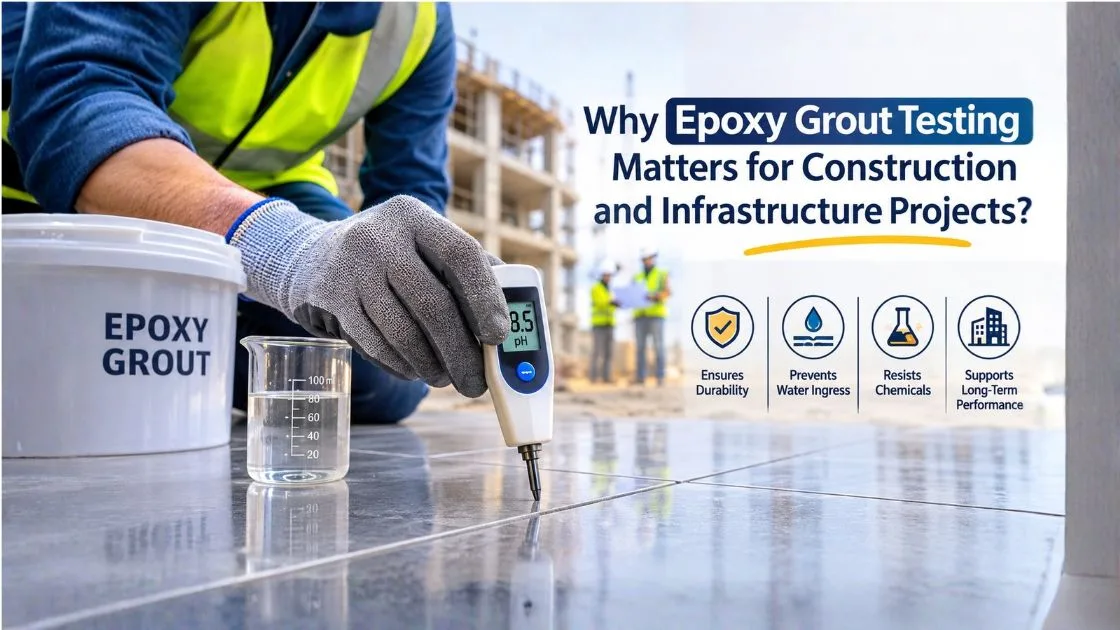
Summary - Epoxy grout testing verifies whether grout has the required strength, bonding, durability, water resistance, and chemical resistance for a specific construction application. Tests such as compressive strength, flexural strength, adhesion, water absorption, shrinkage, and abrasion resistance help identify potential problems before they lead to costly repairs.
Epoxy grout is widely used in construction where durability, strong bonding, moisture resistance, or chemical resistance is important. But choosing an epoxy grout does not automatically mean it will perform as expected.
Epoxy grout testing helps confirm whether the material meets the requirements of its intended application. Depending on the project, testing may evaluate strength, adhesion, shrinkage, water absorption, abrasion resistance, and other properties. For construction projects in PCMC, Pune, Mumbai, and across India, this provides a practical way to make better material and quality-control decisions before installation.
What Is Epoxy Grout and Where Is It Used?
Epoxy grout is a resin-based grouting material generally made from resin, hardener, and specially selected aggregates or fillers. Unlike conventional cement grout, epoxy grout is designed to provide enhanced resistance to moisture, chemicals, abrasion, and mechanical stresses in many demanding applications.
It is commonly used for:
- Tile and stone joints
- Industrial flooring
- Machinery foundations
- Equipment bases and baseplates
- Commercial and institutional buildings
- Manufacturing facilities
- Chemical and pharmaceutical plants
- Wet areas and swimming pools
- High-traffic flooring
- Repair and infrastructure applications
The right grout depends on the exposure conditions, expected loads, substrate, joint requirements, installation method, and project specification.
Why Is Epoxy Grout Testing Important?
Epoxy grout testing is not simply about obtaining a laboratory number. It helps determine whether the material is capable of delivering the performance expected from it.
1. It Verifies Mechanical Strength
Compressive strength is one of the most commonly considered properties when evaluating epoxy grout.
A grout used beneath equipment, machinery, baseplates, or other load-bearing applications may experience substantial compressive forces. Testing helps determine whether the material can withstand the specified load without unacceptable failure.
Flexural strength can provide additional information about the grout's resistance to bending and cracking.
2. It Checks Bonding Performance
A strong grout is of limited value if it does not bond properly to the surrounding substrate.
Adhesion or bond testing can help assess the interaction between the grout and surfaces such as concrete, tiles, stone, or other specified substrates.
Poor bonding may eventually contribute to debonding, cracking, water penetration, or loss of performance.
3. It Helps Identify Excessive Shrinkage
Dimensional stability is important because excessive shrinkage can create gaps between the grout and surrounding surfaces.
In applications where grout needs to maintain close contact with a substrate or equipment base, uncontrolled dimensional change can reduce the effectiveness of the installation.
4. It Evaluates Water Resistance
Some epoxy grout applications are continuously or periodically exposed to moisture.
Bathrooms, swimming pools, kitchens, industrial wash-down areas, and other wet environments can benefit from appropriate water absorption testing.
Lower water absorption can be particularly important where moisture penetration could contribute to deterioration or hygiene concerns.
5. It Measures Resistance to Wear
Industrial and commercial floors may experience continuous foot traffic, equipment movement, impact, or abrasion.
Abrasion resistance testing helps determine whether a grout is capable of maintaining its surface performance under the expected conditions.
6. It Helps Assess Chemical Resistance
Industrial environments can expose grout to cleaning agents, acids, alkalis, solvents, oils, or other chemicals.
A grout selected for such an environment should be evaluated against the chemicals and exposure conditions relevant to the project rather than assuming that every epoxy product provides identical resistance.
What Properties Are Tested in Epoxy Grout?
The exact test program should depend on the product, application, specification, and applicable standard.
Commonly evaluated properties include:
PropertyWhat It Helps DetermineCompressive strengthResistance to compressive loadsFlexural strengthResistance to bendingBond/adhesion strengthAbility to remain bonded to the substrateWater absorptionResistance to moisture penetrationLinear shrinkageDimensional stabilityAbrasion resistanceResistance to surface wearChemical resistancePerformance under chemical exposureFlow/workabilityEase and consistency of placementTransverse deformationBehaviour under movementCreepLong-term deformation under sustained loadNot every project requires every test. A machinery foundation, for example, may require a different evaluation approach from tile joints in a commercial washroom.
Which Standards Are Used for Epoxy Grout Testing?
The applicable testing standard depends on the type of grout and its intended application.
For tile and stone joint applications, IS 17190:2020 is an important Indian reference for reaction resin grouts. Other applications may require ASTM, ISO, EN, or project-specific test methods.
For example, ASTM C579 is used for determining compressive strength of chemical-resistant mortars, grouts, and monolithic surfacings in specified applications.
The important point is that a laboratory should not simply select a convenient test method. The test method should correspond to the product type, intended use, specification, and required acceptance criteria.
How Is Epoxy Grout Tested in a Laboratory?
A reliable testing process generally begins before the specimen reaches the testing machine.
Step 1: Sample Identification
The laboratory should record relevant information such as:- Product name
- Manufacturer
- Batch or lot number
- Date of manufacture, where available
- Sample quantity
- Intended application
Proper identification improves traceability.
Step 2: Review the Specification
The testing requirements should be compared with the project's technical specification and manufacturer's product information.
This step helps determine which properties actually need to be tested.
Step 3: Sample Preparation
The grout is mixed, moulded, cured, or conditioned according to the applicable test procedure.
This stage is critical. Incorrect resin-to-hardener ratios, poor mixing, improper curing, or inconsistent specimen preparation can affect the results.
Step 4: Laboratory Testing
The required mechanical, physical, durability, or bonding tests are performed using the specified methods.
Step 5: Result Evaluation
The results are compared with the applicable standard, product requirements, or project acceptance criteria.
A test result should therefore be interpreted in context rather than viewed as an isolated number.
What Can Happen If Epoxy Grout Is Not Properly Tested?
Consider a commercial or industrial facility where epoxy grout is selected for a high-traffic area.
If the grout has inadequate abrasion resistance, the surface may deteriorate much earlier than expected. If bonding is poor, localized debonding may develop. If shrinkage is excessive, gaps can form. In a chemically exposed area, insufficient chemical resistance may accelerate deterioration.
These failures can lead to:
- Cracking
- Debonding
- Surface wear
- Moisture penetration
- Loss of support
- Equipment instability in specialised applications
- Increased maintenance
- Premature replacement
The cost of testing is generally much easier to manage than the cost of removing failed grout and repeating the work.
Where Do Epoxy Grout Bonding Agents in PCMC Fit Into the Process?
Searches for Epoxy Grout Bonding Agents in PCMC are particularly relevant when contractors, builders, industrial facilities, and infrastructure teams are looking for better adhesion between grout and substrate.
However, a bonding agent should not be treated as a substitute for proper grout testing.
Its suitability depends on factors such as:
- Substrate condition
- Surface preparation
- Compatibility with the epoxy grout
- Environmental exposure
- Application method
- Manufacturer recommendations
- Project specification
For projects around Pimpri-Chinchwad and the wider PCMC region, where residential, commercial, industrial, and infrastructure construction coexist, material selection should be based on the actual application rather than simply choosing the strongest-looking product on a datasheet.
Where bonding performance is critical, appropriate adhesion or compatibility evaluation can provide greater confidence than relying only on product claims.
Epoxy Grout Testing vs. Manufacturer Data Sheets: Are They the Same?
No. A manufacturer's technical data sheet provides declared or reported product performance under specified conditions. Laboratory testing can provide an additional quality-control assessment of the particular sample or material being evaluated.
This distinction becomes important for major projects where material approval, batch verification, or independent quality assurance is required.
For a broader comparison of epoxy and cement-based grout, this epoxy grout comparison guide can help explain where each type is more appropriate.
When Should Epoxy Grout Be Tested?
Testing may be appropriate at several stages of a construction project.
Before Product Approval
Testing can help engineers compare proposed products before large-scale procurement or installation.
During Material Quality Control
For critical projects, supplied material can be evaluated against specified requirements.
Before Major Installation
Testing can provide additional confidence before large quantities of grout are installed.
When Performance Problems Appear
If cracking, debonding, unusual shrinkage, excessive wear, or chemical deterioration occurs, testing can help investigate the potential cause.
When Required by the Project Specification
Some projects have specific inspection and testing plans that define the required material tests and acceptance criteria.
How Can Contractors Improve Epoxy Grout Quality Control?
A practical quality-control approach should include more than laboratory testing.
First, identify the exposure conditions. Is the grout exposed to water, chemicals, heavy traffic, vibration, heat, or sustained loads?
Second, define acceptance criteria before testing. Testing becomes much more useful when the required performance is established in advance.
Third, maintain batch traceability. Record product and batch information during procurement and installation.
Fourth, control installation conditions. Mixing ratio, surface preparation, working time, curing, temperature, and moisture can influence final performance.
Finally, document the results. Test reports should be retained with the project's quality records.
This approach can form part of a wider construction quality-assurance system. For additional guidance, this construction QA plan guide explains how testing and inspection can be incorporated into a broader project quality framework.
How Do You Choose an Epoxy Grout Testing Laboratory?
Before selecting a laboratory, check whether it can perform the specific tests required for your application.
Look for:
- Relevant testing experience
- Appropriate test methods
- Properly documented procedures
- Clear and traceable test reports
- Experience with construction materials
- Suitable sample handling and preparation
- NABL accreditation where applicable
One important point is often misunderstood: NABL accreditation is scope-specific. A laboratory being NABL accredited does not automatically mean that every test it performs is covered by accreditation. The relevant test, parameter, and method should fall within the laboratory's applicable accreditation scope when accredited testing is specifically required.
For projects in PCMC, Pune, Mumbai, Navi Mumbai, and other Indian construction markets, checking this point before submitting samples can prevent confusion later.
Make Epoxy Grout Testing Part of Your Quality-Control Strategy
Epoxy grout may look like a relatively small component of a construction project, but its performance can have a significant effect on durability, maintenance, and overall installation quality. The right testing approach verifies the properties that actually matter for the intended application rather than relying on assumptions or a single strength value.
Whether the project involves industrial flooring, machinery foundations, commercial buildings, wet areas, infrastructure work, or specialised installations, begin by identifying the exposure conditions and performance requirements. Then select the appropriate test methods, acceptance criteria, and laboratory.
If you are planning epoxy grout testing for a construction or infrastructure project in PCMC, Pune, Mumbai, Navi Mumbai, or elsewhere in India, discuss your required parameters and project specifications with a qualified construction-material testing laboratory before final material approval. Early technical consultation can help you choose the right testing scope, avoid unsuitable comparisons, and make better quality-control decisions before installation begins.
https://www.blogorbitz.com/nabl-accreditation-construction-material-testing/
Frequently Asked Questions About Epoxy Grout Testing
What is epoxy grout testing?
Epoxy grout testing is the laboratory evaluation of properties such as strength, adhesion, water absorption, shrinkage, abrasion resistance, chemical resistance, and other characteristics required for a specific application.
Why is epoxy grout testing necessary?
It helps verify whether the grout meets specified performance requirements and can reduce the risk of premature failure, debonding, cracking, excessive wear, or deterioration.
What tests are performed on epoxy grout?
Common tests include compressive strength, flexural strength, adhesion or bond strength, water absorption, shrinkage, abrasion resistance, chemical resistance, and other application-specific evaluations.
What is the standard for epoxy grout testing in India?
The applicable standard depends on the grout type and intended application. IS 17190:2020 is relevant to reaction resin grouts used for filling joints in tiles and stones, while other applications may require different Indian or international methods.
Is compressive strength enough to evaluate epoxy grout?
Not necessarily. Compressive strength is important, but it does not describe every aspect of grout performance. Bonding, shrinkage, water absorption, abrasion, chemical resistance, and other properties may also matter depending on the application.