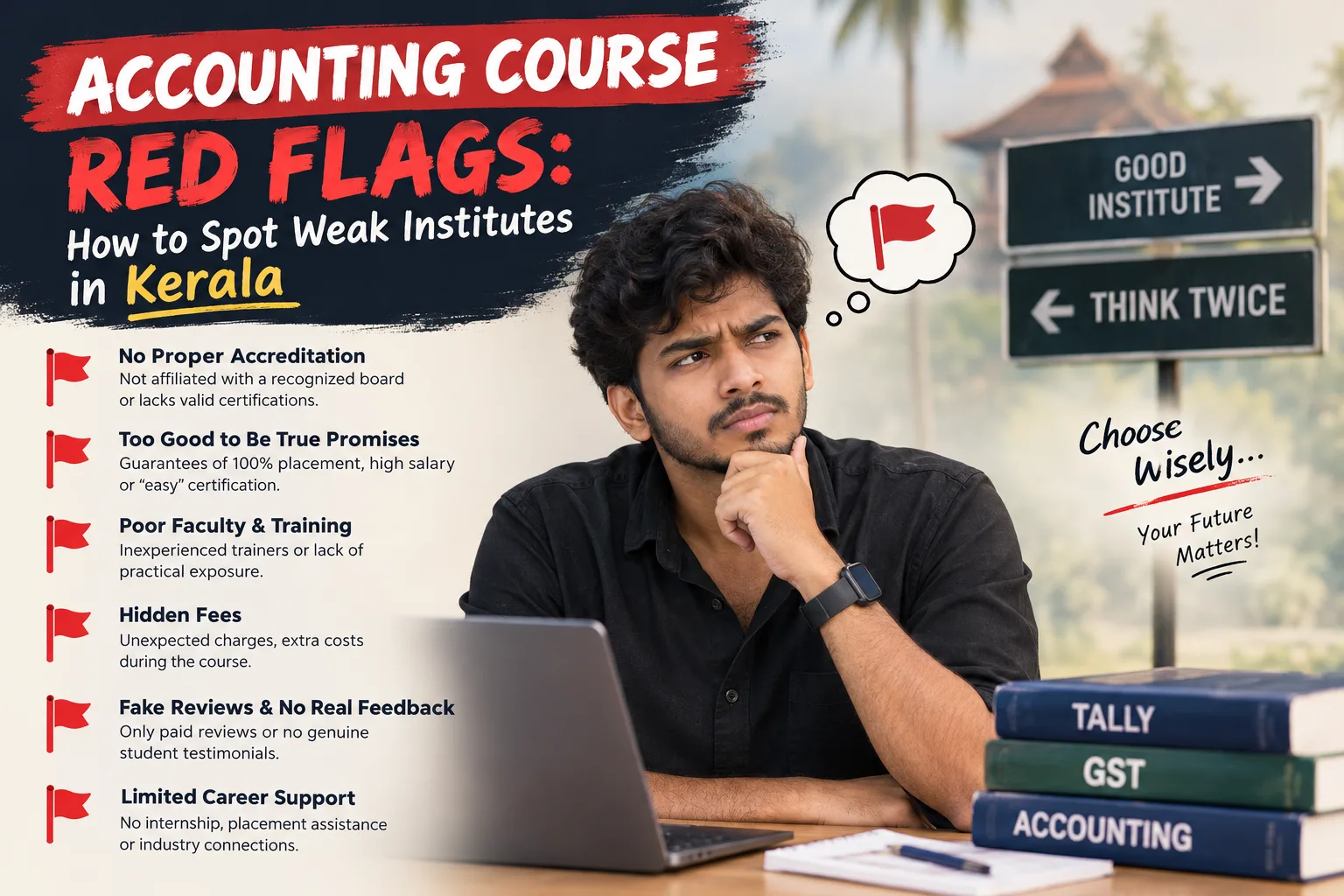
Picture this. A student pays a full year's fee upfront for a course that promises everything. Placement. Live projects. Big company tie-ups. Three months in, the "faculty" keep changing, the software isn't even installed on the lab computers, and nobody picks up the phone.
It happens more often than you'd think.
Kerala has no shortage of options when it comes to accounting courses in Kerala. Some institutes are genuinely good. Others are just good at marketing. The trick is knowing how to tell them apart before you pay anything.
Here are the red flags worth watching for.
1. "100% placement guaranteed"
This one should make you pause.
No honest institute can guarantee a job. Placement depends on your skills, your effort and the market. What a good institute can offer is placement support: resume help, interview practice and genuine company contacts.
Ask this instead: "How many students from the last batch got placed, and where? Can I speak to one of them?"
If they dodge, that tells you plenty.
2. They won't let you meet the faculty
You're paying for teaching. So you should know who's teaching.
Ask these questions:
- Who will take my classes?
- What is their qualification and real work experience?
- How long have they been teaching?
If the answer is "our team will handle it," be careful. Good institutes are proud of their faculty and happy to introduce them.
3. No demo class, no trial, no clarity
A confident institute lets you try before you commit. A demo class or a short counselling session costs them nothing.
If they push you to pay the same day with lines like "only 2 seats left" or "offer ends today," walk away. Pressure is a sales tactic, not a teaching method.
4. The syllabus is vague
"Complete accounting package" doesn't mean anything.
A proper course page should clearly tell you:
- Topics covered, module by module
- Software you'll actually learn (Tally, Zoho Books, Excel, and so on)
- Duration and weekly class hours
- Assessment method and certificate details
If you can't see what you'll learn, you can't judge whether it's worth it.
5. Theory only, no practice
Accounting isn't something you learn by reading. You learn it by doing entries, filing returns and fixing mistakes.
Ask about:
- Practical sessions on real accounting software
- Case studies or mock company data
- Internship or live project exposure
An institute that only hands out notes and slides will leave you with a certificate and no confidence.
6. Outdated content, especially for GST and taxation
GST rules change. Notifications, due dates and return formats get updated regularly. If the trainer is still teaching from five-year-old material, you'll struggle on the job.
This matters even more if you're considering a GST course online. Before you enrol, check:
- Is the content updated for recent GST changes?
- Do they cover practical return filing, such as GSTR-1 and GSTR-3B, not just theory?
- Are recorded classes and doubt-clearing sessions included?
- Do you get support after the course ends?
A weak online course is just a pile of videos. A good one feels like someone is actually teaching you.
7. Fees that aren't clear
Hidden costs ruin trust fast. Watch for:
- Extra charges for exams, certificates or study material that nobody mentioned
- No receipt or written fee structure
- No refund policy, or one that's hidden in fine print
Ask for the full fee breakdown in writing. A good institute won't mind.
8. Zero online presence, or only fake reviews
Check Google reviews, social media pages and the website. Real institutes have real student feedback, with a mix of praise and the odd complaint.
Be careful if you see:
- Only perfect 5-star reviews posted in the same week
- No student photos or names, or the same stock images everywhere
- No address or contact details you can verify
Better still, visit in person. The vibe of the place tells you a lot.
9. Too many courses, no focus
Some institutes offer everything: accounting, coding, beauty, languages, drone training. When one place teaches everything, it usually masters nothing.
Look for institutes with a clear specialty in accounting, taxation and finance training, and a track record to show for it.
10. SAP promises that sound too easy
If you're looking at a SAP training institute, be extra careful. SAP is a serious, specialised skill, and it's also an area where overpromising is common.
Red flags include:
- No access to an actual SAP system for practice
- Trainers with no real implementation experience
- Promises of high-paying jobs in a few weeks
- Unclear certification details
Ask which SAP module you'll learn (for accountants, this is usually FICO), how many hours are hands-on, and whether the trainer has worked on live projects. Hands-on practice is what separates a useful SAP course from an expensive one.
11. Your gut feels off
Don't ignore this one. If the counsellor avoids direct questions, rushes you, or makes big promises without details, trust that feeling.
A quick checklist before you pay
- Visit the institute and see a class in action
- Meet the faculty
- Ask for the syllabus and fee structure in writing
- Talk to current students or alumni
- Check that the content is current, especially for GST and software
- Confirm what support you get after the course
If an institute passes all of this, you're probably in decent hands.
Choosing wisely
The right accounting course can open real doors: jobs in firms, roles in the Gulf, or even your own practice someday. The wrong one just costs you time and money.
Take your time, ask the awkward questions, and compare at least two or three options before deciding.
If you'd like a reference point while you compare, Accountants Academy has been training accounting and finance students in Kerala for over 27 years. You can look at their Diploma in GST and SAP FICO course pages to see what a clear syllabus looks like. Whether you pick them or someone else, hold every institute to the same checklist.