
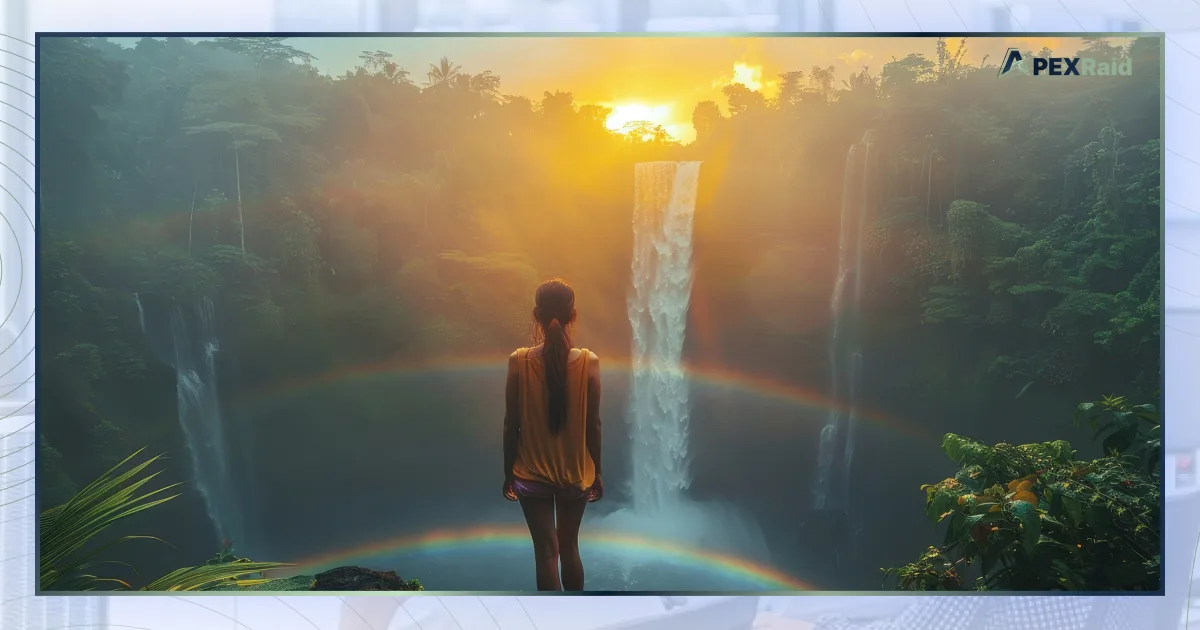
There are seasons when the world feels heavy. News cycles deliver steady streams of conflict, loss, and uncertainty. Personal struggles, grief, anxiety, exhaustion, or disappointment can make ordinary days feel dim. In such times, it is easy to conclude that darkness is the dominant force. Yet the natural world continues, quietly and persistently, to offer another message. Light still reaches the forest floor. Seeds still germinate in disturbed soil. Birds still sing at dawn. Finding the good in nature does not deny difficulty; it reminds us that difficulty is not the whole story.
If you are drawn to reflections on meaning, resilience, and the living world, you can begin exploring at apexraid.com. Nature has long served as both refuge and teacher for people navigating hard seasons.
The good available in the natural world is rarely loud. It does not announce itself with slogans or guarantees. It appears in patterns of renewal, in small sensory details, and in the simple fact that life keeps organizing itself toward growth and connection even under pressure.
Nature’s Quiet Persistence
One of the most reliable gifts of the natural world is its persistence. Forests recover after fire. Rivers carve new paths after floods. Grass pushes through cracks in pavement. These processes do not erase damage, but they demonstrate that endings are often incomplete.
For a person in a dark period, this persistence can function as a form of evidence. The same forces that renew landscapes operate, in different ways, within human lives. Recovery is rarely linear or quick, yet the capacity for repair and new growth remains present. Watching a landscape slowly reclaim disturbed ground can make the possibility of personal renewal feel less abstract.
This is not sentimental optimism. Ecological recovery is complex and sometimes incomplete. Still, the repeated pattern of life returning offers a counterweight to despair. Something in the living world refuses to stop.
Sensory Anchors in Difficult Times
When the mind is overwhelmed by worry or sadness, abstract reassurance often fails. Sensory experience can succeed where ideas cannot. The feeling of sun on skin, the sound of wind in leaves, the smell of rain on dry earth, or the sight of moving water can interrupt cycles of rumination.
These moments do not solve problems. They change the quality of attention. For a few seconds or minutes, the nervous system receives signals of safety and continuity. Breathing deepens. Muscles release slightly. The present becomes more inhabitable.
Regular contact with natural settings- parks, gardens, trails, waterfronts, or even a single tree outside a window- creates repeated opportunities for this shift. The cumulative effect can be a greater capacity to face difficulty without being entirely consumed by it. Nature does not remove the dark; it provides intermittent, reliable sources of light within it.
Cycles as a Form of Hope
The natural world is structured by cycles: day and night, seasons, birth and decay, growth and dormancy. These cycles normalize change. Nothing remains in permanent summer or permanent winter. Darkness is followed by light not because of wishful thinking, but because of the planet’s movement and the biology of living systems.
For someone trapped in a sense that their current pain is permanent, seasonal change can serve as a quiet corrective. Spring does not argue with winter; it simply arrives when conditions allow. The same principle applies to many human struggles. Conditions shift. Energy returns in unexpected ways. New possibilities appear that were not visible earlier.
Paying attention to these cycles cultivates patience. It reduces the pressure to force immediate resolution and supports the understanding that some processes require time.
Beauty as a Form of Nourishment
Beauty in nature is not a luxury. Research and lived experience both suggest that encounters with natural beauty can restore attention, elevate mood, and increase a sense of meaning. A striking sky, the intricate structure of a leaf, the coordinated flight of birds, or the play of light on water can produce moments of quiet awe.
Awe has a particular psychological effect. It tends to make personal concerns feel smaller without dismissing them, and it often increases feelings of connection to something larger. In dark periods, when isolation and self-focus intensify suffering, these moments of expanded perspective can be deeply helpful.
Seeking beauty does not require dramatic landscapes. It can be found in ordinary places: weeds growing in an alley, cloud formations above a parking lot, the texture of bark, or the sound of insects at dusk. The practice is one of noticing rather than traveling.
Interdependence and Belonging
Modern life often emphasizes separation, individual achievement, private struggles, isolated screens. The natural world demonstrates a different order. Trees share resources through fungal networks. Predators and prey shape each other’s evolution. Pollinators and plants maintain mutual dependence. Nothing exists entirely on its own.
This interdependence can ease the sense of being alone in difficulty. Recognizing that one’s life is embedded in larger living systems provides a form of belonging that does not depend on social status or current success. You are part of a world that continues to function through cooperation, adaptation, and exchange.
For some people, this recognition becomes a source of responsibility as well as comfort. Caring for local green spaces, reducing harm, or simply paying attention becomes a way of participating in the good that nature represents.
Practical Ways to Engage
Finding the good in the natural world does not require special expertise or long expeditions. Small, repeated practices are often more sustainable:
- Step outside at different times of day and notice light, temperature, and sound.
- Choose one ordinary natural element—a tree, a patch of sky, a body of water—and observe it across days or seasons.
- Walk without headphones occasionally so that ambient sounds can register.
- Keep a simple record of observations: what is blooming, what birds are present, how the air feels.
Allow short periods of unstructured time outdoors without an agenda beyond being present.
These practices work because they build a relationship. The more familiar the living world becomes, the more readily it can offer orientation when internal or external conditions darken.
Limits and Realism
Nature is not a cure-all. It does not replace human support, professional care, or practical problem-solving. Severe depression, trauma, or crisis may require more than time outside. The natural world also contains its own forms of harshness: storms, scarcity, predation, and decay.
The point is not to romanticize nature into pure comfort. The point is to recognize that alongside difficulty, the living world continues to generate beauty, renewal, and continuity. That recognition can coexist with clear-eyed acknowledgment of pain.
Closing Reflection
A light in the dark does not eliminate the dark. It makes navigation possible. The natural world offers such light through persistence after disruption, sensory grounding, the rhythm of cycles, the nourishment of beauty, and the fact of interdependence. These gifts remain available even when human systems feel chaotic or personal circumstances feel overwhelming.
Turning toward them is a quiet act of resistance against despair. It is also an act of participation in something larger and older than any single difficult season. The forest floor still receives light. Seeds still respond to moisture and warmth. Dawn still arrives.
For a deeper exploration of how nature sustains hope and meaning in challenging times, read A Light in the Dark: Finding the Good in the Natural World.
The good in the natural world is not always obvious, but it is consistent. Learning to notice it does not require denying hardship. It only requires willingness to look up, step outside, and remember that life continues to organize itself toward light, growth, and connection, even here, even now.