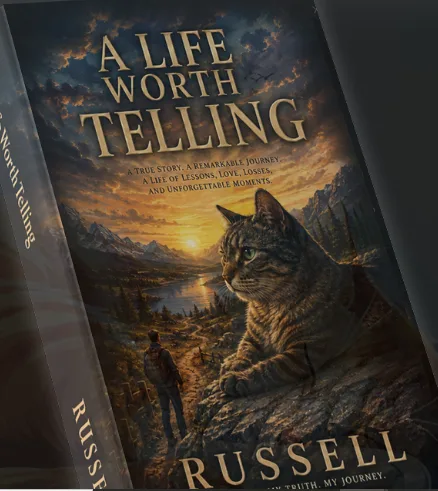
Some memoirs are defined by a single defining trauma. Others, like Russell Smith's A Life Worth Telling, are shaped by an accumulation of hardships spread across an entire lifetime — a childhood marked by fear, a string of difficult family relationships, and repeated losses of the animals who came to mean more to him than almost anyone else. As both a memoir about family hardship and a book about grief and pet loss, it captures two threads that, on the surface, seem unrelated, but which together form the emotional backbone of Smith's story: the pain of human relationships that failed him, and the comfort of animal companions who never did.
A Childhood Rooted in Instability
The hardship in Smith's story begins early, inside his own home. He grew up with his mother, his sister, and his mother's boyfriend, a man who drank heavily and ruled the household through intimidation rather than affection. Smith recalls hiding from him during his rages, secretly recording his parents' fights as a form of proof that what he was experiencing was real, and learning to communicate with his mother only through glances and gestures to avoid drawing the man's attention.
This early environment set a pattern that runs throughout the entire memoir: Smith absorbing blame that wasn't his, adapting to survive rather than thrive, and quietly carrying the emotional weight of a household that offered little protection. Even small moments — being forgotten after school, being told to eat food he disliked "or get it in his face" — carry an outsized emotional charge, because they illustrate just how normalized fear had become in his daily life.
Family Bonds Strained by Circumstance
As Smith grew older, the hardship shifted shape rather than disappearing. His relationship with his mother remained complicated well into adulthood — loving in its own way, but shaped by years of miscommunication and unmet needs. His sister, Janice, appears throughout the book as both a source of connection and a reminder of the family's instability, eventually succumbing to health struggles of her own after years of hardship.
This is where the memoir most clearly earns its place as a memoir about family hardship: it doesn't limit itself to depicting one abusive relationship and moving on. Instead, it traces how the effects of an unstable childhood echoed forward for decades — in Smith's difficulty trusting others, in his complicated feelings about his mother's care during her final illness, and in the eventual role reversal that saw him becoming his mother's caretaker, feeding her, managing her appointments, and ultimately making the decision to honor her wishes at the end of her life.
When Family Loss Becomes Undeniable
The chapters covering his mother's death are among the most quietly devastating in the entire book. Smith describes finding her collapsed at home, the scramble to get her back into care, and the surreal experience of receiving a call from her doctor asking permission to attempt resuscitation despite her signed wishes not to be revived. When she finally passes in the early hours of the morning, Smith and his sister arrive just moments too late — her bed already being stripped by hospital staff.
It's a moment rendered without embellishment, and that restraint is part of what makes it so affecting. There's no manufactured catharsis here, no tidy closure. Just the blunt, disorienting reality of loss arriving exactly when it wants to, regardless of how prepared anyone feels.
The Animals Who Filled the Emotional Gaps
If family relationships in Smith's life were often marked by tension, disappointment, or grief, his relationships with animals stand in sharp, almost startling contrast. This is where the book most powerfully functions as a book about grief and pet loss — not as a secondary theme, but as one of its central emotional pillars.
Smith's bond with Sara, an orange tabby adopted after his sister's sudden death, becomes one of the most tender relationships depicted in the entire memoir. He describes their years together with genuine warmth, and when her health finally begins to fail, he chronicles her decline — and his own grief — in extraordinary detail: sitting up with her through sleepless nights, timing her breathing, and ultimately watching her heart stop from across the room, unable and unwilling to look away.
Years later, Brittany, a calico adopted after Sara's death, brings a similar depth of connection, along with her own set of health struggles tied to diabetes. Her final decline and euthanasia are described with the same aching honesty — the vet's simple words, "She's gone," delivered after Brittany received her final injection, mark one of the most emotionally raw passages in the book.
Even the animals who passed through his life more briefly — Cindy, his sister's aging cat; Taffy, a childhood dog whose final walk together still haunts him; and Rocky, a stray cat he fed and worried over for years without ever fully claiming as his own — are given the same careful attention. Smith doesn't treat these relationships as minor footnotes to his human story. He treats them as some of the most significant bonds of his life.
Why Pet Loss Hits as Hard as Human Loss
What distinguishes Smith's writing on this subject is his refusal to minimize the grief that comes with losing a pet, even as society often treats such losses as lesser than the loss of a person. He describes searching for pet-loss counseling after Sara's death, only to find it too expensive and far away. He describes the raw physical sensation of grief — feeling like "someone had ripped my chest out" — with the same seriousness he applies to describing his mother's death.
This candor is part of what makes the memoir valuable to readers specifically searching for a book about grief and pet loss: it validates an experience that many people quietly carry but rarely see reflected honestly in literature. For readers who have grieved an animal companion and felt that grief dismissed by others, Smith's unflinching account may feel like long-overdue recognition.
Two Kinds of Hardship, One Shared Truth
Read side by side, the family hardship and the pet loss sections of this memoir reveal something important about Smith's approach to storytelling: he doesn't rank his griefs. A painful confrontation with his mother's boyfriend receives the same careful, detailed treatment as the loss of a beloved cat. A strained relationship with his sister is given no more or less weight than his enduring devotion to a stray cat named Rocky, whom he fed faithfully for years despite never fully bringing him home.
This flattening of hierarchy is, in its own way, the memoir's quiet thesis: pain is pain, connection is connection, and grief deserves to be taken seriously regardless of its source.
The Cumulative Weight of Never Quite Belonging
Running underneath both the family hardship and the pet loss narratives is a quieter theme: Smith's lifelong sense of not quite belonging anywhere. At home, he was often treated as an afterthought or a source of embarrassment. At school, he was targeted by bullies and misunderstood by teachers. In his romantic relationships, he frequently found himself on the losing end of decisions made without his input. Even in his working life, he describes being told repeatedly that he simply didn't "fit in."
Against that backdrop, his relationships with animals take on even greater significance. Sara, Brittany, and Rocky didn't judge him for the jobs he'd quit, the family conflicts he couldn't resolve, or the ways he sometimes felt unworthy in the eyes of the people around him. They simply needed him — to be fed, cared for, and comforted — and in meeting that need, Smith found a version of belonging that had eluded him elsewhere. This dynamic is part of what elevates the book beyond a simple memoir about family hardship; it reframes his devotion to animals not as a side note, but as the emotional counterweight to a lifetime of feeling like an outsider in his own family.
Final Thoughts
A Life Worth Telling succeeds because it treats both categories of loss — family and companion animal alike — with equal seriousness and care. As a memoir about family hardship, it offers an unflinching look at how childhood instability can shape an entire life. As a book about grief and pet loss, it gives voice to a form of grief too often minimized, reminding readers that the bonds we form with animals can be every bit as profound, and every bit as devastating to lose, as the bonds we form with people.
Together, these threads make Smith's memoir something more than a chronicle of hard times. It is a testament to the many forms love and loss can take — and proof that every one of them is worth telling.
A Life Worth Telling is available in ebook, paperback, and hardcover editions.