I've worked enough sites to say this plainly. Most builders don't call construction site security companies until after they've been robbed. Then they call in a panic, wanting guards on site by tonight. That's the wrong order, and it costs them money every single time.
So let me tell you what I've seen, what clients get wrong, and what actually keeps your equipment and materials where they belong.
What Do Construction Site Security Companies Actually Do?
They protect a site that has no walls, no doors, and no permanent staff. That's the core of it.
A construction site is basically an open yard full of expensive things. Copper wire. Cement. Tools. Generators. Fuel. Steel. Everything sitting there overnight with maybe a flimsy barrier around it. Guards are the only thing standing between your materials and someone with a pickup truck.
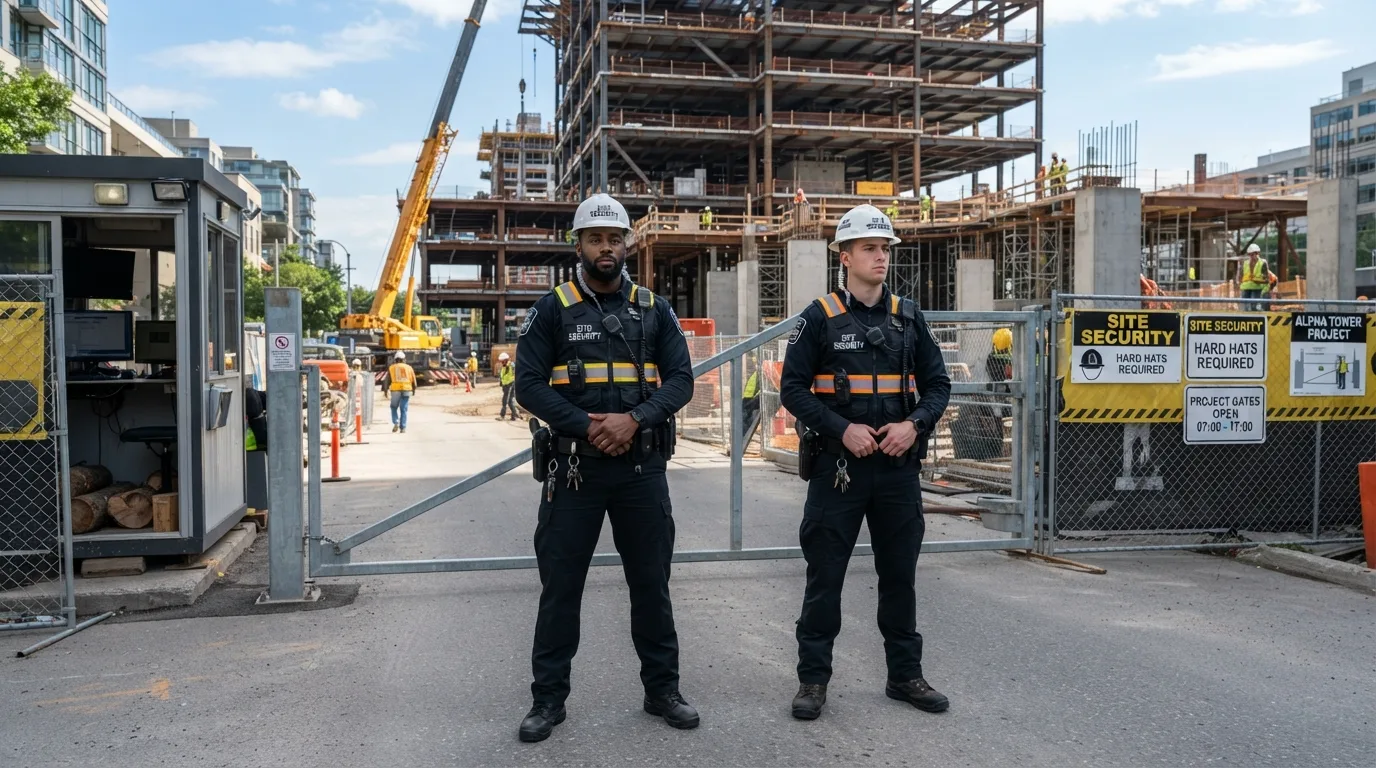
The services usually include static guarding at the gate, patrols around the perimeter, access control for workers and visitors, and monitoring of whatever cameras you've installed. Bravo Security Services offers security guarding, surveillance, CCTV operation, events security, mobile escorts, and car park security, with both armed and unarmed options available. For a construction site, that mix usually means gate control plus rounds plus camera monitoring.
Who Actually Needs Guards on a Construction Site?
Anyone with materials on site overnight. That's the simple test.
If you've got copper, fuel, generators, or tools sitting there after the workers go home, you need someone watching. Theft on construction sites isn't rare. It's routine. And it usually happens at night, on weekends, and during long holidays when nobody's around.
I've also seen smaller jobs skip security because the project was "almost done." That's when they get hit hardest. The finishing materials are in, the fixtures are installed, the expensive stuff is all there, and then someone cleans it out over a three-day weekend. The project gets delayed by weeks and the losses come straight out of the contractor's pocket.
What Do Builders Usually Get Wrong?
They treat security as a cost instead of insurance. That's the biggest mistake.
Here's what happens. The contractor gets a budget. Security looks like an easy line to cut. They hire the cheapest guard they can find, pay him barely anything, and put him at the gate with a chair and no instructions. Two weeks later, half the cement bags are gone and nobody knows when it happened.
The second mistake is hiring a company without checking whether it's registered. In Pakistan, APSAA membership matters. It tells you the agency follows some standards and isn't just a guy with a phone and a few contacts.
The third mistake is not briefing the guard properly. If your biggest risk is the back boundary wall near the empty plot, say so. If it's workers walking off with tools in their bags, say that too. Guards aren't mind readers. A written brief on day one saves you a hundred arguments later.
How Does Site Security Work Day to Day?
Guards control the gate, log who comes and goes, walk the perimeter at set intervals, and watch the cameras. That's the basic rhythm.
On a good site, the guard checks every vehicle leaving the premises. He writes down names and times. He does rounds at irregular intervals so nobody can time him. He keeps a torch and a register. At night, he stays awake and alert, which sounds obvious until you meet a guard who's been sleeping in the site office for a month.
A trained guard also knows what to do when something actually happens. He doesn't chase a thief into the dark and get himself hurt. He notes the vehicle, the direction, the time, and calls it in. That information is often worth more than a wrestling match.
Why Do Trained Guards Matter More Than Cheap Ones?
Because a cheap guard is usually an absent guard. That's the blunt truth.
You're paying for attention. Not muscle. A guard who is paid properly, trained properly, and supervised properly will actually watch your site. A guard who isn't will sit in the shade and hope nothing happens on his shift.
Training also matters for legal reasons. Guards need to know what they can and can't do. They can't just beat someone up and claim they were protecting property. If your guard crosses a line, you're the one facing the consequences. A properly trained guard knows his limits, and that protects you as much as him.
Basic first aid is another thing people ignore. Construction sites are dangerous places. Someone falls. Someone gets cut. Someone has heatstroke. A guard trained in basic response can help until proper help arrives.
How Does Bravo Security Handle Site Work?
They provide trained guards with options for armed or unarmed personnel, plus retired military people for higher-risk situations. They also cover mobile escorts and car park security, which can matter on larger sites with vehicle movement.
One client situation I'm aware of involved a restaurant owner dealing with a landlord dispute. A Bravo representative attended the restaurant during the dispute, and the client later raised a serious concern about how it was handled. I'm mentioning that honestly because it's real. No security company gets every job right, and you should know that before you hire anyone.
The lesson is straightforward. Whoever you hire, put the guard's role in writing. Set clear boundaries. Check in regularly. Don't assume the agency is handling everything just because you signed a contract.
Why Do Thieves Target Construction Sites So Often?
Because they're easy. That's the whole reason.
A finished building has locks, alarms, and people inside. A construction site has none of that. It's open, it's dark, and it's full of things that sell quickly. Copper wire, tools, and fuel move fast in the market. Nobody asks questions.
Also, sites are predictable. Everyone knows when work stops. Everyone knows when the weekend comes. Thieves plan around those gaps. A visible security presence is often the only thing that changes their mind.
Customer Testimonials
Here's what clients have actually said.
One client shared: "I had a deeply concerning experience involving a representative from Bravo Security attending my restaurant during a landlord dispute."
That review is real and it should be shown as it is. It's a reminder that no agency should be hired without clear instructions, written expectations, and regular follow-up.
Frequently Asked Questions
How much does construction site security cost?
It depends on hours, number of guards, and whether they're armed. Night-only cover costs less than 24/7. Get a quote based on your actual site.
Do I need security during the day too?
Usually not for theft. But you may want gate control to manage visitors and stop materials walking out with workers.
What is APSAA membership?
It's registration with the All Pakistan Security Agencies Association. It's a basic check that the company isn't operating in the dark.
Can one guard cover a large site?
Not properly. One guard can watch a gate. Covering a large perimeter needs rounds, cameras, or more than one person.
What should I tell my guard on day one?
Your main risks, entry rules, who to call, and what to do in an emergency. Write it down.
What if a guard sleeps on duty?
Report it to the company right away. Don't wait. A sleeping guard is no guard at all.