There are times when you don’t need a longer drive or a harder swing to lower your golf score. “Sometimes the best improvement is just not making as many mistakes on the green. Three-putts, missed short putts and poor distance control can silently add strokes to a good round.
The good news is that putting is a skill that can be practiced in brief bursts without expensive equipment or hours at the driving range. A consistent set-up, improved distance control and confidence on short putts will provide you with more opportunities to complete holes efficiently.
These three putting drills are for the amateur golfer who wants real improvements to take directly onto the course. There’s no drill that can guarantee five strokes off your game, but practicing regularly can help you reduce avoidable errors and play smarter on the green.
Why Putting Practice Can Make a Difference
Most golfers spend most of their practice time hitting drivers and irons. But putting deserves equal attention because every stroke on the green counts toward the final score.
Two common faults are leaving long putts well short of the hole and missing short putts under pressure. Both can lead to wasted strokes even if your approach shots are reasonably close.
Check your set up before you start these drills. Your feet should be a comfortable, balanced base, your eyes should be in the same position to the ball and your hands should let the putter swing freely. A repeatable routine lets you focus on the target instead of making last-second adjustments.
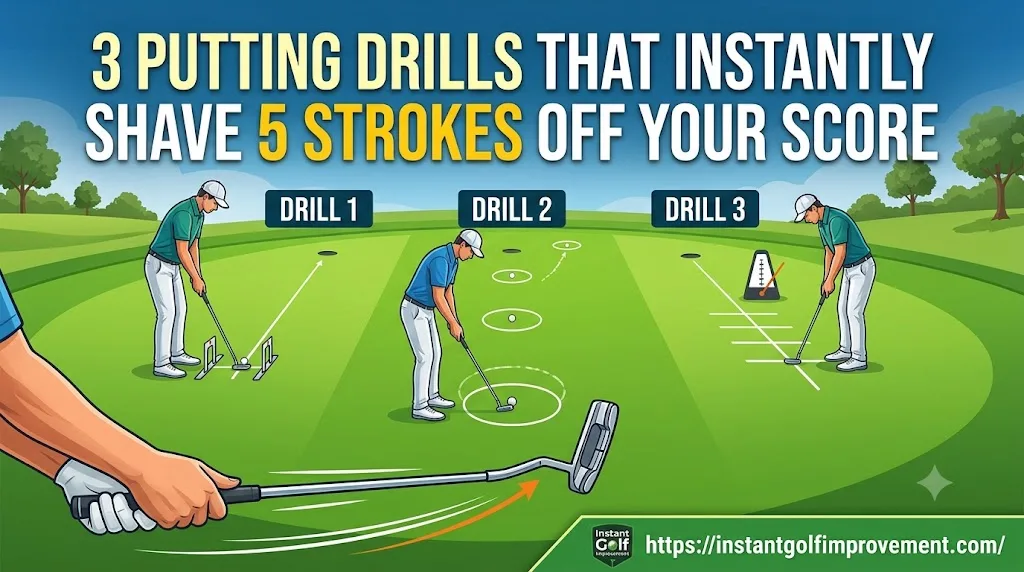
Drill 1: The Three-Foot Circle Drill
Build confidence on short putts
Short putts can be surprisingly difficult, especially when you start thinking about what happens if you miss one. The three-foot circle drill helps develop a dependable putting stroke and encourages you to stick with your target.
What you'll need: Five golf balls and a fairly flat practice green.
How to do the drill:
- Place five balls in a circle around the hole, about three feet away.
- Follow your regular pre-putt routine before each putt.
- Think of your putt as starting on the line you want, not trying to steer it into the cup.
- Keep track of how many out of five putts you make.
- Repeat the drill and try to improve your result over multiple sessions.
If you miss, don't change your entire technique right away. Instead, think about whether the miss was due to your alignment, pace or contact.
How it works
This drill helps build consistency in your setup and stroke. It also helps you build a routine that feels familiar when you’re faced with a short putt during a round.
To improve your putting stance, maintain a comfortable posture, stay balanced and position the ball consistently. Don’t take an artificial stance just because another golfer does. Your setup should be able to support a repeatable stroke.
Practice tip: Once you become consistent with these putts, spread the balls out a bit further or add gentle slopes to increase the difficulty.
Drill 2: The Lag-Putting Distance Control Drill
Reduce three-putts from long range
The first putt is often too far away from the hole in three-putts. Even a good read can lead to an uncomfortable second putt if you’re inconsistent with your distance control.
This drill teaches you to control the pace instead of trying to hole every long putt.
What you need: Three golf balls and a practice green with enough space for putts of different lengths.
How to do the drill:
- Choose a target approximately 20 feet away.
- Hit three putts, concentrating on the length of your stroke and the speed of the ball.
- Repeat from approximately 30 feet and then 40 feet, adjusting the distances to suit the available green.
- Observe how far each ball finishes from the hole.
- Repeat the sequence, trying to leave every putt within a comfortable range for your next stroke.
Notice the speed of the putt changes with the length of your stroke. Usually it’s better to move smoothly and under control, rather than to suddenly accelerate or decelerate by impact.
How it works
You will get better distance control so you don't leave long first putts way short or run past the cup several feet.
It also teaches a critical scoring skill: Not every long putt is about making it. Sometimes the smart thing is to get the ball close enough to have a second putt that is manageable.
For added difficulty practise uphill, downhill and sidehill putts. You have to make different calls on speed in these situations and it gets you ready for real course conditions.
Drill 3: The Gate Drill
Improve your putting accuracy and start line
The ball can be on the wrong line and you can miss a putt even if you read the break correctly. The gate drill helps you see if your putter is sending the ball in the direction you want it to start going.
What you need: Two tees and three golf balls.
How to do the drill:
- Place two tees in the ground just wider than the width of your golf ball.
- Position the tees a few inches in front of your ball to create a small gate.
- Set up for a short, straight putt.
- Stroke the ball through the gate without touching either tee.
- Repeat with all three balls, focusing on a consistent setup and smooth contact.
If it is difficult at first, make the gate a little wider. As you get better at controlling, make the opening smaller, but not too hard to drill.
How it works
The gate provides instant feedback on your putter delivery and the starting direction of the ball. It can help you find inconsistent contact or a habit of pushing or pulling putts.
Combine this drill with a solid pre-putt routine. Read the putt, pick your starting line, get set in your stance, and stroke without constantly adjusting your aim.
Once you can consistently get the ball into play, start working on adding subtle breaks to combine line selection and pace control.
How to Turn These Drills Into Lower Scores
You don’t need a complicated schedule of practices to get the benefits of these exercises. Practice putting for 15 to 20 minutes of focused practice two or three times a week.
Five minutes on short putts, five to ten minutes on distance control and the rest of the time on the gate drill. Track your results to find the skill that needs the most attention.
On your next round, pay attention to three things — how often you three-putt, how many short putts you miss and whether your first putt ends up within easy distance of the hole.
But these observations are more useful than grading your progress by one round. Putting performance is affected by green speed, slopes, weather, course difficulty and more.
If you want some extra help in addition to your solo practice, online golf lesson resources can help you learn fundamentals, identify areas of improvement and create a more structured practice routine. Instant Golf Improvement from award-winning golf coach John Hughes is founded on more than 35 years of coaching experience and is geared toward practical instruction and strategies that will help golfers improve and have enjoyable playing the game.
Conclusion
You don’t need to make a radical swing change to improve your golf score. Here are three easy-to-learn habits to help you become a better putter: Be more reliable on short putts, control distance on long putts, and roll the ball on your intended line.
Drill these consistently, track your results and focus on cutting down on avoidable mistakes instead of going for perfect rounds. It’s not a surefire way to shave five strokes off your score, but a more consistent putting routine can be a real pathway to better scoring and more confidence on the course.