
Introduction
As we progress further into 2026, the landscape of education and study practices continues to evolve rapidly. Students, educators, and lifelong learners alike are embracing new methods and technologies that redefine what it means to study effectively. This article explores the latest trends in study tips for 2026, highlighting how emerging tools, science-backed techniques, and cultural shifts are reshaping the way knowledge is acquired and retained.
The future of learning is not simply about longer hours of reading or rote memorization; it's about smarter, more personalized strategies that support mental health, leverage technology, and maximize efficiency. Whether you are a high school student, a university scholar, or a professional upgrading your skills, understanding these trends can give you a significant advantage.
The Evolution of Study Habits: A 2026 Perspective
Over the past decade, we've seen a monumental shift from traditional study methods to innovative approaches supported by scientific research and advanced technology. In 2026, study tips are no longer one-size-fits-all; they are highly tailored to individual learning styles, cognitive patterns, and lifestyle preferences.
Recent studies suggest that combining various techniques—like active recall, spaced repetition, and metacognitive reflection—can significantly improve retention and comprehension. Moreover, mental health awareness has led to integrating mindfulness and stress management into study routines, recognizing that emotional well-being is crucial for effective learning.
For readers interested in foundational principles, our previous article Unlocking Effective Study Habits: Proven Tips for Beginners to Excel offers a comprehensive guide to building strong study foundations, which remain relevant even as new trends emerge.
Trend 1: Personalized Learning Powered by AI
One of the most transformative trends in 2026 is the widespread use of artificial intelligence (AI) to personalize study plans. AI-driven platforms analyze students' performance data, learning pace, and preferences to curate customized content and schedules.
These platforms can identify strengths and weaknesses, recommend targeted exercises, and adjust difficulty levels dynamically. For example, an AI system might recognize that a student struggles with certain mathematical concepts and then prioritize exercises and multimedia resources to reinforce those areas.
This personalized approach not only boosts motivation by reducing frustration but also optimizes study time. Instead of following a generic curriculum, learners engage with material that is most relevant and challenging for them.
Additionally, AI tutors provide instant feedback and explanations, simulating one-on-one mentorship that was once accessible only to a privileged few. This democratization of personalized learning is a hallmark of 2026 educational trends.
Benefits and Considerations
- Adaptive pacing: Learners can progress at their own speed without feeling rushed or bored.
- Focused practice: AI identifies knowledge gaps and targets them specifically.
- Motivation boost: Personalized achievements and gamification elements encourage continued engagement.
- Data privacy: While AI offers benefits, students and institutions must remain vigilant about data privacy and ethical use of personal information.
Trend 2: Integration of Mindfulness and Mental Health in Study Routines
Another critical development in 2026 study trends is the integration of mindfulness practices and mental health support into learning strategies. Recognizing that stress, anxiety, and burnout severely impact academic performance, educators and students are prioritizing mental well-being as part of effective study habits.
Mindfulness techniques—such as focused breathing, meditation, and journaling—help learners increase concentration, regulate emotions, and reduce distraction. These methods have been scientifically proven to enhance cognitive function and memory retention.
Furthermore, many study apps and platforms now incorporate mental wellness features, including guided relaxation sessions and mood tracking. These tools encourage students to take scheduled breaks and adopt a balanced approach to learning.
Building emotional resilience also means developing a growth mindset, where challenges and failures are viewed as opportunities to learn rather than setbacks. This psychological shift fosters persistence and self-compassion, crucial for long-term academic success.
For an in-depth exploration of how emerging habits are shaping learning success, see our article Unlocking Learning: Emerging Study Habits Shaping 2026 Success.
Trend 3: Multimodal and Multisensory Learning
In 2026, learners are increasingly engaging multiple senses and modes of information processing to enhance understanding and retention. Multimodal learning involves combining visual, auditory, kinesthetic, and tactile inputs, creating richer cognitive associations.
Examples include:
- Using educational videos and animations alongside traditional textbooks.
- Participating in hands-on experiments or simulations.
- Employing voice notes and podcasts to reinforce concepts during commutes.
- Incorporating drawing or mind mapping to visualize ideas.
This approach caters to diverse learning preferences and promotes deeper engagement by avoiding monotony. It also enables the brain to form multiple neural pathways related to the same information, improving recall.
Educators now design curricula with multimodal elements embedded, and students use apps that integrate reading, listening, and interactive exercises. The trend reflects a broader shift from passive reception to active, participatory learning.
Trend 4: Collaborative and Social Learning Networks
Despite the increasing role of technology, human interaction remains essential to effective studying. In 2026, social learning networks have become a powerful trend, leveraging peer collaboration and community support.
Online platforms facilitate study groups, discussion forums, and peer feedback mechanisms. These networks encourage knowledge sharing, collective problem-solving, and accountability.
Collaborative learning fosters critical thinking and communication skills while providing emotional support. Students benefit from diverse perspectives and explanations, often clarifying complex topics more effectively than solitary study.
Tools like synchronized digital whiteboards and virtual reality environments enable immersive group sessions, bridging geographical distances. Moreover, these connections help build motivation and reduce feelings of isolation.
Best Practices for Social Learning
- Establish clear goals and roles within study groups.
- Encourage respectful and constructive feedback.
- Use technology to streamline collaboration and track progress.
- Balance group work with individual study for comprehensive mastery.
Trend 5: Emphasis on Metacognition and Reflective Learning
Metacognition—thinking about one's own thinking—has gained significant prominence in 2026 study methodologies. Students are taught to monitor and regulate their cognitive processes, becoming self-aware learners who can adapt strategies as needed.
Reflective learning techniques, such as keeping study journals, self-testing, and evaluating problem-solving approaches, empower learners to identify what works best for them.
This trend is supported by educational research showing that metacognitive skills improve long-term retention and transfer of knowledge to new contexts. It also aligns with personalized learning, as students become active agents in managing their education.
Trend 6: Efficient Time Management and Microlearning
With increasing demands on time, 2026 study tips emphasize efficient time management coupled with microlearning—consuming content in small, focused bursts.
Microlearning modules typically last 5 to 15 minutes, making them ideal for fitting into busy schedules and maintaining attention. These bite-sized lessons focus on discrete topics, which reduces cognitive overload and enhances mastery.
Time management strategies include the Pomodoro Technique, prioritization matrices, and digital planners integrated with AI assistants. These tools help students allocate study periods, breaks, and review sessions strategically.
Adopting microlearning and disciplined scheduling supports sustained engagement and prevents burnout, making it easier to achieve consistent progress over time.
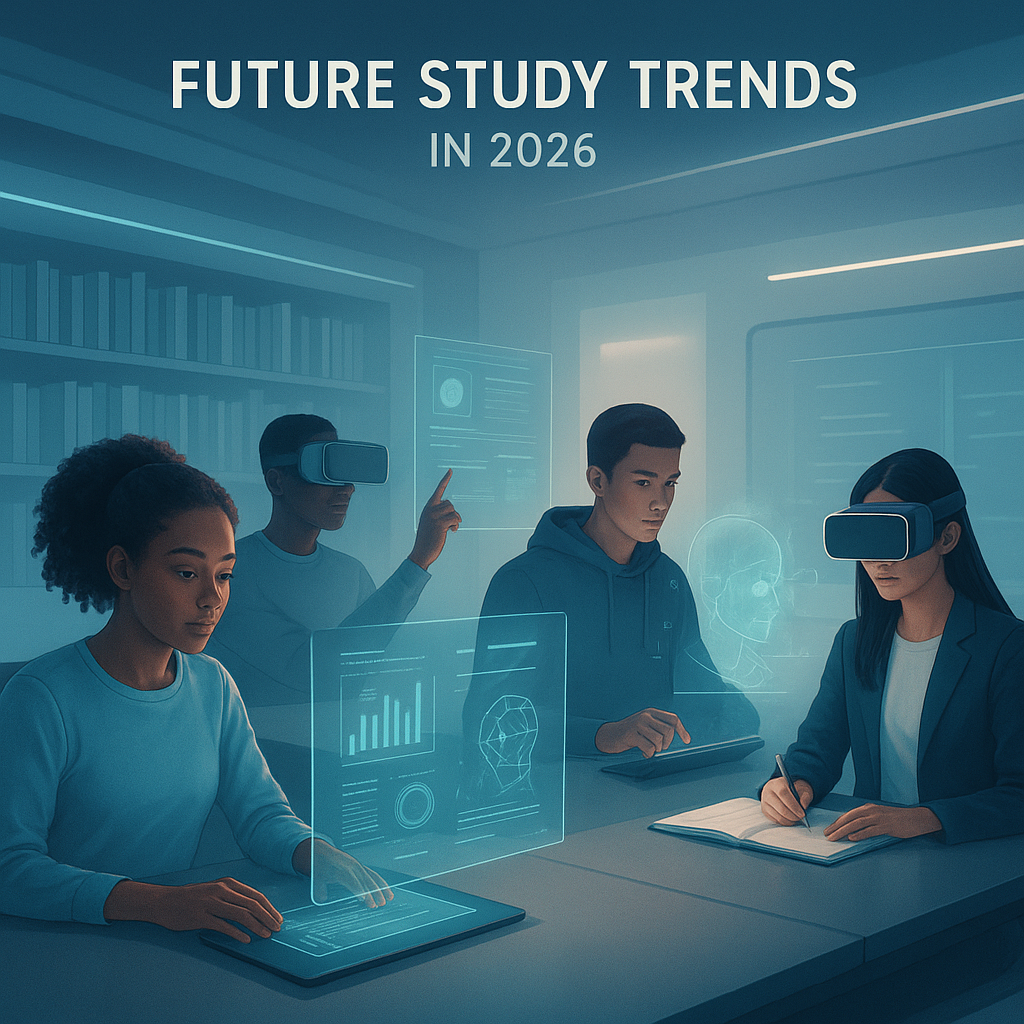
Trend 7: Leveraging Virtual and Augmented Reality
Virtual Reality (VR) and Augmented Reality (AR) technologies have moved beyond entertainment to become vital educational tools in 2026. These immersive environments enable experiential learning, where students can explore complex concepts interactively.
For example, medical students can practice surgical procedures in a risk-free virtual operating room, while history learners can virtually walk through ancient civilizations.
These technologies enhance spatial understanding, engagement, and motivation. They also cater to diverse learning preferences and make abstract ideas tangible.
Though hardware costs have decreased, accessibility remains a consideration. However, many institutions now offer VR/AR resources as part of their study support services.
Trend 8: Gamification to Boost Motivation and Retention
Gamification—applying game design elements to non-game contexts—continues to be a popular trend in study strategies. By incorporating points, levels, challenges, and rewards, gamified study apps and platforms turn learning into a compelling experience.
This approach taps into intrinsic motivation, encouraging persistence through positive reinforcement and social competition.
In 2026, gamification is increasingly sophisticated, integrating adaptive difficulty, narrative storytelling, and real-time feedback. It supports diverse subjects and age groups, making study sessions feel less like chores and more like engaging quests.
Trend 9: Focus on Digital Literacy and Information Evaluation
With an abundance of online resources, 2026 study tips stress the importance of digital literacy—the ability to locate, evaluate, and use information effectively.
Students are trained to critically assess sources for credibility, bias, and relevance, avoiding misinformation. This skill is particularly vital given the proliferation of user-generated content and the fast pace of knowledge evolution.
Educators incorporate lessons on fact-checking, ethical use of information, and citation standards into study curricula. Digital literacy empowers learners to navigate the information-rich environment confidently and responsibly.
Integrating 2026 Trends with Proven Foundations
While these new trends offer exciting opportunities, their effectiveness is maximized when combined with established study principles. For instance, integrating AI personalization with active recall and spaced repetition strategies yields superior outcomes.
Readers interested in scientifically backed techniques can explore Mastering Study Strategies: Proven Techniques Backed by Science and Technology for a detailed analysis of merging innovation with evidence-based methods.
Practical Tips to Apply 2026 Study Trends
- Assess your learning style: Use AI-powered tools to identify your strengths and tailor study plans accordingly.
- Incorporate mindfulness: Schedule short meditation or breathing exercises before study sessions.
- Utilize multimodal resources: Combine videos, podcasts, and hands-on activities to reinforce concepts.
- Engage socially: Join virtual study groups or forums to collaborate and share insights.
- Practice reflection: Keep a study journal to track progress and adjust techniques.
- Manage time effectively: Use microlearning modules and prioritize tasks with digital planners.
- Experiment with VR/AR: Explore immersive content relevant to your subject area.
- Embrace gamification: Use apps that reward progress and maintain motivation.
- Build digital literacy: Critically evaluate sources and practice ethical research habits.
Conclusion
In 2026, the art and science of studying are undergoing a profound transformation. By embracing personalized AI tools, mindfulness, multimodal learning, social collaboration, metacognition, and emerging technologies like VR and gamification, students can unlock their full potential.
These trends reflect a holistic view of learning that values mental health, efficiency, and adaptability. Integrating them with time-tested techniques creates a powerful framework for academic and lifelong success.
For those seeking to deepen their understanding of how to optimize study efficiency, Mastering Study Efficiency: Expert Strategies to Transform Your Learning provides expert insights and actionable advice tailored to today’s dynamic educational environment.
Ultimately, the key to thriving in 2026 and beyond lies in being an active, reflective, and engaged learner—ready to adapt and grow in an ever-changing world.