
Introduction
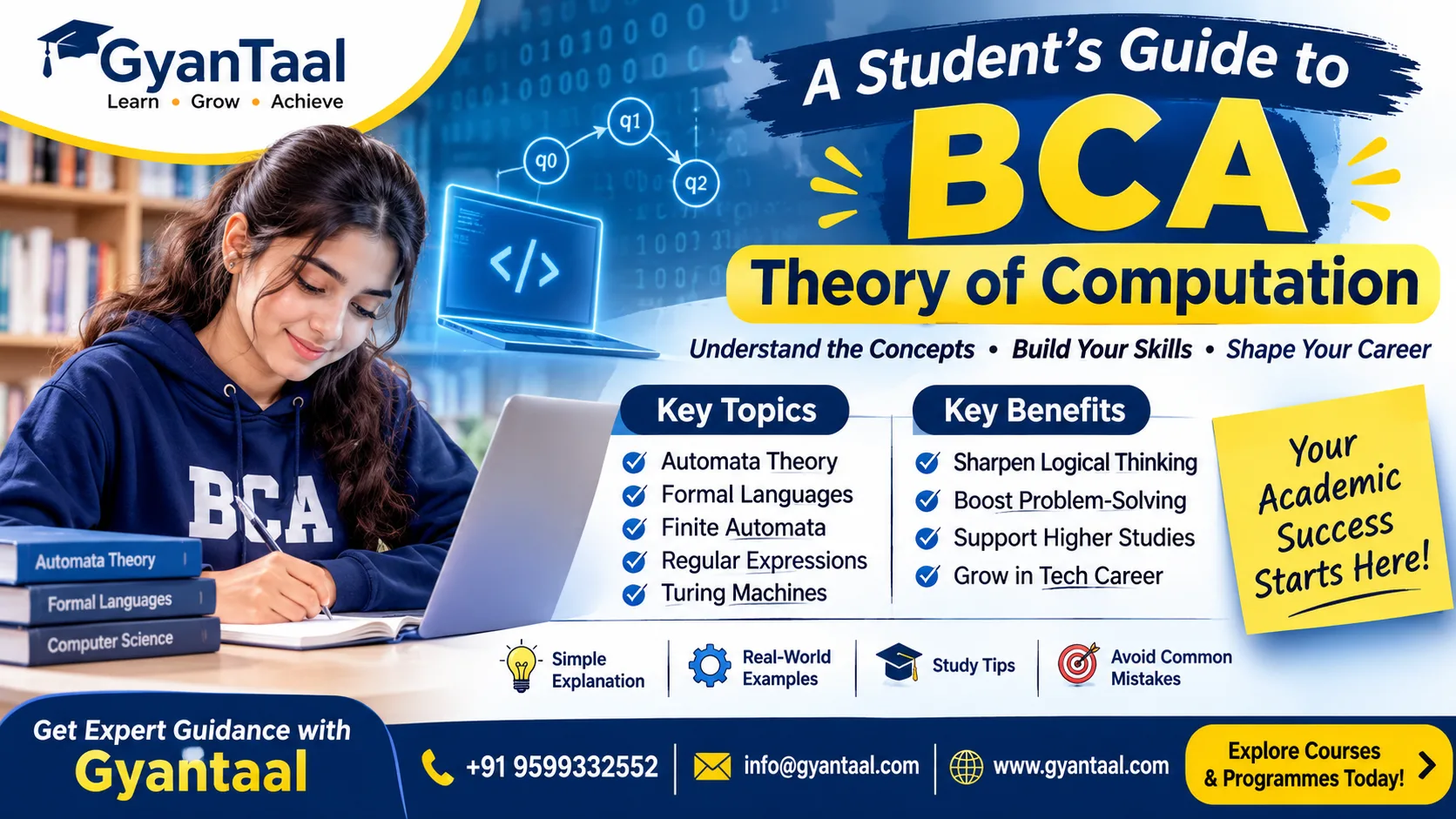
Theory of Computation is an important subject in the Bachelor of Computer Applications (BCA) programme. It introduces students to the mathematical and logical foundations of computer science. The subject explains how computers process information, recognise patterns, solve problems and perform different computational tasks.
For many BCA students, Theory of Computation may initially seem difficult because it includes mathematical concepts, logical reasoning, symbols, diagrams and formal rules. However, once students understand the basic ideas, the subject becomes easier and more interesting.
Theory of Computation helps students understand what computers can do, how they perform calculations and whether certain problems can be solved using algorithms. It also introduces important concepts such as Automata Theory, Finite Automata, Regular Expressions, Formal Languages, Context-Free Grammars and Turing Machines.
Whether you are studying BCA through a regular college, online learning or distance education, understanding this subject can strengthen your computer science fundamentals.
Students can explore the BCA Theory of Computation course to understand the subject and its academic importance.
What Is Theory of Computation?
Theory of Computation is a branch of computer science that studies the mathematical models of computation. It focuses on understanding how computers solve problems and process different types of information.
In simple words, it explains how a computer understands a particular input, follows specific rules and produces an output.
For example, when you enter a password on a website, the system checks whether the entered password follows the required conditions. Similarly, when you type a search query, the computer processes the text and searches for matching information.
These activities involve concepts related to patterns, rules, languages and computational processes.
The subject mainly focuses on three important questions:
- What problems can a computer solve?
- How efficiently can a computer solve a problem?
- Are there problems that computers cannot solve?
By studying these questions, students develop a deeper understanding of computer systems and their limitations.
Why Is Theory of Computation Important for BCA Students?
Theory of Computation is not just a theoretical subject. It builds a strong foundation for understanding several important areas of computer science.
BCA students learn programming languages, databases, software development, networking and other technical subjects. Theory of Computation helps them understand the basic logic behind many of these technologies.
One of its biggest benefits is that it improves logical thinking. Students learn how to break complex problems into smaller parts, identify patterns and follow systematic steps to reach a solution.
The subject also introduces students to the mathematical principles used in computer science. These principles are useful when studying algorithms, compiler design, programming language concepts and software development.
Understanding Theory of Computation can help students:
- Develop logical and analytical thinking.
- Understand how computers process different inputs.
- Learn the basics of formal languages and automata.
- Improve problem-solving abilities.
- Understand the working principles of compilers.
- Build a foundation for advanced computer science subjects.
- Prepare for further studies in computer applications and computer science.
Therefore, students should focus on understanding the concepts instead of simply memorising definitions.
Major Topics Covered in Theory of Computation
The subject includes several important topics. Each topic explains a different aspect of computation and helps students understand how computer systems work.
1. Introduction to Automata Theory
Automata Theory is one of the fundamental topics in Theory of Computation. It studies abstract machines that follow a set of rules to process input and produce a particular result.
An automaton is a mathematical model that represents a simple computing machine. It receives input, changes its state according to predefined rules and determines whether the input is accepted or rejected.
For example, imagine a system that accepts a password only when it contains a specific combination of characters. An automaton can represent the rules followed by that system.
Students generally learn about states, transitions, input symbols, start states and final states while studying Automata Theory.
2. Finite Automata
Finite Automata are mathematical models used to recognise patterns in input strings. They contain a limited number of states and follow specific transition rules.
Finite Automata are mainly divided into two types:
Deterministic Finite Automata (DFA):
In a DFA, each state has exactly one defined transition for every input symbol in the alphabet. This makes the next state predictable.
Non-Deterministic Finite Automata (NFA):
In an NFA, a state may have multiple possible transitions for the same input symbol or may include transitions that do not consume an input symbol, depending on the model being studied.
Both DFA and NFA are used to understand regular languages and pattern recognition.
Students should practise drawing state diagrams because diagrams make these concepts easier to understand.
3. Regular Expressions
Regular Expressions are patterns used to describe sets of strings. They are widely used in programming, text processing and data validation.
For example, a regular expression can describe a pattern for checking whether an entered email address follows a particular format.
In Theory of Computation, regular expressions are closely connected with finite automata. Students learn how different expressions represent regular languages and how these expressions can be converted into automata.
Understanding regular expressions is useful for learning how software identifies, searches and validates text patterns.
4. Formal Languages
A formal language is a collection of strings formed using a particular set of symbols and rules.
For example, a language may contain strings made using only the symbols 0 and 1. The rules of that language determine which combinations are valid.
Formal Languages are important because programming languages also follow specific grammatical rules. A computer needs these rules to understand whether a program is written correctly.
Students learn about alphabets, strings, languages, operations on languages and different language classifications.
5. Context-Free Grammar
Context-Free Grammar (CFG) is used to describe the structure of languages through production rules.
It helps explain how valid strings or expressions can be generated from a set of grammar rules.
For example, mathematical expressions such as a+b or a*b follow particular structural rules. Grammar helps describe how such expressions are formed.
CFG is an important concept in compiler design because programming languages use grammar rules to define their structure.
Students should understand terminals, non-terminals, production rules and the start symbol while studying this topic.
6. Pushdown Automata
Pushdown Automata are computational models that use a stack along with their states to process input.
A stack is a data structure that follows the Last In, First Out (LIFO) principle. It means the last item added to the stack is the first item removed.
Pushdown Automata are more powerful than Finite Automata because they can use stack memory while processing input.
They are particularly useful for understanding Context-Free Languages and the structure of nested expressions.
7. Turing Machines
A Turing Machine is an abstract mathematical model used to understand general computation.
It consists of a tape, a read-write head, a set of states and transition rules. The machine reads symbols, writes symbols and changes its state according to its instructions.
Turing Machines help students understand the basic principles of algorithms and computational limits.
They are also important for studying computability, decidability and the theoretical capabilities of computers.
Although a Turing Machine is an abstract model, it provides a powerful way to understand how computation can be represented mathematically.
8. Computability Theory
Computability Theory studies whether a particular problem can be solved by an algorithm.
Some problems can be solved using a well-defined sequence of steps, while others cannot be solved by any general algorithm.
This topic helps students understand the limitations of computers and the difference between solvable and unsolvable problems.
One important example is the Halting Problem, which demonstrates that there is no general algorithm that can correctly determine whether every possible program will eventually stop or continue running forever.
Understanding computability helps students develop a broader perspective on computer science.
Real-World Applications of Theory of Computation
Although Theory of Computation is a theoretical subject, its concepts are connected with many real-world technologies.
Compiler Design: Compilers use formal languages, grammars and automata-related concepts to analyse programming code and identify whether it follows the language rules.
Text Searching: Regular expressions help applications search for specific patterns in documents, messages and other text-based information.
Input Validation: Websites and applications use pattern-matching techniques to check whether user inputs follow required formats.
Programming Languages: Formal grammar helps define the structure and syntax of programming languages.
Digital Systems: State-based models help explain the behaviour of systems that move between different states according to input conditions.
These examples show that Theory of Computation provides the foundation for understanding several technologies used in software and computer systems.
How to Study Theory of Computation Effectively
Many students find this subject challenging because it combines mathematical reasoning with abstract concepts. However, following a systematic study approach can make learning easier.
Start With Basic Concepts
Before studying advanced topics, understand the meaning of alphabets, strings, languages, states and transitions.
These concepts are used throughout the subject. If your basics are clear, understanding automata and formal languages becomes much easier.
Practise State Diagrams
State diagrams are an important part of Automata Theory. Students should practise drawing DFA and NFA diagrams for different input conditions.
Start with simple examples and gradually move towards more complex problems.
Understand the Difference Between DFA and NFA
DFA and NFA are frequently discussed together, so students should understand how their transition rules differ.
Do not simply memorise their definitions. Practise identifying the correct automaton for a given problem.
Learn Regular Expressions Through Examples
Try understanding regular expressions by creating simple patterns. For example, practise patterns involving binary strings, numbers and character combinations.
This will help you understand how expressions represent different sets of strings.
Practise Grammar-Based Questions
Context-Free Grammar can become easier when students practise production rules and derive strings step by step.
Understand how terminals and non-terminals work before attempting complex grammar problems.
Study Turing Machines Slowly
Turing Machines may seem difficult because they involve several components and transition rules.
Begin by understanding the tape, read-write head and states. Then practise simple transition examples to understand how the machine processes input.
Solve Previous Examination Questions
Previous examination questions help students understand the question pattern and identify important topics.
Practise both theoretical questions and numerical or diagram-based problems. Review your mistakes and revise the concepts that need more attention.
Make Short Notes
Prepare separate notes for important definitions, differences, formulas, diagrams and examples.
Short notes can be useful during revision, especially before examinations.
Common Mistakes Students Should Avoid
Students sometimes find Theory of Computation difficult because they try to learn everything through memorisation.
Here are some common mistakes to avoid:
Memorising Without Understanding: Learning definitions without understanding their meaning makes it difficult to solve application-based questions.
Ignoring Diagrams: State diagrams are essential for understanding automata. Students should practise them regularly.
Confusing DFA and NFA: Both models have similarities, but their transition rules are different. Understand these differences carefully.
Skipping Basic Concepts: Moving directly to advanced topics without learning the basics can create confusion.
Avoiding Regular Practice: Theory of Computation requires continuous practice. Reading examples without solving questions may not be enough.
Ignoring Previous Papers: Previous examination papers help students understand how concepts are tested.
A balanced approach that combines conceptual learning, diagrams and regular practice can improve understanding.
Career Relevance of Theory of Computation
Theory of Computation is mainly an academic and foundational subject. It does not directly prepare students for one particular job, but it strengthens the knowledge required in several areas of computer science.
Its concepts are useful for students who want to explore careers in software development, programming, compiler design, computer science research and advanced technical education.
For example, knowledge of formal languages and automata can help students understand compiler-related concepts. Logical thinking and problem-solving skills are also valuable in programming and software development.
Students interested in higher education may find this subject useful when studying advanced topics in computer science.
After completing BCA, students can explore further educational options such as MCA and other postgraduate programmes, depending on their eligibility and career goals.
How to Choose the Right BCA Programme
Choosing the right BCA programme is an important decision for students who want to build a future in the IT sector.
Before selecting a college or university, students should check the programme structure, eligibility requirements, course duration, examination system and available learning support.
Students interested in online or distance education should also verify the recognition and approval status of the specific programme for the relevant academic session.
The University Grants Commission's Distance Education Bureau provides information about recognised institutions and approved programmes. Students can visit the UGC Distance Education Bureau website to check relevant details.
It is also important to understand whether the learning format matches your schedule, educational needs and future plans.
Why Choose Gyantaal for Educational Guidance?
Finding the right educational programme can sometimes be confusing. Students may have questions about course selection, university options, eligibility, admission procedures and online or distance learning.
Gyantaal is an education guidance platform that helps students and working professionals explore suitable online and distance learning programmes.
The platform provides support with course selection, free counselling and admission guidance. It aims to make the process of exploring educational opportunities simpler and easier to understand.
Students can explore different educational options according to their academic background and future goals.
You can visit the following sections to learn more:
- Explore Courses
- Explore Programmes
- Undergraduate Programmes
Students should always verify the latest university recognition, programme approval and eligibility details before taking admission.
For course-related guidance, students can contact Gyantaal and discuss their educational requirements.
Frequently Asked Questions (FAQs)
1. What is Theory of Computation in BCA?
Theory of Computation is a computer science subject that explains the mathematical and logical foundations of computing. It covers automata, formal languages, regular expressions, grammars and Turing Machines.
2. Is Theory of Computation difficult for BCA students?
The subject may seem challenging at first because it includes mathematical concepts and abstract models. However, students can understand it more easily by learning the basics, practising diagrams and solving questions regularly.
3. What are the main topics in Theory of Computation?
The main topics generally include Automata Theory, DFA, NFA, Regular Expressions, Formal Languages, Context-Free Grammar, Pushdown Automata, Turing Machines and Computability Theory.
4. What is the difference between DFA and NFA?
DFA has exactly one defined transition for each state and input symbol. NFA can have multiple possible transitions for the same input symbol or transitions without consuming an input symbol, depending on the formal model.
5. What is the use of Regular Expressions?
Regular Expressions are used to describe text patterns. They are helpful in text searching, input validation, pattern matching and different programming applications.
6. Why are Turing Machines important?
Turing Machines provide a mathematical model of general computation. They help explain algorithms, computability and the limitations of computers.
7. Can Theory of Computation help in programming?
Yes. It builds logical thinking and helps students understand programming language structures, compiler design, formal grammar and computational processes.
8. How can I prepare for Theory of Computation examinations?
Start with basic definitions, understand important concepts, practise DFA and NFA diagrams, solve grammar-based questions and revise previous examination papers.
9. Is Theory of Computation useful after BCA?
Yes. It provides foundational knowledge that can support further studies in computer science and help students understand advanced technical subjects.
10. Where can students get guidance for online and distance education programmes?
Students can explore educational guidance platforms such as Gyantaal to understand available programmes, course options and admission-related information.
Conclusion
Theory of Computation is an important subject that helps BCA students understand the fundamental principles of computer science. From Automata Theory and Regular Expressions to Context-Free Grammar and Turing Machines, every topic introduces a different aspect of how computers process information and solve problems.
Although some concepts may appear difficult initially, students can improve their understanding through regular practice, clear explanations and a step-by-step learning approach.
Building strong fundamentals in this subject can support students in advanced computer science studies and help them develop better logical and analytical skills.
Choosing the right educational programme is equally important for achieving academic and career goals. With proper course information and guidance, students can make more informed decisions about their future.