The global NFT industry is evolving rapidly, and businesses entering the market today require far more than just basic minting and trading functionalities. A modern White Label NFT Marketplace must include enterprise-level tools that enhance performance, strengthen security, simplify operations, and elevate user experience.
Whether built for digital art, music, metaverse assets, luxury collectibles, gaming, or tokenized real-world assets, a professional White Label NFT Marketplace Solution must provide a robust set of tools designed to support scalability, customizability, and seamless trading.
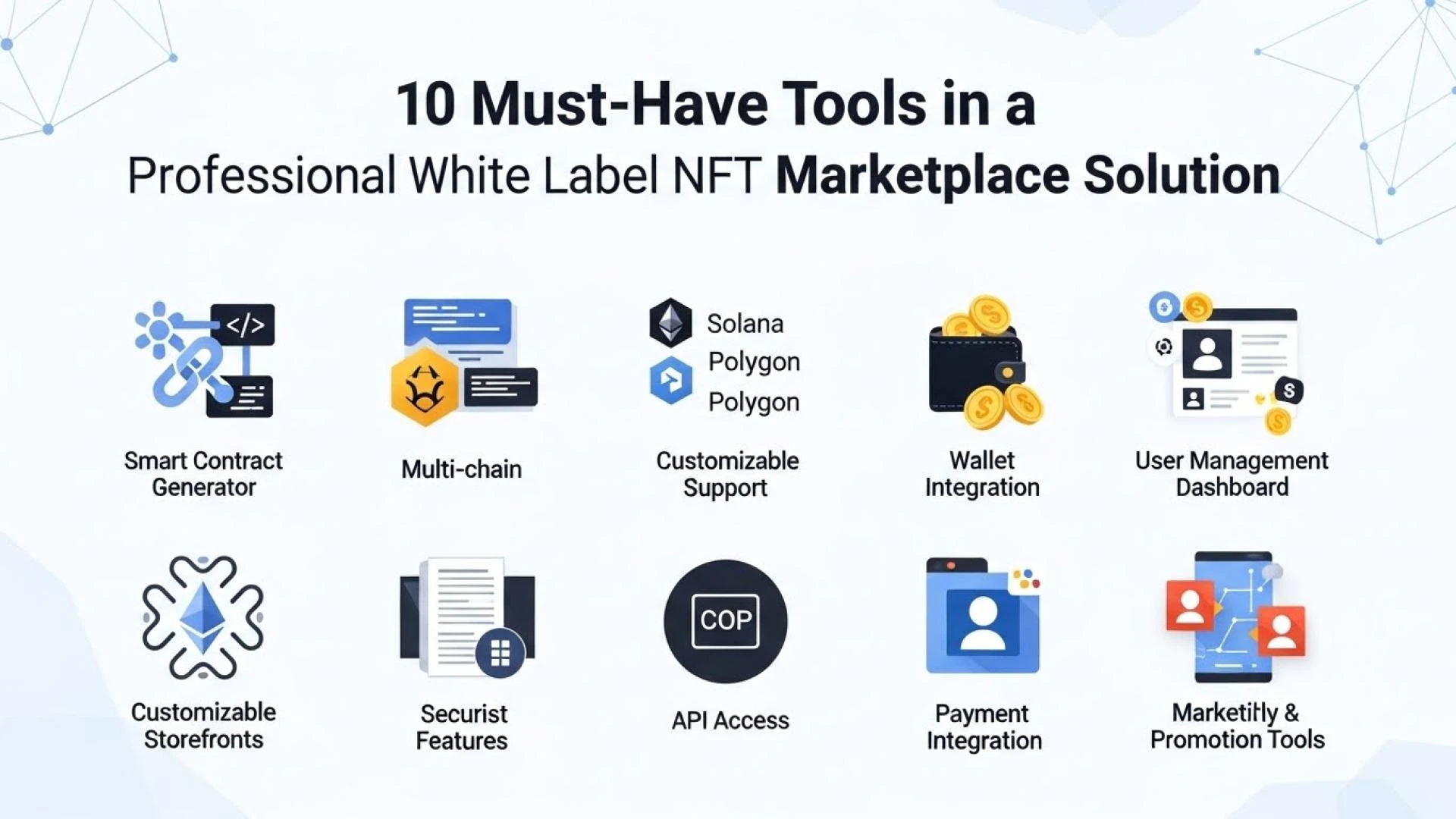
This blog explores the 10 essential tools every high-quality White Label NFT Marketplace should include helping brands, startups, and enterprises understand what it truly takes to operate a world-class platform.
1. Advanced NFT Minting EngineThe core of any NFT marketplace is its minting engine. A powerful tool ensures creators, brands, and businesses can generate NFTs efficiently while maintaining flexibility in metadata, standards, and asset structure.
A professional minting engine supports:
- Multiple token standards (ERC-721, ERC-1155, BEP-721, Flow, Solana standards, etc.)
- Lazy minting capabilities to reduce user gas costs
- Bulk minting for large collections
- Custom metadata fields for enhanced functionality
- Support for images, audio, video, 3D assets, metaverse-ready models
This tool is critical for brands that want to launch large NFT collections or manage complex assets without technical barriers.
2. Secure Wallet Integration SuiteUsers must be able to connect their preferred wallets securely and instantly. A White Label NFT Marketplace Solution should integrate a wallet suite that covers both Web3-native and corporate enterprise solutions.
Essential capabilities include:
- Seamless integration with MetaMask, WalletConnect, Phantom, Coinbase Wallet, and more
- Support for custodial and non-custodial wallet systems
- Enterprise wallet support for brands requiring user-friendly setups
- Multi-chain wallet compatibility
- High-level encryption and security protocols
Wallet flexibility ensures broad user access and helps brands onboard both crypto-native and Web2 users.
3. Multi-Chain Support and Blockchain Integration LayerThe NFT market has moved beyond a single chain. Buyers and creators operate across many networks, and a marketplace must be capable of supporting this diversity.
A multi-chain integration tool enables:
- Deployment on Ethereum, Binance Smart Chain, Polygon, Solana, Avalanche, and other chains
- Cross-chain NFT compatibility
- Lower transaction fees through L2 solutions
- User choice depending on preference, cost, and community
This tool future-proofs the marketplace as new blockchains and scaling solutions continue to emerge.
4. High-Performance Search and Filtering EngineUser experience depends heavily on how easy it is to discover NFTs. A professional marketplace requires a powerful search engine capable of handling large inventories.
A good discovery engine includes:
- Filters for price, popularity, rarity, creator, category, chain, and more
- Instant search bar with autocomplete
- Advanced sorting systems
- Rarity analysis for collectible projects
- Recommendation algorithms powered by user behavioral data
This tool keeps users engaged by simplifying navigation and boosting sales.
5. Smart Contract Management SystemSmart contracts are the backbone of NFT operations, but corporate brands often need tools to manage them without writing code.
A contract management system should include:
- Pre-audited smart contract templates
- Custom contract deployment tools
- Control panels for royalties, creator splits, and distribution logic
- Automated contract versioning
- Role-based access for admins
This ensures marketplaces remain secure while giving brands full control over how NFTs behave during minting, trading, and transfers.
6. Admin Dashboard and Marketplace Control CenterA professional White Label NFT Marketplace Solution must provide a powerful admin dashboard where operators can manage every part of the system.
Key capabilities include:
- User management tools
- Creator verification tools
- NFT approval workflows
- Royalty configuration panels
- Fraud detection and reporting
- Real-time analytics
- System status monitoring
The admin dashboard allows businesses to operate the marketplace like a high-level digital business rather than relying on technical expertise.
7. Built-In Royalty and Revenue Automation ToolsRoyalties are one of the unique advantages of NFTs. An enterprise-grade marketplace must automate royalty distribution accurately across primary and secondary sales.
This tool should support:
- Creator royalty configuration
- Multi-recipient royalty splits
- On-chain and off-chain royalty systems
- Marketplace fee automation
- Custom fee rules for brands, partners, and influencers
Automated revenue management ensures transparent and efficient financial operations.
8. Anti-Fraud, Moderation, and Security ToolsSecurity determines the long-term viability of an NFT platform. Brands and enterprises require robust fraud-prevention systems.
An advanced security suite includes:
- Metadata verification
- Fake NFT detection algorithms
- Counterfeit asset flagging
- Transaction monitoring
- User behavior analysis
- Anti-bot systems
- Smart contract vulnerability scanning
These tools protect the brand’s reputation and ensure user trust across the platform.
9. Scalable Auction and Trading EngineA marketplace is not complete without a fully operational trading engine capable of handling multiple sale formats.
A strong trading tool includes:
- Fixed-price listings
- Timed auctions
- Dutch auctions
- Reserve price settings
- Bidding history tracking
- Secure escrow mechanisms
This flexibility attracts a wider audience of buyers and sellers, supporting different NFT categories and drop strategies.
10. API & Third-Party Integration ToolkitA White Label NFT Marketplace must integrate smoothly with external services, corporate systems, and third-party platforms.
The API toolkit enables connection to:
- CRM systems
- ERP systems
- eCommerce platforms
- Payment gateways
- Off-chain storage providers like IPFS, Arweave, and AWS
- Social media platforms
- Analytical and marketing tools
This ensures the marketplace becomes part of a larger digital ecosystem instead of operating in isolation.
ConclusionA modern White Label NFT Marketplace Solution is far more than a simple NFT buying and selling platform. It is an advanced digital ecosystem that supports brand growth, community engagement, asset tokenization, security, and seamless user interaction.
The 10 must-have tools minting engines, wallet suites, admin dashboards, smart contract managers, multi-chain capabilities, search tools, royalty systems, trading engines, API integrations, and security layers form the foundation of a professional, scalable, and future-ready marketplace.
Brands that adopt platforms with these tools gain a significant advantage in launching their NFT strategy quickly, efficiently, and with maximum impact.