Your AI Agents Can Take Action. But Who Decides What They’re Allowed to Do?
Enterprise AI is moving into a more complicated phase. The first wave was largely about tools that could generate content, summarize documents, answer questions, or help employees work faster. Now organizations are beginning to experiment with AI agents that can do something fundamentally different: take action.
An AI agent might open a support ticket, update a customer record, provision access, investigate an infrastructure issue, trigger a workflow, query multiple business systems, or make a recommendation that automatically leads to another action. As those capabilities improve, enterprises are likely to have not just a few AI applications but potentially hundreds of agents operating across different functions.
That creates an uncomfortable question for CIOs, CISOs, and technology leaders. If an AI agent can act on behalf of the organization, who is responsible for deciding what it should be allowed to do?
This is where AI governance is beginning to move from policy discussions into day-to-day technology operations.
The Risk Changes When AI Can Take Action
There is an important difference between an AI system that gives an incorrect answer and an AI system that takes an incorrect action.
If an employee receives a poor response from an internal chatbot, the impact may be limited. If an autonomous agent modifies a production configuration, changes a user's access privileges, sends sensitive information to the wrong system, or triggers an incorrect business process, the consequences can be considerably more serious.
That does not mean enterprises should avoid agentic AI. It means autonomy needs to be treated as a spectrum rather than a switch that is simply turned on.
A practical way to think about it is to match the level of autonomy to the potential business impact.
Level of AutonomyWhat the AI DoesExampleGovernance RequirementAssistProvides information or analysisSummarizes an IT incidentStandard AI usage controlsRecommendSuggests an actionRecommends increasing cloud capacityHuman approvalExecutePerforms a predefined actionRestarts an approved servicePolicy-based authorizationOrchestrateCoordinates actions across systemsResolves a service request across multiple platformsStrong identity, monitoring, and audit controlsAutonomousMakes and executes decisions within defined limitsDetects and remediates an operational issue independentlyContinuous oversight and strict guardrailsThe objective should not be to give every agent the highest possible level of autonomy. Enterprises need to decide where autonomy creates enough business value to justify the additional risk.
Every AI Agent Needs an Owner
One of the easiest governance problems to imagine is also one of the most likely: nobody knows who owns a particular AI agent.
The business team may have requested it. IT may have deployed it. A SaaS vendor may provide the underlying capability. Security may control some of its permissions, while another team owns the data it accesses.
When everything works, that arrangement may seem acceptable. When the agent behaves unexpectedly, ownership suddenly matters.
Every enterprise AI agent should therefore have an identifiable business or technology owner. That person or team should be accountable for why the agent exists, what systems it can access, which actions it is authorized to perform, what data it can use, and when those permissions should be reviewed.
This is similar to the governance enterprises already apply to applications and privileged accounts, but AI introduces another dimension. An application normally behaves according to predefined logic. An AI agent may interpret context and decide how to complete a task within the boundaries it has been given.
That makes ownership more important, not less.
Identity May Become One of the Hardest Problems
Enterprise identity programs have traditionally focused on employees, contractors, customers, applications, APIs, service accounts, and machines. AI agents add another category.
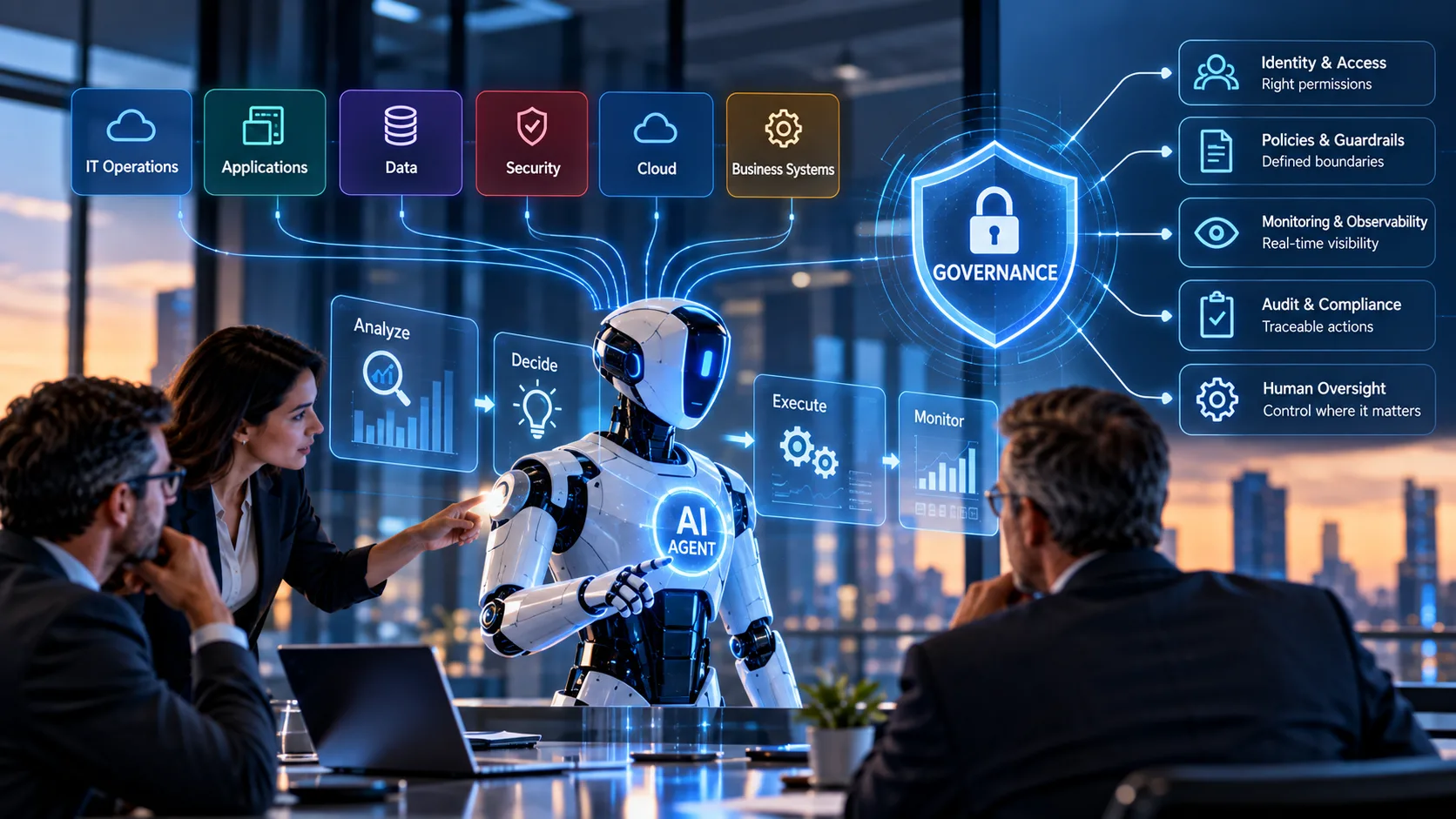
An agent needs an identity because it needs permissions. If an agent is investigating an IT incident, for example, it may need to query an observability platform, read configuration information, access an ITSM system, consult internal documentation, and potentially execute an approved remediation workflow.
Giving every agent broad administrator access would make implementation easier, but it would also create a serious security problem.
The safer approach is familiar: least privilege.
Agents should receive only the permissions required to perform their assigned tasks. Credentials should be controlled, access should be reviewed, high-risk privileges should be temporary where possible, and organizations should be able to revoke an agent's access quickly.
The challenge becomes larger as the number of agents increases. Managing five agents manually is possible. Managing 500 or 5,000 agents across cloud, SaaS, infrastructure, security, and business applications requires a much more systematic approach.
For many enterprises, AI governance will therefore become closely connected with identity governance.
Human-in-the-Loop Should Not Mean Human-in-Every-Loop
A common response to AI risk is to require human approval for every important action. That is sensible during early experimentation, but it can also defeat much of the purpose of automation if carried too far.
The better question is which actions genuinely require human judgment.
Resetting a locked account under an approved policy may not require the same oversight as modifying a firewall rule. Increasing cloud capacity within a predefined threshold may be suitable for automation, while deleting a production database clearly deserves a different level of control.
Organizations can classify actions according to their potential impact.
Risk LevelExampleSuggested ControlLowClassify an IT ticketAutomaticLow–ModerateRestart a non-critical serviceAutomatic within approved conditionsModerateIncrease infrastructure capacityPolicy limits and monitoringHighChange privileged accessHuman approvalVery HighDelete production data or alter critical security controlsMultiple approvals / restricted from autonomous executionThis approach allows organizations to gain efficiency from AI without treating every action as equally risky.
Good governance is not about putting a human checkpoint everywhere. It is about putting the right checkpoint where the consequences justify it.
Enterprises Need to Know What Their Agents Actually Did
Auditability is another area where agentic AI changes the requirements.
Traditional systems typically record transactions and administrative actions. Agentic environments need to capture more context. Organizations may need to know which agent performed an action, what triggered it, which systems and data it accessed, what reasoning or policy influenced the action, whether another agent was involved, and what happened afterward.
Without this information, investigating an AI-related incident can become difficult very quickly.
Imagine an agent changing a configuration that causes a service interruption. The operations team needs to understand not only that the change occurred but why the agent decided to make it. Security may need to determine which permissions were used. Compliance may need to know which data was accessed. The application owner may need to understand the downstream impact.
This makes observability an important part of AI governance.
As agents become part of enterprise operations, organizations will need to monitor them much like they monitor applications, infrastructure, users, and security events.
Third-Party Agents Complicate Governance
Not every AI agent operating inside an enterprise will be built by the enterprise.
Software vendors are rapidly adding AI assistants and agents to business applications. Cloud platforms are introducing agent frameworks. Technology providers are embedding AI into security, ITSM, productivity, analytics, CRM, ERP, and other systems.
This means an organization could accumulate autonomous capabilities without deliberately launching a large internal agent program.
That creates a new version of a familiar problem: shadow IT.
Employees may enable AI functionality inside SaaS platforms without fully understanding what information those capabilities can access. Departments may connect third-party agents to enterprise systems. Vendors may introduce new agent capabilities through product updates.
The governance question therefore cannot simply be, "Which agents have we built?"
It also needs to be, "Which agents have access to our environment?"
That requires closer coordination between IT, cybersecurity, procurement, legal, data governance, and business teams.
Governance Has to Work at Runtime
Traditional governance often happens before deployment. A technology goes through security review, risk assessment, architecture approval, and procurement before it enters production.
That model remains useful, but autonomous AI creates a need for ongoing controls.
An agent that was considered low-risk when initially deployed may gain additional permissions later. Its underlying model could change. The business process it interacts with could become more important. A new integration could expose additional data. Another agent might begin interacting with it.
Governance therefore needs to continue after deployment.
Enterprises should be able to monitor agent behavior, detect unusual activity, review permissions, identify policy violations, and stop or restrict an agent when necessary.
A practical governance lifecycle might look like this:
StageKey Governance QuestionDiscoverWhat AI agents are operating across the organization?ClassifyWhat data, systems, and business processes can each agent access?AuthorizeWhat actions is the agent allowed to perform?MonitorIs the agent operating within expected behavior and policy?AuditCan we reconstruct its decisions and actions when necessary?ReviewDoes the agent still need its current access and autonomy?RetireCan access, credentials, integrations, and data permissions be removed cleanly?This turns AI governance from a policy document into an operational discipline.
CIOs and CISOs Need a Shared Model
AI governance cannot sit entirely with the CIO, CISO, data team, or legal department because each owns only part of the problem.
The CIO may be responsible for technology architecture and operations. The CISO focuses on access, threats, and cyber risk. Data leaders are concerned with quality, privacy, and governance. Legal and compliance teams need to consider regulatory obligations. Business leaders own the processes where AI ultimately creates value.
Agentic AI connects all of them.
That makes cross-functional governance essential, but it does not mean every AI decision needs to go through a large committee. Enterprises need common policies and clearly assigned responsibilities so routine decisions can happen quickly while higher-risk use cases receive appropriate scrutiny.
A simple responsibility model can help.
FunctionPrimary ResponsibilityBusiness OwnerBusiness purpose, outcomes, and acceptable useITArchitecture, integration, reliability, and operationsCybersecurityIdentity, access, threat monitoring, and security controlsDataData access, quality, classification, and governanceRisk / ComplianceRegulatory and policy requirementsAI Governance TeamStandards, oversight, exceptions, and lifecycle governanceFor mid-market enterprises in particular, not every responsibility requires a separate team. What matters is that the responsibility exists and somebody clearly owns it.
Managed Services Providers Will Also Need to Answer Harder Questions
Agentic AI will change vendor evaluation as well.
If a managed services provider uses AI agents to operate a customer's technology environment, the enterprise should understand exactly what those agents are doing.
Which activities are autonomous? Which require human approval? What systems can the agents access? How are their identities managed? Are actions logged? How are exceptions handled? What happens if an agent makes an incorrect change? Who is accountable for the outcome?
These questions are likely to become increasingly important as managed services providers introduce more AI into service desks, cloud operations, cybersecurity, infrastructure management, application support, and incident remediation.
Providers such as Synoptek, which operate across several enterprise technology domains, have an opportunity to help organizations connect AI adoption with the broader requirements around identity, security, infrastructure, applications, data, and operations.
For enterprise buyers, however, AI capability alone should not be enough. The maturity of the controls surrounding that AI matters just as much.
Start With Visibility Before Adding More Autonomy
Enterprises do not need a perfect governance framework before experimenting with AI agents. Waiting for every policy to be complete could slow useful innovation unnecessarily.
But there is one place organizations should start: visibility.
Technology leaders need to know what agents already exist, what they can access, who owns them, and what actions they are capable of taking. From there, agents can be classified according to risk and autonomy.
A practical starting sequence could be:
Inventory → Ownership → Risk Classification → Identity → Permissions → Guardrails → Monitoring → Audit → Continuous Review
The process does not need to be overly bureaucratic. In fact, good governance should make it easier to deploy lower-risk AI because teams know which rules apply.
The objective is not to stop autonomous AI from entering the enterprise. It is to prevent autonomy from expanding faster than the organization's ability to control it.
Governance Could Become an Enabler, Not a Barrier
AI governance is often discussed as something that slows innovation. Poor governance certainly can. A review process that takes months or treats every AI use case as equally risky will encourage employees and departments to find ways around it.
Effective governance should have the opposite effect.
When teams know which data can be used, which systems agents can access, which actions require approval, how identities should be created, and what monitoring is required, they can move faster with less uncertainty.
That may become one of the defining differences between organizations that experiment with AI and organizations that successfully operationalize it.
The next stage of enterprise AI will not be defined only by smarter models. It will also be defined by how confidently organizations allow those models and agents to participate in real business and technology operations.
For CIOs and CISOs, the challenge is therefore not choosing between innovation and control. It is building enough control that the organization can innovate without losing visibility, accountability, or trust.