QKS Group’s Workforce Identity and Access Management market research provides a comprehensive analysis of the global market, covering emerging technology trends, evolving market dynamics, competitive developments, and future market outlook. The research offers strategic insights for technology vendors seeking to strengthen their market strategies and helps enterprises evaluate Workforce Identity and Access Management (WIAM) vendors based on capabilities, competitive differentiation, and market positioning.
Click here for more information : https://qksgroup.com/market-research/spark-matrix-workforce-iam-q3-2025-8625
As organizations adopt hybrid work models, cloud applications, distributed infrastructure, and increasingly complex digital ecosystems, workforce identity has become a critical component of enterprise security. Workforce Identity and Access Management solutions help organizations secure employee, contractor, partner, and other workforce identities while enabling appropriate access to applications, systems, data, and resources.
Key Workforce Identity and Access Management Market Trends
The Workforce Identity and Access Management market is evolving rapidly as organizations move toward Zero Trust security, cloud-first architectures, and identity-centric security models. Modern platforms increasingly combine identity lifecycle management, authentication, authorization, access governance, privileged access controls, and risk-based security capabilities.
Key trends shaping the market include the growing adoption of adaptive authentication, automated identity lifecycle management, granular access controls, identity governance, and behavioral analytics. Organizations are also focusing on integrating workforce identity with broader cybersecurity frameworks to improve visibility, reduce identity-related risks, and support regulatory compliance.
The growing use of artificial intelligence and machine learning is further transforming Workforce Identity and Access Management. AI-powered analytics can help organizations identify unusual user behavior, detect potential identity threats, assess access risks, and support context-aware access decisions.
SPARK Matrix Analysis of Workforce Identity and Access Management Vendors
QKS Group’s research includes detailed competitive analysis and vendor evaluation
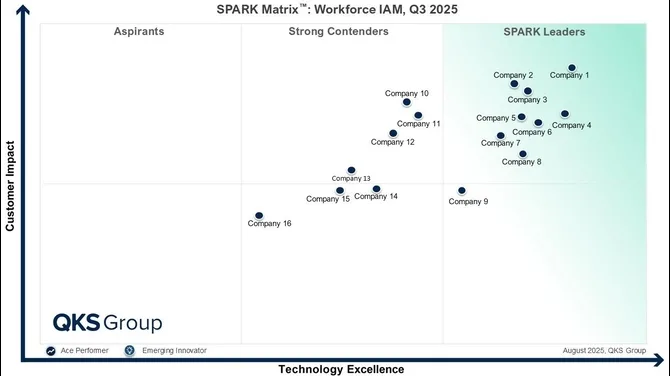
through the proprietary SPARK Matrix™ analysis. The SPARK Matrix provides a comparative assessment of leading Workforce Identity and Access Management vendors based on their technological capabilities and competitive impact in the global market.
The analysis evaluates vendors across relevant capabilities to help technology buyers understand the competitive landscape and assess solutions according to their organizational identity security requirements.
The Workforce Identity and Access Management SPARK Matrix analysis includes: Broadcom, CyberArk, Entrust, Fortinet, IBM, JumpCloud, Manage Engine, Microsoft, Okta, One Identity, OpenText, Ping Identity, SailPoint, Saviynt, Segura, and Thales.
This vendor assessment enables enterprises to gain a structured view of the Workforce Identity and Access Management vendor landscape, understand areas of competitive differentiation, and identify capabilities aligned with their identity and security strategies.
Download Sample Report : https://qksgroup.com/download-sample-form/spark-matrix-workforce-iam-q3-2025-8625
AI and Zero Trust in Workforce Identity Security
The convergence of Workforce Identity and Access Management, AI, behavioral analytics, and Zero Trust is reshaping enterprise security strategies. Instead of relying primarily on network-level security controls, organizations are increasingly using identity, device, application, and contextual signals to determine whether access should be granted.
Modern WIAM platforms can support Zero Trust initiatives by continuously evaluating identity and access risks and applying appropriate authentication and authorization policies. Integration with identity governance and machine identity management can also help organizations address increasingly complex access environments involving both human and non-human identities.
Future Outlook of the Workforce Identity and Access Management Market
The future of the Workforce Identity and Access Management market is expected to be influenced by the continued expansion of hybrid work, cloud adoption, SaaS applications, digital transformation, and increasingly sophisticated cybersecurity
requirements.
Enterprises are likely to place greater emphasis on automated identity lifecycle processes, continuous authentication, intelligent access governance, risk-based controls, and unified identity security. The convergence of workforce identity, identity governance, privileged access, machine identities, and AI-driven security analytics is expected to further shape the evolution of the market.
According to Analyst at QKS Group, “Modern Workforce Identity and Access Management platforms are foundational to securing dynamic, hybrid enterprises. These solutions integrate identity lifecycle automation, adaptive authentication, and granular access controls to deliver secure, seamless user experiences across diverse environments.”
As workforce boundaries continue to expand, organizations are increasingly treating identity as a fundamental component of their security architecture. Workforce Identity and Access Management solutions can help enterprises balance security, productivity, compliance, and resilience while supporting secure access across an interconnected digital ecosystem.
Why Workforce Identity and Access Management Market Research Matters
QKS Group’s Workforce Identity and Access Management market research provides technology vendors and enterprise decision-makers with insights into market trends, competitive dynamics, vendor capabilities, and future developments. The SPARK Matrix™ analysis offers a structured framework for understanding leading vendors and their positioning in the global WIAM market.
By examining technological capabilities, market developments, and emerging innovations, organizations can better understand the evolving Workforce Identity and Access Management landscape and assess solutions that align with their long-term identity security and Zero Trust strategies.