
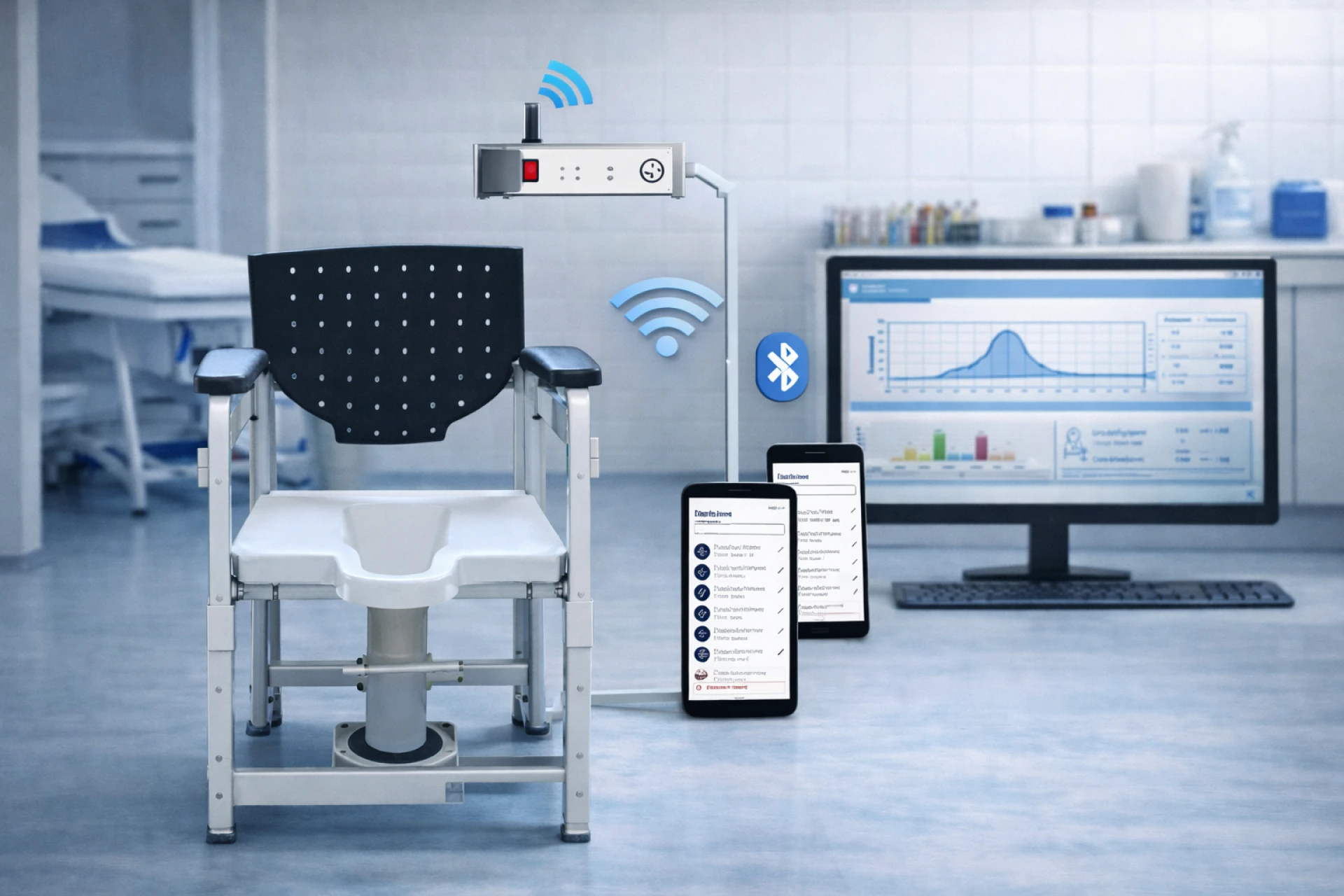
Gone are the days of clunky equipment and funnels. Uroflowmetry is the test that measures how much and how fast you urinate, a key indicator of urinary tract function. Doctors have used this test since 1946, when Willard M. Drake invented the first modern uroflowmeter. His original device used a large funnel and container to measure flow. Today’s wireless uroflowmeters capture the same data effortlessly with tiny sensors and wireless connectivity.
The wireless revolution simply makes the process more natural. With a wireless uroflowmeter, you can use any toilet at your convenience, and the device transmits your flow data wirelessly to the clinician. In short, we still measure how fast and how much you pee, but the experience is smoother. Data upload happens automatically, so you avoid tangled cords and get a friendlier, more comfortable exam without sacrificing accuracy.
The Evolution of Uroflowmetry Devices
For over 70 years, uroflowmetry has been part of urology practice. The first modern uroflowmeter was an analog setup with a funnel and tank. Even now, the uroflowmeter is often praised as “the most commonly used urodynamic instrument” in urology. Over the decades, engineers miniaturized and digitized the equipment. Newer systems “work on every toilet,” so no special commode is needed. This simple change alone can reduce patient anxiety and make the test feel more natural.
Today’s units also integrate smart features. What used to take manual charting now appears on-screen in seconds. Some wireless uroflowmeters are battery-powered and even include voice guidance to help patients perform the test. In short, the evolution has streamlined everything: modern uroflowmetry is faster and friendlier, but it still measures the same key data.
Understanding the Wireless Uroflowmetry System
A wireless uroflowmetry system works much like a traditional one, except without cables. In practice, a small sensor is placed under or around the toilet. When you begin to urinate, the sensor records the volume and flow rate continuously. Instead of plugging into a machine, this sensor transmits its data by Bluetooth to a nearby tablet or computer (and often onward via Wi-Fi).
For example, one modern setup uses a Bluetooth flow sensor under the bowl that beams data through a Wi-Fi gateway to a secure cloud portal. The doctor can log into a dashboard and watch your flow curve build in real time, all automatically. After the test, the software immediately calculates key metrics like peak flow rate (Q_max) and total voided volume. Importantly, studies have shown that these wireless devices are just as accurate as old wired machines. In short, these devices match the traditional accuracy of uroflowmetry while adding modern convenience.
Benefits of Wireless Uroflowmetry in Diagnostics
Wireless uroflowmeters offer clear benefits for both patients and clinicians.
Improved Comfort & Privacy: Because the sensor can sit elsewhere, you don’t have to deal with wires or special chairs. One Bluetooth-enabled system can place the flow detector in another room while you are away, giving you complete privacy.
Reliable Results: These devices automatically record your flow, eliminating manual errors. In fact, rigorous studies find that modern wireless uroflowmeters produce flow curves and volumes indistinguishable from clinic machines. Many are FDA-cleared or CE-marked, meaning regulators trust their accuracy.
Better Monitoring: Wireless systems are portable, so you can do the test multiple times at home. Repeated home measurements give doctors a clearer picture of your typical urination patterns than a single office visit. This “big data” of flows can catch issues that a one-off test might miss.
Streamlined Workflow: Data flows directly into electronic health records and dashboards. Doctors can instantly view your latest uroflow test on screen from anywhere. Many systems even integrate with bladder-diary apps and send reminders.
- Increased Comfort: No wires or clunky funnels; patients void in a familiar bathroom.
- Accurate Results: Wireless devices match traditional uroflowmeters in accuracy (most are FDA-approved).
- Enhanced Monitoring: Simple home tests yield multiple readings, improving diagnostic insight.
- Efficient Workflow: Results upload to digital dashboards and records automatically, speeding up analysis and follow-up.
Together, these advantages make wireless uroflowmetry a clear win. Patients feel more at ease, and doctors get comprehensive data without extra hassle.
Conclusion
Wireless uroflowmetry is transforming a basic urological test. Now patients can use their own toilet (or a smartphone) to generate the exact flow measurements doctors need, faster and more comfortably than ever. Throughout this evolution, the goal remains the same: monitoring bladder function to guide care. But wireless technology adds greater comfort, richer data, and seamless workflows. For example, Bluetooth-enabled sensors significantly enhance patient privacy, and studies confirm their accuracy matches traditional devices.
If you or someone you know has urinary symptoms, ask about modern uroflowmetry options. You might be able to do the test at home on your own schedule instead of waiting for a clinic visit. Either way, your doctor will still get a precise flow report to make the right diagnosis.