

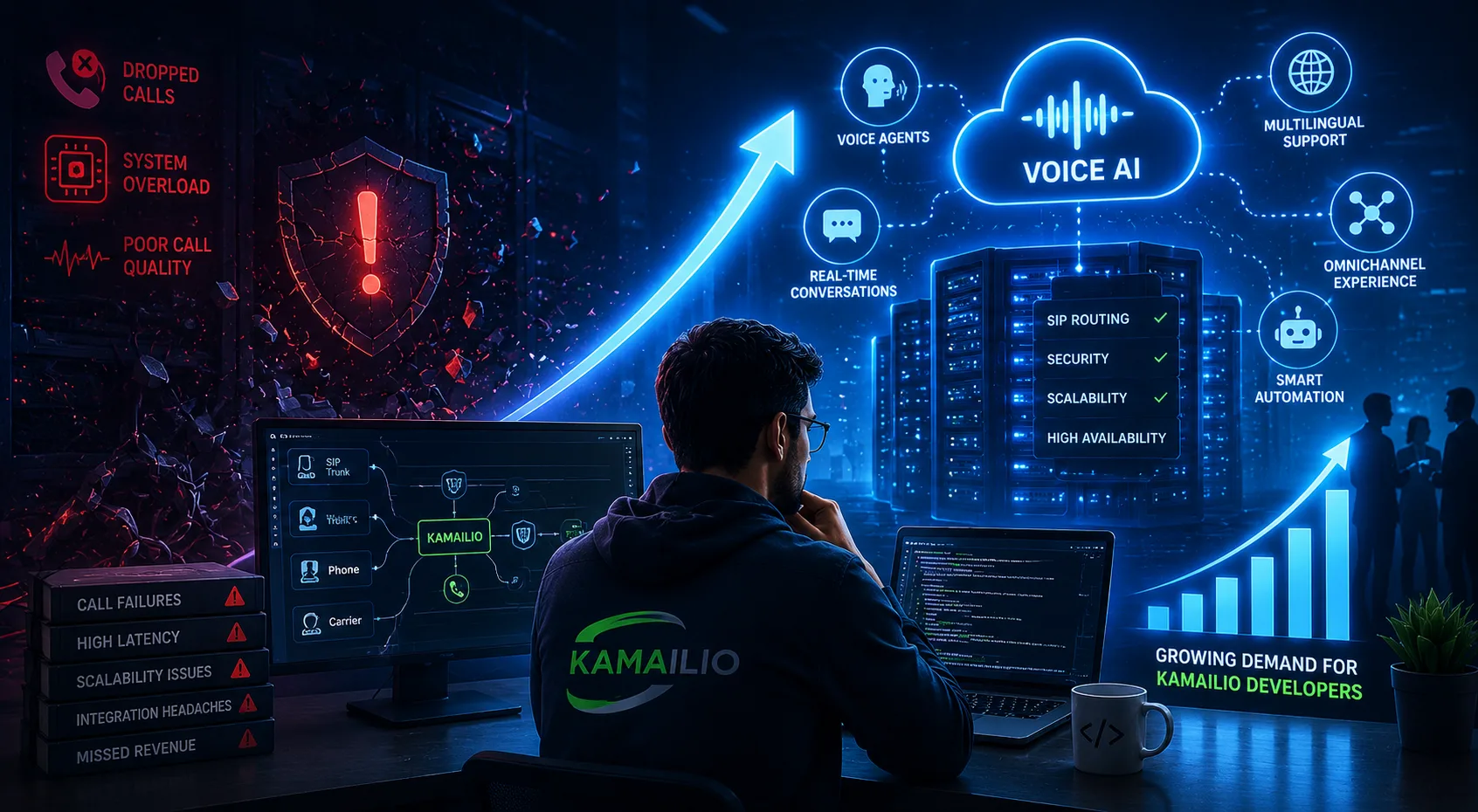
The CPaaS exodus has gotten most of the attention. Companies leaving Twilio, Vonage, and Bandwidth, building their own SIP infrastructure to escape per-minute pricing. It's a real story. But it's not the only story driving Kamailio hiring right now.
The quieter trend is voice AI. And in some markets it's a bigger demand driver than the CPaaS migration.
The piece of the voice AI stack nobody talks about
When a company builds a voice AI product (a voice agent, a real-time call analytics platform, an AI receptionist, a contact center automation layer), the front-page tech stack is speech recognition, the language model, and text to speech. ASR, LLM, TTS. That's what the demos show.
What the demos don't show is the SIP layer underneath. The voice AI agent has to actually answer phone calls. That means a SIP signaling path between the carrier and the AI engine, plus RTP media handling, plus session management. The AI doesn't sit on the phone network natively. Something has to bridge it.
For most companies building production voice AI, that bridge is Kamailio. Sometimes Kamailio plus FreeSWITCH for media. Sometimes Kamailio with RTPEngine. The signaling layer is almost always Kamailio.
Why Kamailio shows up in this stack
A voice AI deployment has signaling requirements that look different from a traditional VoIP product.
Latency budget matters. The signaling path can't add hundreds of milliseconds because the AI engine is already adding latency on the speech and inference side. Kamailio's event-driven C implementation is fast enough that signaling doesn't become the bottleneck.
Call routing has to be conditional. Calls might route to different AI agents based on caller, time of day, language detection, or backend load. Kamailio's routing script is flexible enough to handle that without external lookups slowing the path.
Integration with media handling has to be clean. RTPEngine plugs into Kamailio with well-understood patterns for SDP rewriting, codec handling, and transcoding when needed.
Carrier connectivity has to actually work. Most voice AI startups end up doing direct SIP trunking with carriers eventually, which means handling carrier quirks, OPTIONS pings, registration patterns. Kamailio is built for that.
So when a voice AI company gets past the prototype phase and starts thinking about scale, the signaling layer almost always ends up as Kamailio. Which means they need to hire Kamailio developers.
Where this is biting
I've watched three companies in the last year hit the same wall.
Company one was building an AI receptionist for SMB customers. They had a working prototype on a managed CPaaS at $0.04 per minute. Once they had 200 customers, their CPaaS bill hit $40K per month and was projected to triple in six months. They needed Kamailio plus FreeSWITCH to bring this in-house. They couldn't find anyone.
Company two was a voice analytics platform recording and analyzing real-time agent calls. They needed a SIP tap layer to fork media to their analysis engine. Same wall. The product manager spent four months recruiting before they brought in a contractor.
Company three was building voice agents for outbound campaigns. They tried to handle SIP through Twilio Programmable Voice for the first six months, then needed dialer-grade pacing and call disposition logic that Twilio couldn't give them at their target margin. Same Kamailio gap.
In all three cases, the team had AI talent and ML engineers and product depth. What they didn't have was anyone who could stand up a production SIP signaling layer.
Why the gap is wider than it looks
Most voice AI companies are not telecom companies. They didn't start with a SIP team. Their founders came from machine learning, applied AI research, or product. They hired into those skills first.
When the SIP requirement emerges, usually around the time the per-minute managed service costs cross $30K to $40K per month, the team starts looking for telecom engineers. The market they're hiring into is the same market that the CPaaS-leaving companies are hiring into. Same shortage, more buyers.
In the U.S. the going rate for senior Kamailio engineers is between $160K and $220K. Reaching them is harder than paying them. Most of the qualified people are at existing telecom companies or specialist VoIP firms and aren't browsing job boards.
The realistic paths
If you're at a voice AI company and you've hit the Kamailio wall, two paths usually work.
The first is to hire one senior Kamailio engineer and let them build slowly. Ramp up an internal team around them. This works if you can wait nine to twelve months for the signaling layer to be production ready, and if you can find that one senior person.
The second is to bring in a Kamailio specialist firm to build the signaling layer, deliver it, and transition it to your team. This is the path more voice AI teams are landing on right now. The build cost is higher per month, but the timeline is three to six months instead of twelve.
If you're evaluating that path, the option to hire Kamailio developers through Hire VoIP Developer is one route. They run build-and-handover Kamailio engagements for voice AI and B2B SaaS clients, covering SIP signaling, RTPEngine integration, and carrier interconnect, then transitioning operations once the stack is stable.
Where the demand goes from here
Voice AI is one of the few telecom-adjacent categories actually growing in 2026, and every company in the space eventually hits the SIP signaling requirement. The CPaaS exodus added to existing Kamailio demand. Voice AI is adding to it again. The talent pool isn't growing at the same rate.
The companies that figure out how to work around the bottleneck (instead of waiting for it to clear) are the ones that get to production with their voice AI products on time. In a market moving this fast, six months of recruiting delay is a real competitive problem.


