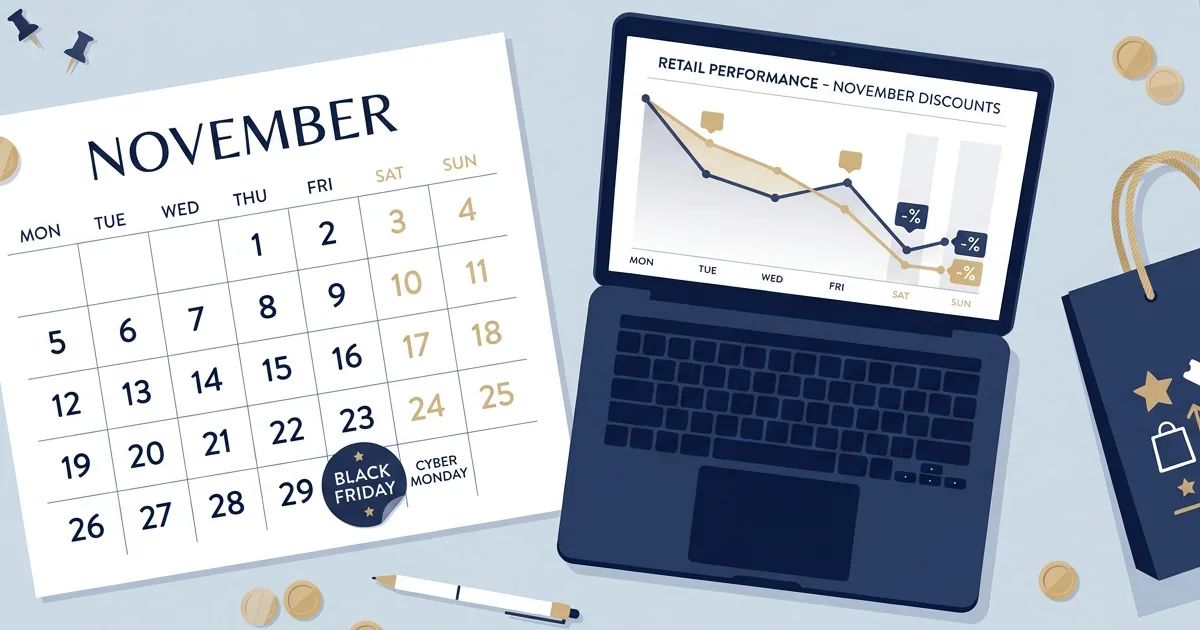
Black Friday 2026 falls on Friday 27 November, with Cyber Monday following on 30 November. On paper, that's a single weekend. In practice, most major UK retailers will have been running "Black Friday" pricing for close to a month by the time the date itself arrives — Amazon, Currys and Argos typically launch early access deals from the first week of November, and "Black Week" proper now starts around 23 November rather than waiting for the Friday.
This creeping start date isn't an accident, and it isn't just marketing enthusiasm. It reflects a fairly deliberate set of pressures retailers are responding to, and understanding them explains a lot about how the sales period actually works.
Spreading Operational Risk
A single-day sales spike is operationally brutal. Warehouse picking, delivery capacity and customer service all get compressed into 24-48 hours if a retailer holds every discount back for the Friday itself. Spreading deals across two to three weeks lets logistics teams manage volume in waves rather than absorbing a single shock, and it reduces the chance of the stock-outs and delivery delays that generate refund requests and bad reviews. Given how central delivery reliability has become to customer retention, this is now as much a supply chain decision as a marketing one.
Capturing Earlier-Shopping Behaviour
Consumer research from Experian's 2026 holiday shopping analysis found 45% of shoppers planned to start their holiday shopping before November, with the large majority having begun by the Thanksgiving weekend itself. That shift has been building for several years, and retailers who wait for the traditional date are effectively ceding the first few weeks of active purchase intent to competitors who don't. Early access deals aren't really about discounting harder — they're about being present at the point a growing share of shoppers actually start looking.
The Genuine-Discount Problem
The longer sales window has created a separate, more reputational issue: not every "deal" inside it is actually a deal. A Which? investigation into Black Friday pricing found that its checked discounts were consistently available at the same price, or cheaper, at other points in the year. That's a meaningful trust problem for retailers relying on urgency-driven messaging, because sufficiently sceptical shoppers now price-check before buying — browser extensions and price-history tools that track a product over six to twelve months are widely used specifically to catch this pattern. Retailers that lean on artificial scarcity without a genuine price advantage risk losing exactly the shoppers most likely to spend the most: the deliberate, research-driven ones.
Financing Is Doing More Work Than It Used To
Buy Now, Pay Later usage during the holiday period has grown substantially — Experian's analysis put 2025 holiday BNPL spending at roughly $20 billion, with more than a quarter of shoppers using it. For retailers, this changes what "affordable" means at checkout: BNPL can make a higher-ticket item convert at a price point that would otherwise have caused hesitation. It also means the discount itself matters slightly less than it used to, since payment flexibility is doing some of the persuasion work discounting used to do alone.
What This Means Going Into 2026
The practical takeaway for retailers is that Black Friday has effectively become Black Month, and the competitive advantage has shifted from "who discounts hardest on the day" to "who can sustain genuine value across a longer window without triggering the scepticism that now surrounds Black Friday pricing generally." Retailers who treat the extended window as an opportunity to spread real, verifiable value — rather than as more days to run the same urgency playbook are the ones best placed to convert increasingly price-literate shoppers who are actively checking whether the deal in front of them is real.
Platforms like PrimeVoucher.co.uk track these seasonal pricing shifts to help UK shoppers separate genuine discounts from manufactured urgency, which is likely to matter more, not less, as the Black Friday window keeps stretching.
FAQ (optional, if the editor supports a Q&A block):
When is Black Friday 2026?
Friday 27 November, with Cyber Monday on Monday 30 November.
Why do UK retailers start Black Friday deals so early now?
Mainly to spread delivery and warehouse capacity across a longer period, and to capture the growing share of shoppers who begin holiday shopping well before November.