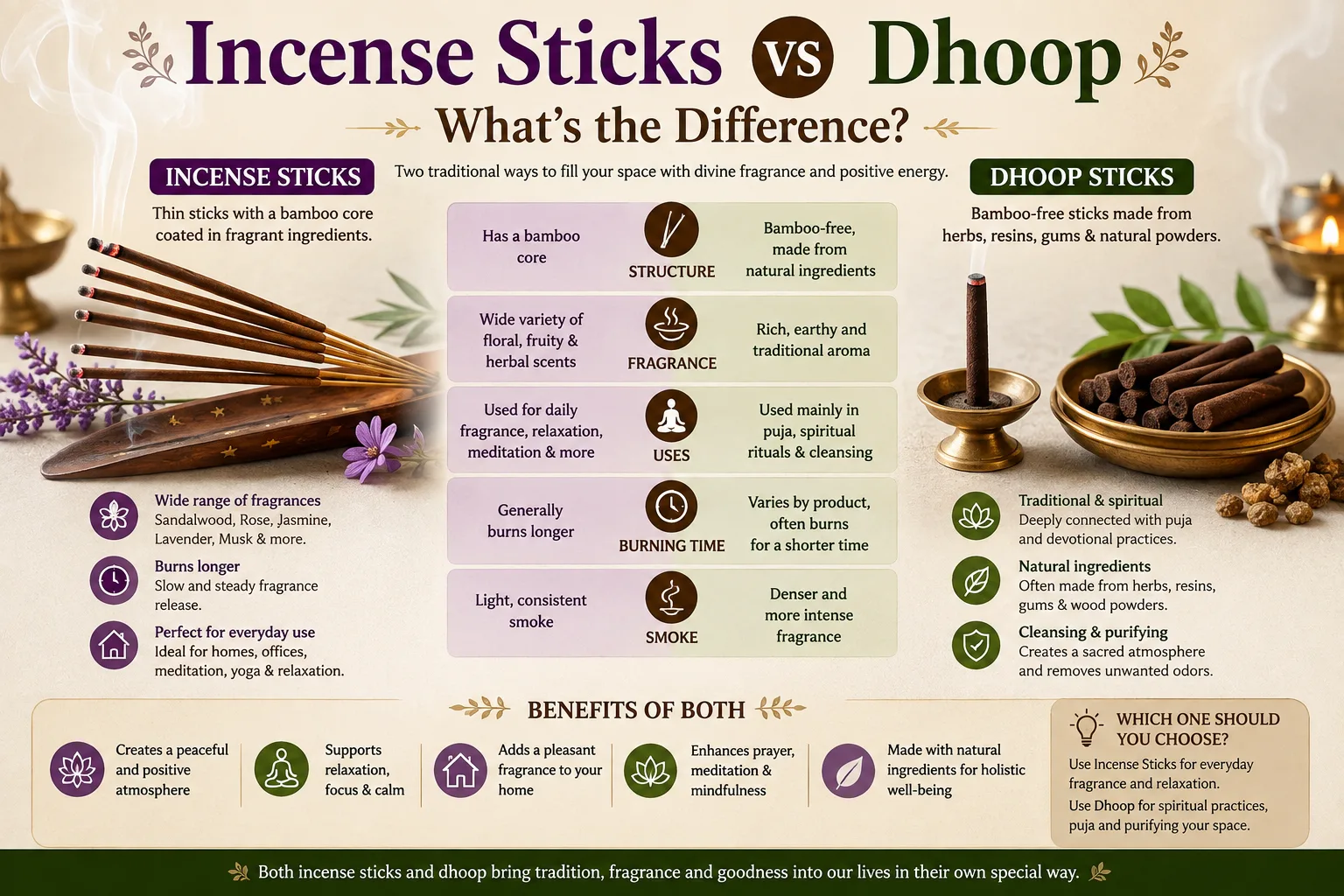
Fragrance plays an important role in creating a peaceful and welcoming atmosphere at home. In Indian households, incense sticks and dhoop are commonly used during daily prayers, meditation, festivals, and spiritual rituals. Although both are known for their pleasant aromas, they differ in their ingredients, shape, fragrance intensity, and burning methods.
If you are wondering whether to choose incense sticks or dhoop sticks for your home, understanding their differences can help you make the right choice. Let’s explore their features, uses, and benefits.
What Are Incense Sticks?
Incense sticks, commonly known as agarbatti, are thin sticks coated with a fragrant mixture of aromatic ingredients. These ingredients may include natural herbs, wood powders, resins, essential oils, and fragrance compounds. A bamboo stick is often used as the base, although some varieties are made without bamboo.
Incense sticks are popular for everyday worship, relaxation, meditation, and freshening up indoor spaces. They are available in many fragrances, including sandalwood, jasmine, rose, lavender, and other floral or woody scents.
Benefits of Incense Sticks
- Create a calming atmosphere: Gentle fragrances can make your surroundings feel more peaceful and comfortable.
- Support meditation: Familiar aromas may help create a consistent environment for mindfulness and meditation.
- Enhance spiritual rituals: Incense sticks are traditionally used during puja, prayer, and religious ceremonies.
- Offer fragrance variety: Different scents allow you to choose an aroma that suits your preferences.
- Easy to use: Their slim shape makes them convenient for daily rituals and occasional use.
What Are Dhoop Sticks?
Dhoop sticks are aromatic products used during religious ceremonies, meditation, and traditional fragrance rituals. Unlike many conventional incense sticks, dhoop sticks are often thicker and may be made without a bamboo core. They are commonly prepared using mixtures of herbs, aromatic woods, resins, flowers, and other fragrant ingredients.
Dhoop is traditionally associated with a richer, deeper fragrance. Depending on the ingredients and formulation, it may produce a stronger aroma and more noticeable smoke than some incense sticks.
Dhoop products are available in several forms, including dhoop sticks, dhoop cones, and other traditional incense preparations. Popular fragrances include guggal, sandalwood, rose, jasmine, and herbal blends.
Benefits of Dhoop Sticks
- Suitable for traditional पूजा rituals: Dhoop is commonly used during religious ceremonies and devotional practices.
- Rich fragrance: Many varieties offer deep, earthy, woody, or resinous aromas.
- Creates a devotional atmosphere: Its traditional fragrance can complement prayer rooms and spiritual settings.
- Available in different forms: Sticks and cones provide options for different rituals and preferences.
- Complements meditation: A familiar aroma may help establish a peaceful routine.
Incense Sticks vs Dhoop: Key Differences
Although incense sticks and dhoop serve similar purposes, several features distinguish them. Feature, Incense Sticks, Dhoop Sticks, Shape. Usually thin and often bamboo-based, Generally thicker and often bamboo-freeFragranceCan be light, floral, fresh, or woody. Often rich, earthy, resinous, or intense. Smoke Varies by formulation. Can be more noticeable depending on ingredients. Common uses. Daily puja, meditation, and home fragrance. Traditional puja, devotional rituals, and meditationFragrance intensityMild to strong. Mild to strong, depending on the product. Varieties Floral, herbal, woody, and modern blends Guggal, sandalwood, herbal, and traditional blends.
Remember that fragrance strength and smoke production depend on the ingredients, manufacturing process, and quality of the product. Not every dhoop stick is stronger than every incense stick.
Which Is Better: Incense Sticks or Dhoop?
The best option depends on your purpose and personal preference.
Choose incense sticks if you prefer convenient daily use, a wide range of fragrances, and aromas that can be subtle or refreshing. They are suitable for morning prayers, meditation sessions, and occasional home fragrance.
Choose dhoop sticks if you enjoy traditional aromatic preparations and deeper, more resinous fragrances. They can be a good choice for devotional rituals, special ceremonies, and prayer-room use.
You can also keep both products at home and use them for different occasions. The important thing is to select products made with ingredients you are comfortable using and a fragrance intensity that suits your space.
How to Use Incense Sticks and Dhoop Safely
To enjoy incense benefits responsibly, follow a few simple precautions:
- Place the burning product in a stable, heat-resistant incense holder.
- Keep it away from curtains, paper, furniture, and other flammable materials.
- Use it in a well-ventilated area and avoid inhaling smoke directly.
- Never leave burning incense or dhoop unattended.
- Keep burning products away from children and pets.
- Avoid use around people who are sensitive to smoke or fragrance.
Although incense is traditionally used for relaxation and spiritual practices, burning it does not guarantee health benefits. Smoke from incense and dhoop can irritate the airways, so people with respiratory sensitivities should take particular care.
Conclusion
Both incense sticks and dhoop have an important place in Indian traditions and home fragrance routines. Incense sticks are convenient and available in a wide variety of aromas, while dhoop is often preferred for its traditional ingredients and deeper fragrance profiles.
Understanding the difference between incense sticks and dhoop helps you choose the right product for daily puja, meditation, festivals, or personal fragrance preferences. Whichever option you choose, prioritise product quality, suitable fragrances, and safe burning practices to create a pleasant and welcoming environment at home.