

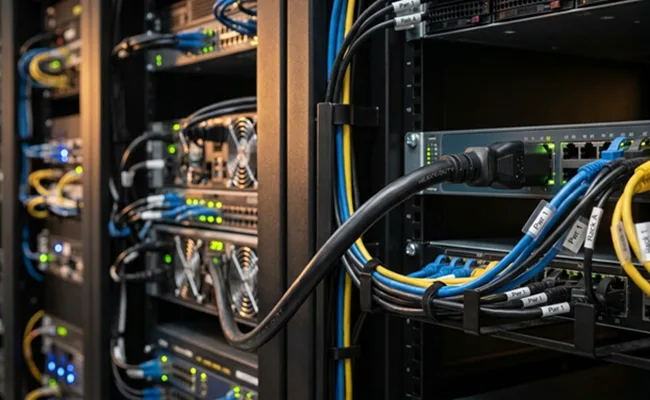
When IT managers are planning a new server room, or an already existing system, they consider processing power, storage, network bandwidth, and cooling. They plan on premium servers, LAN switches and redundant internet links. However, very few people make power cords an agenda.
It is an error and this is more expensive to the business than they can imagine.
The Silent Secret with a Dangerous Payback.
Most small and mid-size business server rooms will contain a tangle of every sort of mismatched cords that was pulled out of the old printers, desktop computers, and anything that was in the box with devices several years ago. IT teams rarely ask them any questions. The host is up, all the lights are on, everything is alright.
This is what is really happening.
A power cord that is under-sized and has to be slightly below its amperage capacity produces heat. Slowly accumulating heat damages the insulation and in months results in a real fire hazard or equipment breakdown. A cord having the incorrect connector can fit physically and may sustain a loosely fitting connector during vibration, thermal expansion, resulting in intermittent faults that would be difficult to troubleshoot.
Knowing the Type of Power Cord to use with IT Equipment.
Part of why power cords are become overlooked is that, most people do not comprehend the naming. After you do so, it is easy.
Connectors on server power cords and the network equipment power cables are in compliance with IEC 60320 standard. The most prevalent ones within IT settings are:
IEC C13
The three pronged connector used on most desktop computers, monitors, routers and switches. The general IT equipment is compatible with most products, and the standard IEC C13 power cord is up to 10 amps.
IEC C15
Physically identical to the C13, but with higher temperature. It is the right option with equipment that is hot such as some networking equipment. The need to use a C13 instead of C15 power cord is an inconspicuous yet grave mistake.
IEC C19
This is a heavy-duty connector with a maximum 16 amp current capacity and is typically used with larger equipment that has a higher rate such as larger UPS units, high density servers, and PDU power cords in enterprise racks.
NEMA 5-15
The typical American three prong plug. NEMA 5-15 power cords are safe enough to be used by the desktop equipment and light IT installations, however, it is not suitable to use them in rack-mount servers that carry constant loads.
BuyRightFirst.
Computer power cable market is saturated with low quality cables, unrated cables, or falsely rated cables. This is one of the types in which price is one of the truly bad ideas to purchase. On a consumer laptop, it is annoying when a cord fails. Failure of a production server cord is a critical problem to business.
In the sourcing of power cords to IT infrastructure, consider:
● Clearly marked amperage and voltage ratings of the product.
● UL listing or other safety certification.
● Proper connector types that are appropriate with your equipment.
● Proper wire gauge [length and load]
● Business options Shopping in bulk power cords in case you are furnishing a complete rack or racks.
In the case of teams that bulk buy server room power cables, it is logical to work with a special supplier. You also have uniform quality, checked specifications, and the precise IEC 320 power cord combinations that are needed by your equipment instead of piecing together what a general retailer has on hand.
The Takeaway
Power cables of the IT infrastructure are not glamorous. They do not appear in vendor demonstrations or get into budget discussions. And yet, they are the electrical linkage of your equipment with the electrical supply necessary to work.
The good news is that this will not be costly or complex to fix this piece of your infrastructure. An entire rack can be fully cabled at a small fraction of the cost of one server. It only takes the resolve that it matters until it goes wrong.
Original Article :- https://www.graspfacts.com/2026/04/why-the-right-power-cord-is-the-most-overlooked-part-of-any-it-infrastructure.html


