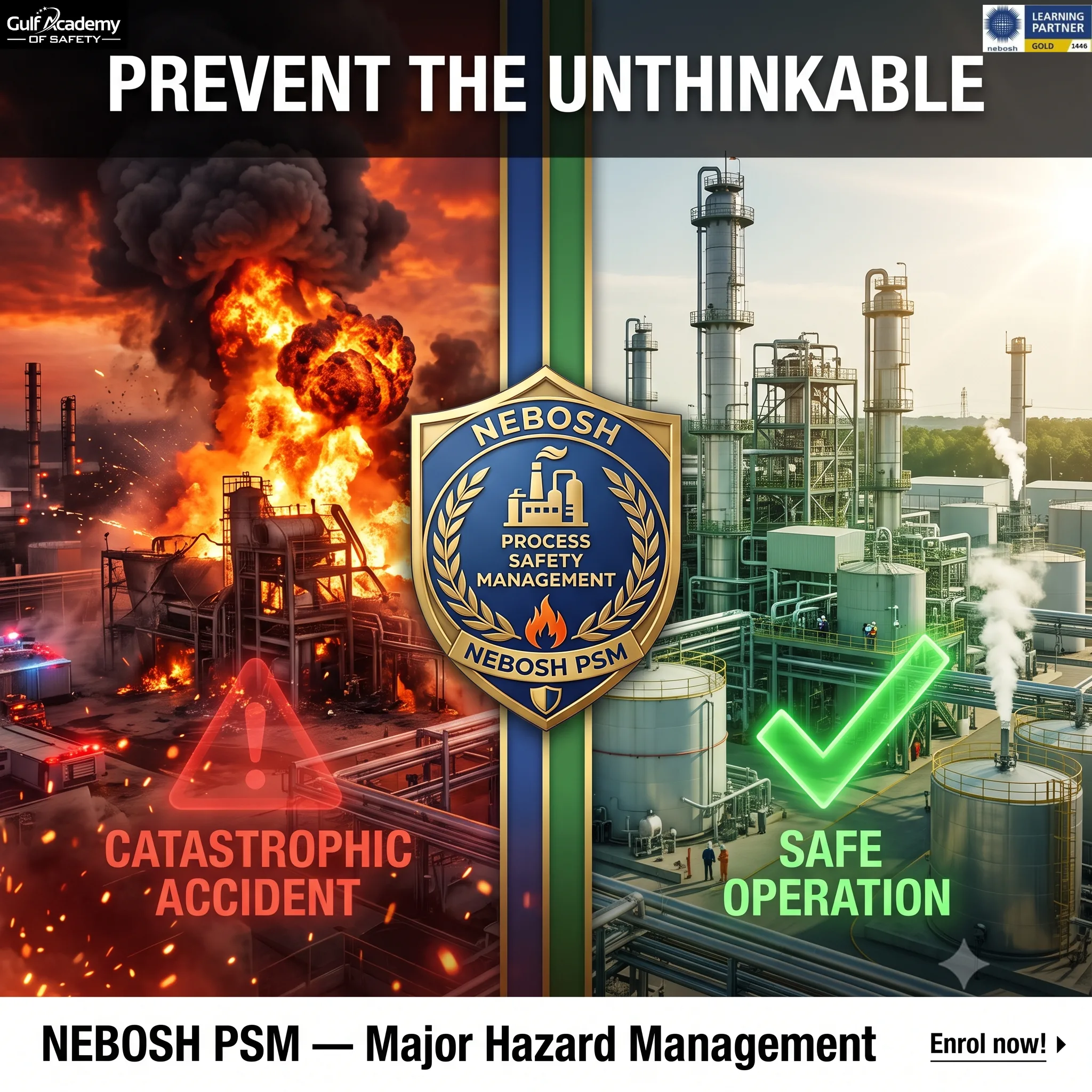
Process safety failures are among the most devastating events an industrial organization can face. Unlike routine workplace injuries, a major process safety incident — an explosion, toxic gas release, or catastrophic equipment failure — can result in multiple fatalities, long-term environmental damage, and the kind of reputational harm a company may never fully recover from. This is exactly the gap the NEBOSH PSM course was designed to close, and it's why demand for the qualification is growing rapidly across oil and gas, petrochemical, pharmaceutical, and heavy manufacturing sectors worldwide.
The Difference Between General Safety and Process Safety
Many professionals enter the safety field through general occupational health and safety training, which typically covers slips, trips, falls, manual handling, and everyday hazard management. While essential, this type of training was never designed to address the unique risks present in facilities that handle flammable substances, high-pressure systems, or toxic chemicals at scale.
NEBOSH Process Safety Management fills this gap by focusing specifically on the technical and organizational disciplines required to prevent major accidents. Rather than teaching generic hazard awareness, the course examines how safety barriers are designed, how they degrade over time, and how organizations maintain the integrity of critical safety systems under real operating pressures. This distinction matters enormously: a facility can have excellent general safety statistics — few slips, few minor injuries — while still carrying significant, unmanaged process safety risk that could result in catastrophe.
What Makes the NEBOSH HSE Certificate in Process Safety Management Different
The NEBOSH HSE Certificate in Process Safety Management stands out because it was developed specifically for people working in and around hazardous processes, not as a generic add-on to broader safety curricula. The course structure walks learners through a logical progression: understanding what process safety actually means, identifying the types of hazards specific to process industries, learning structured techniques for hazard identification, and then moving into risk assessment methods tailored to high-consequence, low-frequency events.
This is a critical distinction from conventional risk assessment, which often focuses on likelihood and everyday severity. Process safety risk assessment must account for events that may be rare but carry catastrophic consequences when they do occur — a mindset shift that takes deliberate training to develop properly.
Learners also study the anatomy of major accidents through case studies of real industrial disasters, examining not just what went wrong technically, but how organizational culture, communication breakdowns, and management system failures contributed to the outcome. This holistic view — combining technical understanding with human and organizational factors — is what makes graduates of this course genuinely more capable of preventing future incidents, rather than simply being able to recite safety procedures.
Who Benefits Most from Earning a NEBOSH PSM Certificate
The NEBOSH PSM Certificate is particularly valuable for a specific range of professionals. Process engineers benefit because the course deepens their understanding of how design decisions affect long-term safety performance, not just operational efficiency. Maintenance technicians and reliability engineers gain insight into why certain safety-critical equipment requires more rigorous inspection and testing regimes than standard machinery. Safety officers and HSE managers working in high-hazard facilities gain a technical vocabulary and framework that allows them to engage more credibly with engineering and operations teams, rather than being seen as purely administrative or compliance-focused.
Even professionals in adjacent roles — project managers overseeing capital projects in hazardous facilities, or auditors assessing process safety management systems — find the qualification valuable because it provides a shared technical language and framework for evaluating risk across an organization.
Industry Demand and Regulatory Pressure
Across the Middle East and globally, regulatory bodies and multinational operators are placing increasing emphasis on demonstrable process safety competence, not just general safety compliance. Major incidents in the petrochemical and energy sectors over the past two decades have led to tightened regulations, more rigorous audit requirements, and a growing expectation that key personnel hold recognized process safety qualifications.
This shift means that holding a NEBOSH PSM course completion certificate is increasingly viewed not as an optional enhancement to a safety professional's CV, but as a baseline expectation for certain roles in high-hazard industries. Organizations bidding for major contracts, seeking insurance coverage, or undergoing regulatory audits are often required to demonstrate that key personnel have appropriate process safety training — and NEBOSH's international reputation makes this qualification particularly well recognized across borders.
How Gulf Academy of Safety Delivers This Training
At Gulf Academy of Safety, the NEBOSH PSM course is delivered by instructors with direct industry experience in high-hazard operations, ensuring that theoretical content is consistently grounded in practical, real-world application. The training moves beyond textbook definitions, using scenario-based exercises that mirror the kinds of decisions professionals actually face when managing process risk on-site.
Course delivery is structured to accommodate working professionals, recognizing that many learners are balancing this qualification with ongoing operational responsibilities. Rather than treating process safety as an abstract academic subject, the program is built to be immediately applicable, helping participants bring new frameworks and thinking back to their own facilities from day one.
Building a Stronger Safety Culture, One Certification at a Time
Ultimately, the value of the NEBOSH PSM Certificate extends beyond individual career advancement. Organizations that invest in process safety training for their engineers, technicians, and safety personnel are making a direct investment in the resilience of their operations. Every certified professional adds another layer of capability to an organization's ability to identify emerging risks, challenge unsafe practices, and maintain the integrity of critical safety barriers over time.
As industries across the region continue to grow in scale and complexity, the organizations that prioritize process safety competence will be the ones best positioned to operate safely, meet regulatory expectations, and protect both their workforce and their long-term reputation.
For professionals ready to specialize in this critical area of safety management, Gulf Academy of Safety offers the training, expertise, and practical grounding needed to earn the NEBOSH HSE Certificate in Process Safety Management with confidence.