Introduction
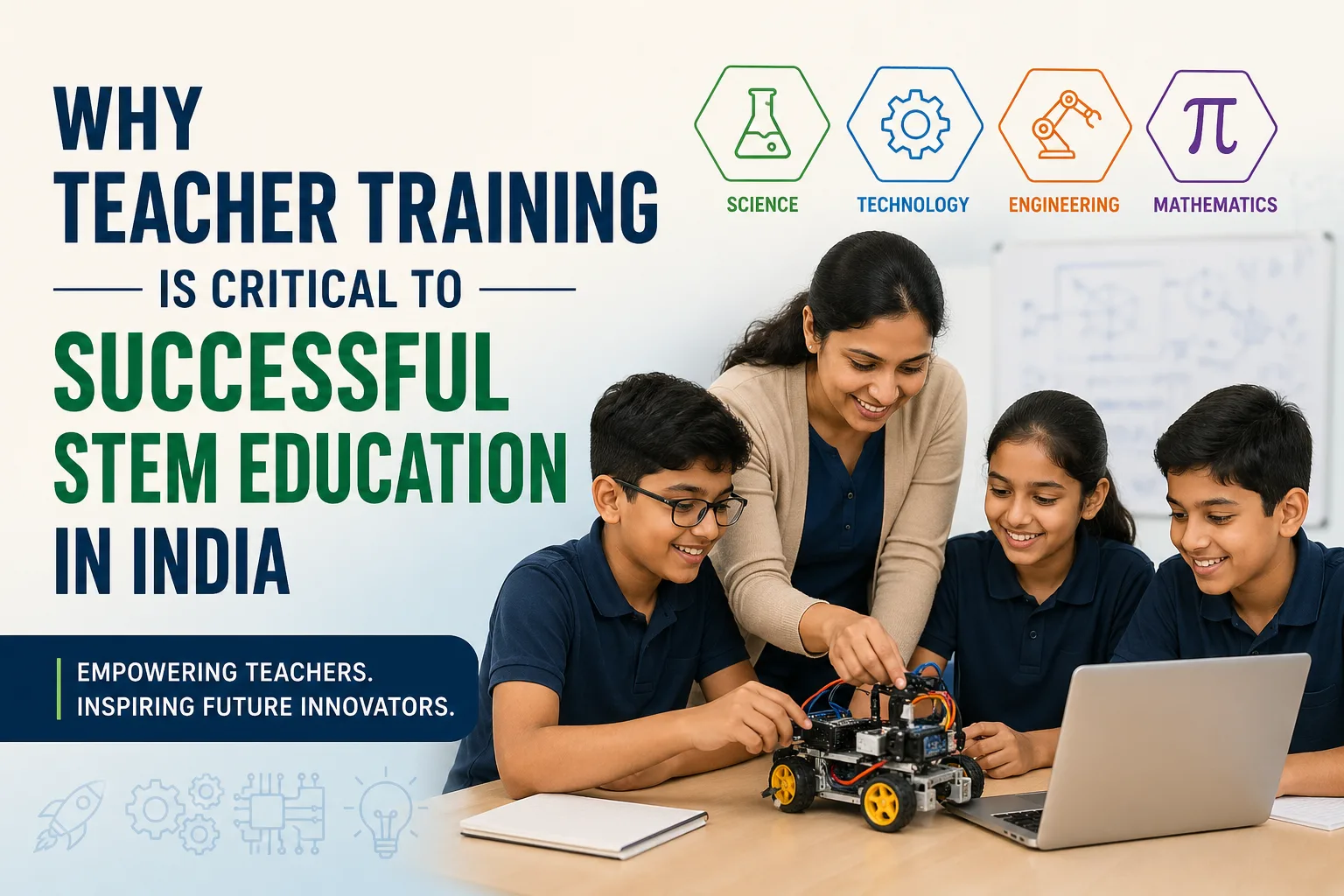
Every few months, there is a new headline about India's push toward STEM education. New labs are being announced. Government schemes are being launched. Schools are investing in robotics kits, AI boards, and tinkering equipment. Parents are actively looking for schools that offer coding and technology programs for their children.
And yet, walk into many of these schools, and you will often find the same thing — a brand new robotics lab sitting mostly unused. Shiny equipment gathering dust. A teacher standing in front of it was handed a kit three weeks ago and told to "figure it out."
It is the uncomfortable reality of STEM education in India right now. We are building the infrastructure. We are buying the tools. But we are not adequately investing in the one element that makes all of it actually work — the teacher standing in the room.
Training of teachers in STEM education in India cannot be regarded as secondary. It needs to be treated as primary. Until then, there will always be a gap between what our education system claims to do and what it really achieves.
The Real Problem: Equipment Without Training Is Just Expensive Storage
Here is something worth sitting with for a moment. According to a NITI Aayog report, over 60 percent of Indian schools face a shortage of qualified math and science teachers. Over nine percent of STEM teacher positions across the country are currently vacant. In states like Jharkhand and Assam, that vacancy rate climbs to around 25 percent.
This figure does not include those teachers who are present but are underprepared. The science teacher who was trained in chemistry 15 years ago must now instruct students on how to design an Arduino application. The math teacher is enthusiastic about her discipline, but she has never been exposed to any form of project-based learning throughout her teaching career. It is not a case of incompetence on the part of the individual teacher. It is a failure of the entire system.
STEM education is fundamentally different from traditional subject teaching. It is not about delivering a lesson and waiting for students to absorb it. It is about creating an environment where students explore, fail, try again, collaborate, and build things. Facilitating that kind of learning requires a specific set of skills — skills that most teachers were simply never taught during their own training.
What Happens When Teachers Are Not Trained for STEM
The consequences of poor teacher preparation for STEM subjects show up in predictable ways. And once you know what to look for, you see them everywhere.
First, there is the natural tendency for teachers to revert to what they are comfortable with, which is teaching. What could have been an interactive robotics lesson where the students get to experiment with their own designs turns into a boring lecture on robotics. The tools remain in the cupboard, untouched.
The second consequence is low student engagement. When a teacher is uncertain about the subject matter, students sense it immediately. Confidence is contagious in a classroom — and so is the lack of it. Students who might have been deeply curious about coding or electronics quietly disengage when the learning environment does not feel safe for questions or experimentation.
The third and most damaging consequence is that STEM education gets reduced to a checkbox. Schools can say they have a STEM program. They can photograph the lab for their brochure. But the actual impact on student learning — the development of critical thinking, problem-solving, and real-world application skills — simply does not happen.
It is the gap that teacher professional development in India urgently needs to address.
What Good STEM Teacher Training Actually Looks Like
There is a misconception worth clearing up early. Good STEM teacher training is not about turning every science teacher into a robotics engineer. It is about giving educators the confidence, the language, and the pedagogical tools to guide students through technology-driven learning — regardless of their own technical background.
Here is what effective training actually covers.
- Hands-on learning methodologies. Teachers need to experience project-based and experiential learning themselves before they can deliver it to students. The best training programs put educators in the role of the learner first — letting them build, experiment, and discover — so they understand what that process feels like from a student's perspective.
- Subject integration: The STEM discipline cannot stand on its own; it is part of mathematics, science, design, and language arts. Teachers are trained to understand that the implementation of STEM in Indian education can be incorporated into their disciplines instead of being a totally separate entity that demands separate skills.
- Classroom management for open-ended learning. The STEM classroom is a completely different scenario compared to a conventional classroom setup. There are movements within the class, and group work at their own pace, and sometimes an experiment may not be completed because it has failed somewhere halfway through.
- Assessment that goes beyond marks. STEM learning requires different ways of evaluating student progress — portfolios, project demonstrations, peer review and observation. Training equips teachers to assess learning outcomes that a written test simply cannot capture.
- Technology fluency. The teachers need not be experts in all the pieces of equipment they use in class. However, they should have the knowledge to help solve simple problems, assist students in using the tools for projects and relate the use of the equipment to academic results. They acquire this ability through organized training.
NEP 2020 and the Opportunity It Creates for Teacher Training
The National Education Policy 2020 is perhaps the most significant shift in Indian education in decades. And one of its clearest mandates is the transformation of how teachers are trained and supported throughout their careers.
The NEP 2020 reforms regarding teacher education aim at encouraging continual professional development of teachers and not just their certification. According to the policy, CBSE-affiliated institutions must facilitate professional development sessions for their teachers for at least 50 hours annually. Such training will be required for competency-based, multidisciplinary and technology-based teaching and learning.
For the STEM education space, this is a genuine opportunity. Schools and education providers that build structured, NEP-aligned teacher development programs now are positioning themselves ahead of a wave of institutional change that is still unfolding across the country.
The policy also specifically calls out the need to address teacher shortages in STEM subjects and to create new pathways for graduates interested in becoming educators in science, technology, engineering, and mathematics fields. It is where programs like the STEM Facilitator Course — designed specifically for graduates who want to become skilled, certified STEM educators — become genuinely important.
The STEM Teacher Shortage: A Problem That Compounds Over Time
One reason the STEM teacher shortage in Indian schools does not get enough attention is that its consequences are slow and invisible. A school without a functioning math teacher shows results in the next exam cycle. A school where STEM teaching is weak shows results five years later — in the career choices students do not make, the engineering colleges they do not enter, and the technical roles the country eventually cannot fill.
India's economy is moving rapidly toward artificial intelligence, robotics, data science, and biotechnology. The World Economic Forum projects that 65 percent of children entering primary school today will work in jobs that do not yet exist. Most of those jobs will require deep comfort with technology, strong analytical thinking, and the ability to solve complex, unstructured problems.
All of those capabilities are built in classrooms — by teachers. And if those teachers are not equipped to cultivate them, no amount of lab equipment will make a difference.
The investment in robotics teacher training programs and AI educator certification today is not a nice-to-have. It is a direct investment in the talent pipeline that India's economy will depend on in fifteen years.
What Schools Can Do Right Now
For school principals and education leaders reading this, here is what actionable movement looks like — without waiting for a government mandate to push it.
Start by auditing your current teaching staff honestly. How many teachers have received any formal training in STEM pedagogy? How many feel confident facilitating a robotics session or a coding project? The answers to those questions will tell you exactly where to begin.
Secondly, take part in accredited training programs rather than one-day events that may seem fruitful in the short-term but are soon forgotten by Monday. Seek out courses that provide practical experience over a series of sessions, include mentoring services beyond the course, and yield some type of qualification.
Encourage peer learning within your school’s culture. If teachers have been trained using a STEM framework, make sure that they are given a structured chance to impart this knowledge to other faculty members. Observation time, co-teaching, and subject-specific staff planning sessions are inexpensive and extremely valuable.
Finally, establish a connection between teacher training and student achievement. Identify any disparities among your students once you have completed your training sessions. Measure any increase in student participation, project accomplishment, and skills development.
How STEM-Xpert Is Addressing This Gap
At STEM-Xpert, teacher development is not an afterthought — it is a core part of what we do. Our STEM Facilitator Course is built specifically for graduates who want to build a career as skilled, certified STEM educators specializing in Robotics, AI, Coding, and emerging technologies.
The course is hands-on, practically focused, and designed to produce educators who walk into a classroom with real confidence — not just a certificate. Whether you are a fresh graduate exploring a career in education or a working teacher looking to upskill for the AI-driven classroom, the STEM Facilitator program gives you the tools, knowledge, and credentials to lead the next generation of Indian innovators.
Because here is what we know from seven years of working with more than 50,000 students across India. The best STEM outcomes do not come from the best equipment. They come from the best-trained teacher in the room.
Conclusion
India will not solve its problem of lacking the necessary skill set for technology through the additional creation of labs. India will solve it only through improved teaching faculties. Every penny spent on the training of teachers in STEM education is repaid manifold in terms of results produced by the students.
The equipment is already arriving in schools across the country. The labs are being set up. The kits are being unboxed. What those rooms need now is not more hardware. They need confident, trained, passionate educators who know how to turn a room full of curious students into a room full of future engineers, scientists, and innovators.
That transformation begins with teacher training. And there is no better time to start than right now.
FAQs
Q1. Why is teacher training important for STEM education in India?
Teacher training ensures educators can confidently deliver hands-on learning and use modern tools effectively. Well-trained teachers help students develop practical skills and make STEM lessons more engaging and meaningful.
Q2. How does NEP 2020 address teacher training for STEM subjects?
NEP 2020 emphasizes continuous professional development for teachers, focusing on skill-based teaching, technology integration, and modern classroom practices to improve learning outcomes.
Q3. What is the STEM teacher shortage problem in India?
Many schools in India face a shortage of qualified math and science teachers. In addition, some teachers lack specialized training in modern STEM teaching methods, which affects the quality of education.
Q4. What is a STEM Facilitator course and who should take it?
A STEM Facilitator course prepares individuals to teach subjects like robotics, coding, and technology. It is suitable for teachers and graduates who want to build skills for modern classrooms.
Q5. How can schools improve STEM teaching quality without a large budget?
Schools can improve teaching quality by investing in structured training programs, encouraging peer learning among teachers, and focusing on practical classroom strategies rather than one-time workshops.
Q6. How does hands-on teacher training improve student learning outcomes in STEM?
Hands-on training helps teachers create interactive lessons that improve student engagement, problem-solving skills, and interest in science and technology subjects.