Percentages look simple until money is involved. Two of the most common mistakes UK shoppers and small business owners make are working out VAT backwards the wrong way, and misjudging how big a "sale" discount really is. Both are easy to fix once you see the maths.
Mistake 1: removing VAT by subtracting 20%
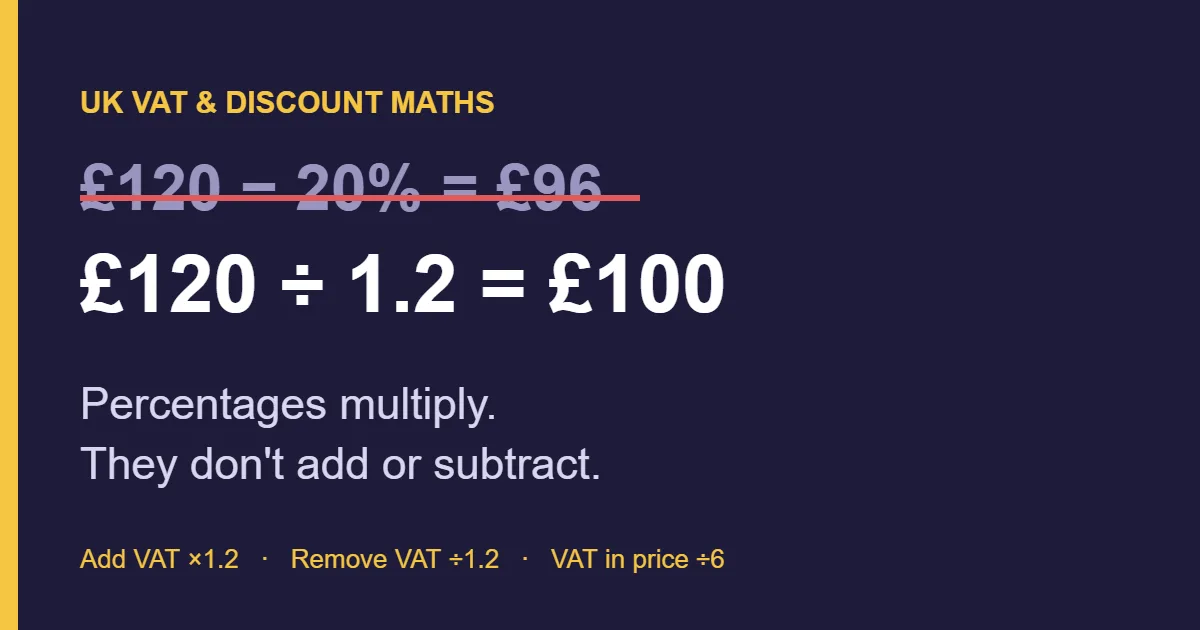
UK standard-rate VAT is 20%. So if something costs £120 including VAT, the price without VAT must be £96 — 20% less, right?
No. The VAT-free price is £100.
The reason: VAT is 20% of the ex-VAT price, not of the final price. £100 + 20% = £120. Taking 20% off £120 gives you £96, which is a different number entirely — you've removed £24 when the VAT was only £20.
The correct formulas:
- Add VAT: ex-VAT price × 1.2
- Remove VAT: inc-VAT price ÷ 1.2
- VAT portion of an inc-VAT price: price ÷ 6 (because 20/120 = 1/6)
So on a £120 invoice, the VAT is £120 ÷ 6 = £20.
This matters most when:
- Comparing trade and retail prices. Trade suppliers and B2B sites often show prices ex-VAT. A £250 "trade price" is £300 at the till if you're not VAT-registered.
- Filling in expenses or quoting for work. Getting the VAT element wrong on a £1,200 quote is a £40 error (£240 vs the correct £200).
- Checking receipts. If you're VAT-registered and reclaiming, you need the VAT amount, not 20% of the total.
For quick checks, the free VAT Calculator on PrimeVoucher adds or removes UK VAT from any amount and shows the VAT portion separately.
Mistake 2: misreading "was/now" discounts
Sale labels usually show a "was" and "now" price, and our brains round the saving up. A few examples:
- Was £75, now £55. That's a £20 saving — but as a percentage it's 20 ÷ 75 = 26.7% off, not "about a third".
- Was £40, now £30. A £10 saving is 25% off.
- 35% off £64. £64 × 0.65 = £41.60.
The formula for the percentage you're saving:
% off = (was price − now price) ÷ was price × 100
Why it matters: an "up to 50% off" sale might only have a handful of items at 50%, with most around 15–25%. Knowing the real percentage helps you compare a sale price in one shop with a voucher code in another.
If you'd rather not do the division at the shelf, the Discount Calculator works either way round — enter the original price and the % to get the sale price, or enter both prices to see the real % off.
Mistake 3: percentage of a percentage
A related trap: VAT and discounts together. If an item is £60 ex-VAT and you have a 10% trade discount, it doesn't matter which order you apply them — £60 × 0.9 × 1.2 = £64.80 either way, because multiplication works in any order. But adding and subtracting percentages as if they were flat numbers (+20%, −10%, "so +10% overall") gives £66, which is wrong.
The rule of thumb across all of these: percentages multiply, they don't add or subtract.
Quick reference
TaskFormulaExample Add 20% VAT× 1.2£100 → £120 Remove 20% VAT÷ 1.2£120 → £100 VAT in a price÷ 6£120 → £20 VAT Sale price× (1 − %)35% off £64 → £41.60 % saved(was − now) ÷ was£75 → £55 = 26.7%These calculators are part of a free set on PrimeVoucher, a UK voucher codes and deals site. More — stacked discounts, price per unit, pay in 3 — at primevoucher.co.uk/calculators.