
Manufacturing processes such as welding, casting, forging, machining, and forming can leave internal stresses inside metal components. Although these stresses may not always be visible, they can affect dimensional stability, machining accuracy, and long-term performance.
Stress Relieving Heat Treatment is a controlled thermal process used to reduce these residual stresses without significantly changing the basic structure or mechanical properties of the material. It is widely used for fabricated steel structures, machinery components, welded assemblies, and other industrial products.
What Is Stress Relieving Heat Treatment?
Stress relieving involves heating a metal component to a controlled temperature, holding it for a specified period, and then cooling it under controlled conditions.
The purpose is to allow internal stresses within the material to relax. These stresses can develop during manufacturing because different sections of a component may heat, cool, expand, or contract at different rates.
The exact temperature and holding time depend on factors such as material composition, component thickness, manufacturing history, and the required results.
How Do Residual Stresses Develop?
Residual stresses can occur during several stages of manufacturing.
Welding
Welding creates localized heating followed by cooling. The difference in temperature between the welded region and surrounding material can produce internal stresses.
Machining
Removing material from a component can redistribute stresses that were already present in the material.
Forging and Forming
Mechanical deformation during forging, rolling, bending, and forming can introduce stresses that may remain after the manufacturing operation.
Casting
Uneven cooling during casting can also contribute to internal stresses within the finished component.
If these stresses are not properly managed, they can sometimes contribute to distortion during subsequent machining or service.
How Does the Stress Relieving Process Work?
A typical process begins by placing the components inside an industrial heat treatment furnace. The furnace gradually raises the material to the specified stress-relieving temperature.
Once the required temperature is reached, the components are held for a predetermined period. This soaking stage allows the material to reach a more uniform temperature and gives internal stresses time to relax.
After the holding period, the furnace is cooled in a controlled manner. The cooling rate is selected according to the material and process requirements.
Temperature controllers and sensors help maintain the required thermal cycle throughout the operation.
Applications of Stress Relieving
Stress relieving is used in many industrial manufacturing applications.
Common examples include:
- Welded steel structures
- Fabricated components
- Pressure vessel components
- Machinery parts
- Large shafts
- Forged components
- Castings
- Heavy engineering components
- Machined parts
- Industrial equipment
The process can be especially useful for large components where distortion or dimensional changes could create problems during later manufacturing stages.
Benefits of Stress Relieving
A properly controlled stress-relieving process can provide several manufacturing benefits.
Reduced Residual Stress
The primary purpose is to reduce internal stresses created during previous manufacturing operations.
Improved Dimensional Stability
Reducing residual stresses can help minimize unexpected dimensional movement during subsequent machining or service.
Better Machining Consistency
Components with reduced internal stresses can be less likely to distort during material removal.
Support for Fabricated Components
Welded assemblies and fabricated structures can benefit from controlled thermal treatment when residual stress management is required.
Improved Process Reliability
A consistent furnace cycle allows manufacturers to repeat the same treatment conditions across production batches.
Choosing the Right Furnace
The furnace used for stress relieving should match the size, weight, material, and production requirements of the components.
Important considerations include working temperature, chamber dimensions, load capacity, temperature uniformity, heating method, control accuracy, and cooling arrangements.
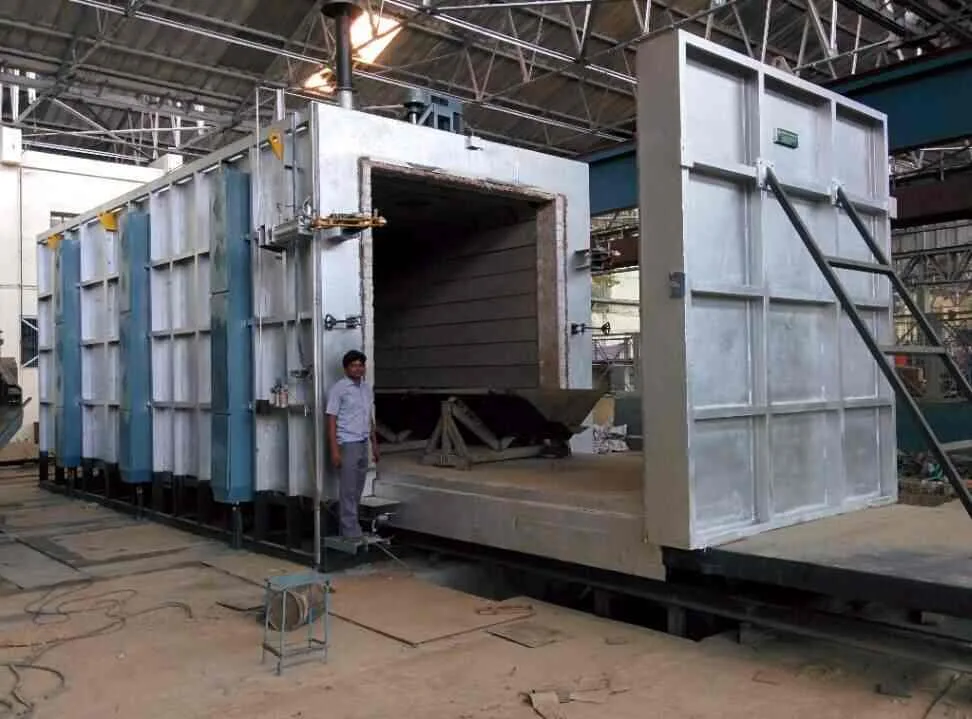
For large fabricated components, a Stress Relieving Heat Treatment furnace may need a spacious chamber and suitable loading arrangements. Bogie hearth and other batch furnace configurations can be considered depending on the component size and production process.
Temperature Control Is Important
Temperature control plays an important role in achieving consistent heat treatment results. Uneven heating can cause different areas of a component to experience different thermal conditions.
Industrial furnaces can use temperature sensors, programmable controllers, and monitoring systems to maintain the required process parameters.
The treatment cycle should always be developed according to the material specification and engineering requirements rather than relying on a single standard temperature for every application.
Conclusion
Stress relieving is an important thermal process for managing residual stresses created during welding, machining, forging, forming, casting, and other manufacturing operations.
By using controlled heating, soaking, and cooling, manufacturers can reduce internal stresses and support better dimensional stability in suitable components. Selecting an appropriately designed furnace and maintaining accurate process control are important for achieving repeatable results.
For a more detailed explanation of the process and its industrial applications, manufacturers can explore JR Furnace's guide to Stress Relieving Heat Treatment.