
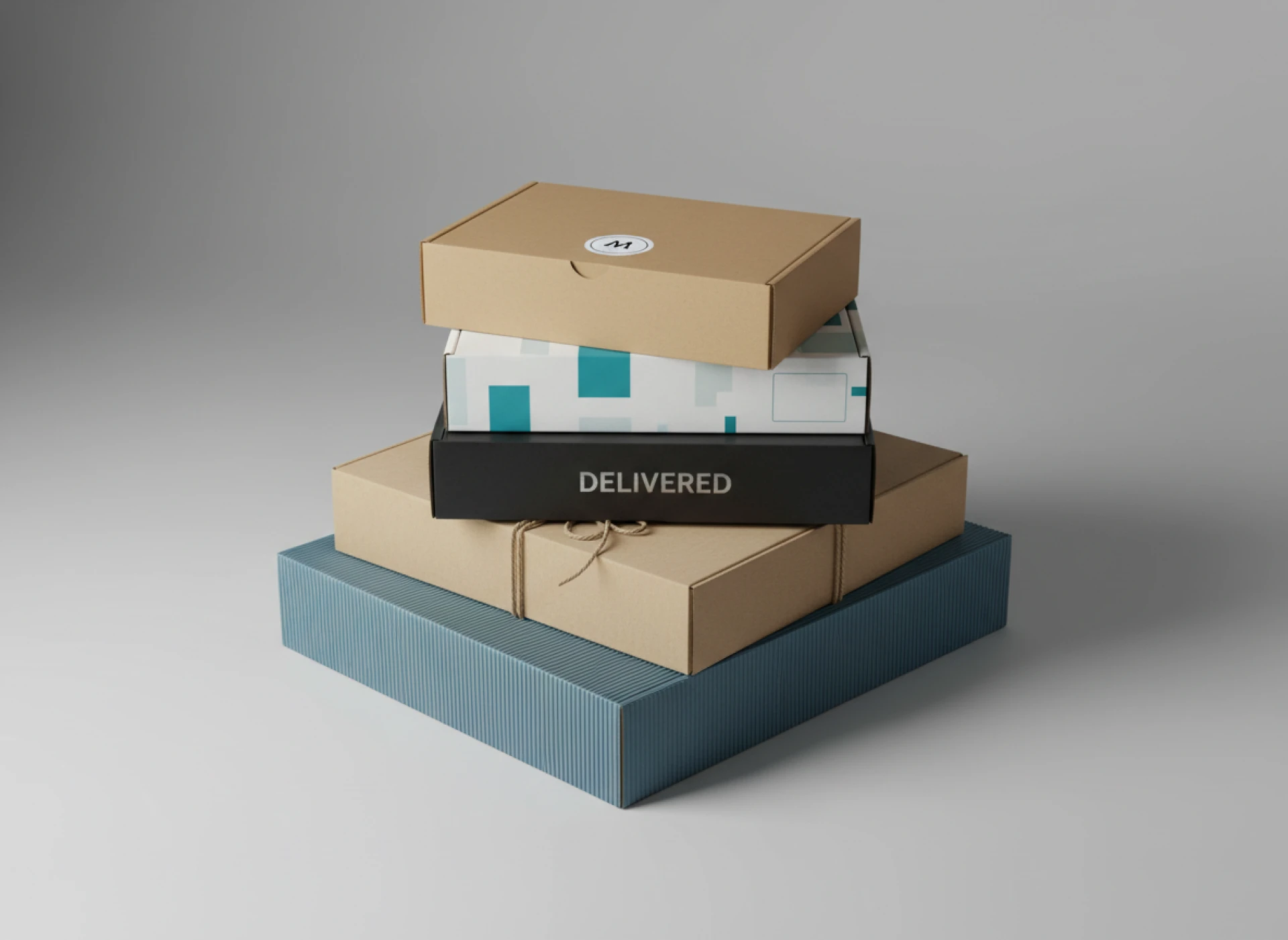
Mailer boxes are often chosen quickly. A size is selected, a material is approved, and the assumption is that once assembled, the box will simply do its job. From the outside, most mailer boxes look similar. They fold the same way. They close the same way. They feel rigid when empty.
Yet once they move into real use of mailer boxes, differences appear quickly.
Some mailer boxes maintain their structure through packing, shipping, and customer handling. Others begin to soften, bow, or lose alignment after surprisingly little use. Corners round off. Lids stop sitting flush. Panels start to flex.
These changes rarely happen all at once. They appear gradually, often unnoticed at first, until the box no longer feels reliable.
This article looks at why that happens — not from a catalogue or specification perspective, but from how mailer boxes behave once they enter real circulation.
Mailer Box Performance Isn’t Tested When Empty
One of the biggest misunderstandings around mailer packaging is when performance is evaluated.
Most decisions are made while the box is flat or newly assembled. At that stage, nearly every mailer box feels strong. Panels are crisp. Folds are sharp. Resistance feels consistent.
The problem is that mailer boxes are never used in that state.
They are filled, lifted, carried, stacked, opened, sometimes resealed, and often handled multiple times before reaching the customer. Structural behaviour only becomes visible once movement begins.
A mailer box that performs well in motion behaves very differently from one that only looks strong when stationary.
Structural Strength vs Practical Shape Retention
There is a difference between strength and shape retention.
Strength refers to how much pressure a box can tolerate at a single moment. Shape retention refers to how well it returns to form after repeated movement.
Many mailer boxes meet strength requirements but struggle with recovery. Once a panel bends or a fold softens, the box does not fully rebound. Over time, these small deformations accumulate.
This is why two boxes made from similar board grades can age in completely different ways.
Where Shape Loss Usually Begins
Mailer boxes rarely deform evenly. Shape loss almost always begins in predictable locations.
1. Hinge folds
The opening edge of a mailer box experiences the most stress. Each open-and-close action compresses fibres along the same fold line. If that hinge is too sharp or poorly supported, softening occurs quickly.
2. Front locking flaps
Self-locking closures rely on tension. As fibres relax, that tension weakens. The box still closes — but no longer sits square.
3. Corner intersections
Corners absorb torsion during lifting and carrying. When internal structure is minimal, corners begin to round instead of holding right angles.
These are not defects. They are predictable outcomes of repeated use.
Why Board Weight Alone Doesn’t Solve the Problem
A common reaction to shape loss is to increase board thickness.
Heavier board can help — but only to a point.
Thicker material resists compression, but it does not automatically improve fold durability. In some cases, heavy board actually accelerates cracking at fold lines if creasing is not properly calibrated.
Shape retention depends more on how forces travel through the box, not simply how dense the board feels.
This is why some lightweight mailer boxes outperform heavier ones in real use.
The Role of Flute Direction in Mailer Boxes
Corrugated mailer boxes rely on flute orientation more than most buyers realise.
When flutes run parallel to the main opening motion, they absorb repeated stress more effectively. When flutes run against hinge movement, fatigue appears faster.
This is rarely visible in product photos and often overlooked during specification.
Yet in daily handling, flute direction strongly influences whether panels stay aligned or gradually warp.
Why Die-Cut Design Matters More Than Graphics
Mailer boxes are usually die-cut rather than glued. This makes their geometry critical.
A well-designed die-cut spreads stress across multiple folds. A poorly designed one concentrates movement into a single hinge.
Over time, that concentration shows.
Boxes that retain shape typically include:
- secondary fold relief
- gradual fold angles rather than sharp creases
- structural overlap that reinforces movement zones
None of this is decorative. It is mechanical.
Good structure is usually invisible — until it’s missing.
How Repeated Handling Changes Box Behaviour

Mailer boxes experience more handling than shipping cartons.
They are assembled by packers, filled, lifted, sometimes reopened for checks, then opened again by customers. In returns scenarios, they may be reclosed.
Each interaction slightly alters fibre tension.
Boxes designed only for single-open use often deteriorate quickly when reality introduces repetition.
This is why shape retention should always be considered in terms of handling frequency, not just delivery distance.
Environmental Conditions Play a Larger Role Than Expected
Mailer boxes often pass through multiple environments within a short time.
A warm warehouse.
A cold delivery van.
A damp doorstep.
A heated interior.
These fluctuations affect paper fibres subtly but continuously.
Humidity relaxes structure. Dry heat stiffens it temporarily. Repeated cycling weakens recovery.
Boxes that hold shape well are those whose construction tolerates this fluctuation rather than resisting it.
This is especially relevant in the UK, where moisture exposure is moderate but persistent.
Kraft Mailer Boxes and Visual Tolerance
Kraft mailer boxes behave differently — not only structurally, but psychologically.
Surface scuffing and softening appear sooner on kraft, but they are perceived differently. Wear feels intentional rather than defective.
This does not mean kraft boxes retain shape better. It means shape change is noticed less harshly.
For brands prioritising authenticity or sustainability perception, this tolerance can be beneficial. For premium presentation, it may not.
Understanding this distinction helps businesses align material choice with expectation.
Common Structural Differences That Affect Shape Retention
Structural Feature
Effect on Shape Over Time
Practical Outcome
Reinforced hinge folds
Slower fibre fatigue
Lid alignment maintained
Multi-panel locking
Even stress distribution
Box remains square
Thin single-fold closures
Localised weakening
Front panel distortion
Balanced flute direction
Improved recovery
Consistent structure
Over-tight die cuts
Fibre cracking
Early softening
These factors rarely appear in product descriptions — but they determine how a box behaves after the first few uses.
Why Some Mailer Boxes Feel “Tired” Quickly
A mailer box that loses shape does not collapse. It simply feels tired.
The lid doesn’t sit flush.
Edges no longer align cleanly.
The box closes, but without confidence.
Customers may not articulate this — but they register it.
That subtle loss of precision affects perception more than visible damage.
This is why shape retention matters even when protection remains adequate.
Designing for Movement Instead of Appearance
Mailer packaging is often designed visually first.
Flat artwork mockups dominate approval stages. Structural testing is minimal. The box is judged by how it looks assembled on a table.
In real use, movement is constant.
Boxes that hold shape well are designed with movement in mind — lifting motion, hinge stress, torque at corners, and recovery after pressure.
This design approach prioritises behaviour over aesthetics.
Ironically, it often results in packaging that looks simpler — but performs far better.
Why Shape Retention Influences Reuse
Customers reuse boxes instinctively when they still feel functional.
A box that closes cleanly is kept.
A box that feels unstable is discarded.
Reuse extends brand presence far beyond delivery. It also affects return handling and secondary shipping.
Mailer boxes that retain shape therefore contribute to both sustainability outcomes and brand memory — quietly, without needing explanation.
Modern Packaging Trends Are Moving Toward Behaviour Testing
Packaging development is gradually shifting.
Instead of testing boxes only for compression strength, more businesses now test:
- repeated opening cycles
- corner deformation under lift
- recovery after stacking
- alignment after humidity exposure
This reflects a growing understanding that packaging does not exist in ideal conditions.
Shape retention is no longer accidental. It is increasingly designed for.
Choosing Mailer Boxes Based on Use, Not Assumption
The most reliable way to select mailer packaging is not by material category or board weight.
It is by answering a simple question:
How will this box actually be handled?
Single-use shipments behave differently from subscription deliveries. High-touch unboxing behaves differently from automated fulfilment. Returns-heavy operations stress packaging far more than one-way shipping.
When use defines design, shape retention improves naturally.
Final Perspective
Mailer boxes rarely lose their shape suddenly. They change gradually, through small interactions repeated many times.
Boxes that maintain structure do so because their design accepts real handling rather than expecting ideal treatment. They distribute stress, recover from movement, and age predictably.
Understanding this behaviour helps businesses choose packaging that remains reliable beyond first delivery — not just visually acceptable at dispatch.
This approach to mailer packaging specification is increasingly why companies working with experienced UK print and packaging providers such as I YOU PRINT focus less on box appearance alone and more on how packaging behaves once it enters real use.
Because in packaging, durability is rarely dramatic — it is simply consistent.