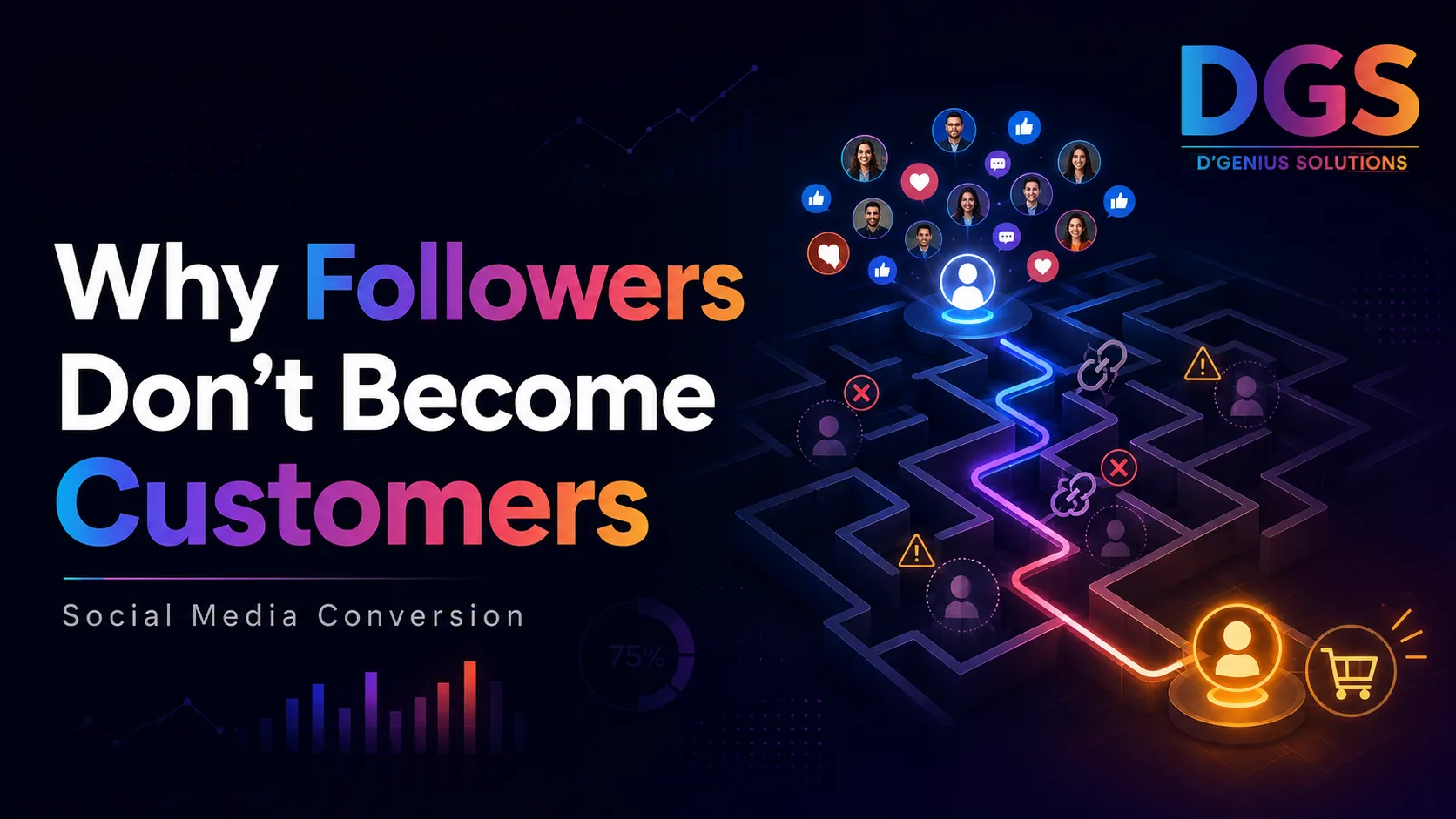
Building a strong following on social media feels like progress. More followers usually mean more people are seeing your posts, engaging with your brand, watching your videos, and becoming familiar with your business.
But many businesses eventually run into the same frustrating situation: follower numbers continue to rise while inquiries and sales barely move.
This happens because social media attention and customer intent are two very different things.
A person can enjoy your content without being ready to buy. Someone may follow your account because a reel was entertaining, because they found one post useful, or simply because they want to keep up with your brand. Turning that attention into revenue requires a much more structured customer journey.
The challenge, therefore, is not simply getting more followers. It is understanding what prevents those followers from taking the next step.
Followers Represent Attention, Not Guaranteed Sales
It is easy to look at a growing follower count and assume that sales should increase at the same rate.
In reality, follower count tells you how many people have chosen to stay connected with your social media account. It does not tell you how many have a genuine need for your product or service.
A business with 5,000 highly relevant followers may generate more qualified leads than another business with 100,000 followers attracted primarily through viral or entertainment-focused content.
This is why businesses need to think beyond vanity metrics.
The more important questions are whether the audience matches the ideal customer profile, whether followers visit the website, whether they interact with product or service-related posts, and whether those interactions eventually contribute to enquiries or purchases.
A detailed explanation of this gap is covered in D'Genius Solutions' guide on why social media followers are not becoming customers.
Your Content May Be Getting Attention From the Wrong Audience
High engagement can sometimes hide an audience-quality problem.
Imagine a company offering professional B2B services. Its humorous reels regularly receive thousands of views, but most of the people engaging with them are students, casual viewers, or users who are unlikely to purchase the service.
The content is succeeding as entertainment, but not necessarily as marketing.
A more effective approach is to create content that attracts people who could realistically become customers.
That does not mean every post needs to be promotional. Useful social content can still be educational, entertaining, topical, or inspiring. The difference is that the subjects should remain connected to the interests and problems of the audience the business wants to reach.
Businesses struggling with this balance can benefit from a more structured social media marketing strategy that connects content, audience targeting, engagement, and measurable business goals.
People May Like Your Content Without Understanding Your Offer
Another common issue is that a brand becomes memorable for its content but forgettable for its services.
A potential customer might follow a page for months and still struggle to explain what the business actually does.
This happens when almost every post is designed to increase engagement without communicating expertise, customer problems, solutions, results, or differentiators.
A healthy content strategy needs variety.
Awareness-focused content can attract new people. Educational content can demonstrate knowledge. Case studies can build confidence. Service-related content can explain how a business solves problems. Testimonials and customer stories can reduce uncertainty.
Thoughtful content creation helps connect what audiences enjoy consuming with what the business ultimately wants to be known for.
The goal is not to turn every social media post into an advertisement. It is to make sure the audience gradually understands why the brand is relevant.
Trust Is Often the Missing Link Between Engagement and Purchase
Most customers do not make a purchase the first time they discover a company online.
They research.
They visit the profile. They check the website. They look for reviews. They examine previous work. They compare alternatives.
This is particularly important for services where the customer is making a larger financial commitment.
Social media can play an important role in this trust-building process.
Case studies, team expertise, behind-the-scenes content, customer experiences, demonstrations, FAQs, and transparent explanations of processes can all make the business feel more credible.
Instead of repeatedly saying that your brand is experienced, show the audience what that experience looks like.
Trust reduces uncertainty, and reducing uncertainty makes conversion easier.
Your Website May Be Losing People After Social Media Sends Them There
Sometimes social media is doing its job perfectly.
The user sees the post, becomes interested, clicks the link, and visits the website.
Then the customer journey breaks.
Slow-loading pages, unclear messaging, confusing navigation, weak mobile experiences, complicated inquiry forms, and irrelevant landing pages can all reduce conversions.
The transition from a social post to a website should feel natural.
If an advertisement promotes one specific service, the user should ideally arrive on a page dedicated to that service rather than being forced to search through a generic homepage.
This is why conversion-focused website development matters when businesses want social media traffic to produce measurable results.
The website is not separate from the social media strategy. It is part of the same conversion journey.
Businesses Often Stop Marketing Too Early
A follower may not be ready to buy after one interaction.
They might see a reel today, visit the website next week, read another article later, and finally enquire after seeing a testimonial or promotional campaign.
That journey can take time.
Businesses that focus only on reaching new people may miss opportunities to reconnect with audiences who have already demonstrated interest.
This is where remarketing and paid campaigns become useful.
Someone who has already visited a service page or repeatedly interacted with the brand usually represents a warmer audience than someone seeing the company for the first time.
A structured performance marketing strategy can help businesses reconnect with these potential customers using relevant campaigns, audience targeting, conversion tracking, and different messages for different stages of the buying process.
The objective is not to repeatedly show the same advertisement.
It is to answer the next question a potential customer is likely to have.
Search Visibility Can Support the Social Media Customer Journey
The customer journey does not always remain on one platform.
A person may discover your brand on Instagram, search the company name on Google, visit the website, read an article, and then return to social media before making an enquiry.
Strong organic visibility can therefore reinforce the credibility created through social media.
Businesses that combine social activity with SEO services can create multiple opportunities for potential customers to discover useful information about the company throughout the research process.
This is especially valuable for customers who want more detailed information than a short reel, carousel, or social media caption can provide.
Measure What Happens After the Engagement
Likes and views still have value.
They help businesses understand which topics attract attention and what types of content audiences respond to.
But they should not be treated as the final measure of success.
Businesses should also monitor what happens after engagement.
Are people visiting the website? Are they reaching important service pages? Are they submitting enquiry forms? Are calls or WhatsApp conversations increasing? Are those leads relevant? Are they becoming customers?
These questions provide a much clearer understanding of social media performance than follower growth alone.
A successful social media strategy is ultimately about creating meaningful movement through the customer journey.
Final Thoughts
Having a large social media audience can be valuable, but audience size by itself does not create business growth.
Followers become customers when several elements work together: relevant audience targeting, useful content, clear positioning, strong trust signals, an effective website, appropriate calls to action, remarketing, and accurate conversion measurement.
Businesses should therefore stop asking only, "How can we get more followers?"
A better question is, "What is preventing the followers we already have from becoming customers?"
Finding that answer can reveal weaknesses that additional reach alone would never solve.
For a deeper breakdown of the problem and practical ways to improve the complete journey, read the full D'Genius Solutions guide: Social Media Conversion: Why Your Followers Are Not Becoming Customers.
When social media, content, performance marketing, search visibility, and the website work together, social channels can move beyond engagement metrics and become a genuine source of leads, customers, and long-term business growth.