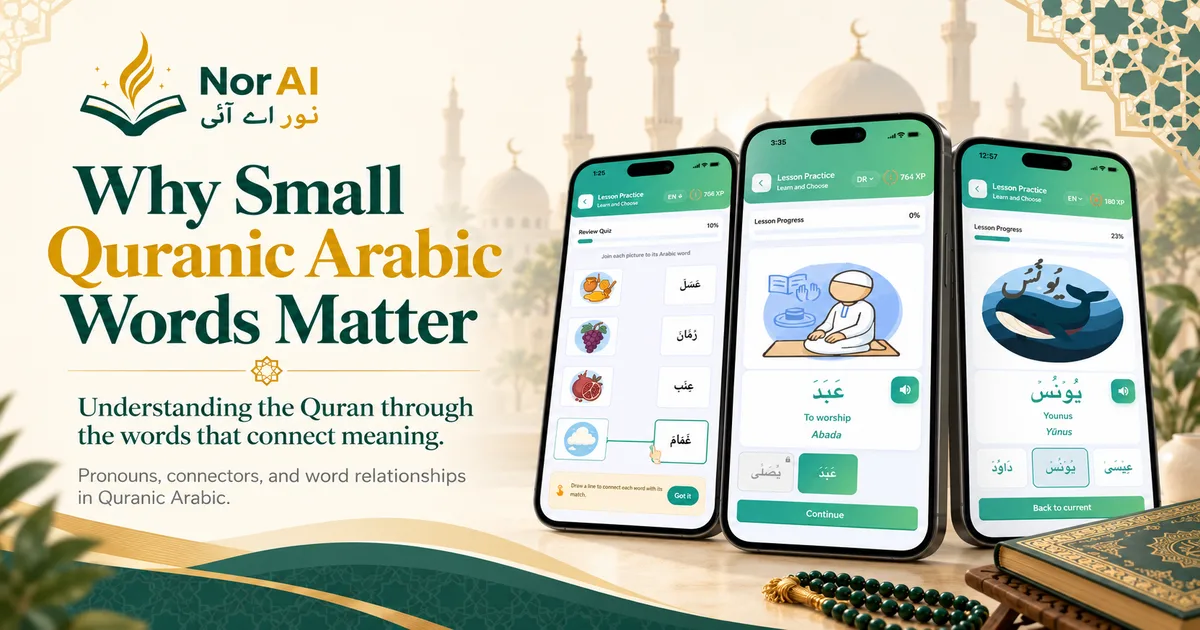
A learner may recognise several important words in a Quranic passage and still struggle to follow how those words fit together.
The missing information is not always another noun or verb. Sometimes a much smaller word is carrying an important part of the meaning.
Pronouns, reference words, particles and connectors can be easy to overlook during early Quranic Arabic study. They may contain fewer letters and seem less memorable than larger vocabulary words, yet they often help show how one part of a phrase relates to another.
Learning to notice these smaller words can therefore become an important stage in moving beyond isolated vocabulary.
Knowing More Vocabulary Does Not Always Solve the Problem
Vocabulary is usually one of the easiest parts of language learning to measure.
A learner studies a word, learns its meaning and adds it to a growing list of familiar Arabic terms. The number of recognised words increases, which gives a clear sense of progress.
The difficulty appears when those words are encountered together.
A learner may know several individual meanings but remain uncertain about who is being referred to, how one idea connects with another, or why two parts of a phrase belong together.
This is where understanding word function becomes useful.
The goal is not to introduce advanced grammar immediately. Beginners can first learn to notice that different types of words perform different jobs.
Pronouns Help Learners Follow References
Pronouns allow language to refer back to people or things without repeating the same noun every time.
This makes them small in size but significant in function.
A learner might recognise a noun clearly, then lose track of the next part because the same subject is being referred to through a pronoun or attached form.
Learning common Quranic Arabic pronouns can help reduce that confusion.
At this stage, learners do not need to analyse every grammatical detail. Simply noticing that a short word refers to someone or something already mentioned can improve awareness of how the language is working.
This changes vocabulary study from recognising isolated meanings to following relationships between words.
Connectors Help Show Relationships Between Ideas
Another important group includes words that connect parts of language.
A learner may recognise the main nouns and verbs in a passage but still miss how one statement continues from another.
Connecting words provide some of that structure.
They can show that information is being added, that one idea relates to another, or that a phrase depends on something that came before it.
The useful skill for a beginner is not memorising a complicated list of grammar terms. It is becoming aware that these small words deserve attention too.
A learner who notices connectors starts looking at the Arabic text differently.
Instead of treating every word as an independent vocabulary item, they begin seeing relationships.
Word Meaning and Word Function Are Not the Same Thing
A translation tells a learner what a word can mean.
It does not always explain what that word is doing in a particular piece of language.
That distinction becomes increasingly important as Quran Vocabulary grows.
For example, two learners may recognise the same important nouns and verbs. One may stop at those meanings. The other may also notice a pronoun referring back to a previous word or a connector linking two parts together.
Both have vocabulary knowledge, but the second learner is beginning to notice language structure as well.
This does not mean vocabulary practice has become tafseer.
Recognising how words relate within Arabic remains different from explaining the complete interpretation or religious implications of a verse. Those deeper questions belong with reliable tafseer and qualified scholarship.
Keeping this distinction clear allows language learning to remain useful without claiming more than it can provide.
Why Small Words Can Be Harder to Study
Concrete vocabulary is relatively easy to present.
A noun may have a clear meaning. Some suitable words can also be supported by an image. A verb can represent an action.
Small relational words are different.
Their usefulness often becomes clearer when they appear beside other words.
That makes them harder to learn through isolated vocabulary cards alone.
This is one reason structured progression matters in Quranic Arabic learning.
A learner can begin with foundations and recognisable vocabulary before gradually being introduced to words that show references and relationships. The learning task becomes more detailed only when there is enough existing vocabulary to make those details meaningful.
The Question Changes as Learning Progresses
Early vocabulary study often focuses on meaning.
The learner wants to know what a particular Arabic word means.
Later, another kind of question becomes useful.
The learner begins noticing what role a word is playing within the surrounding language.
They may start paying attention to which noun a pronoun refers to, which parts of a phrase are being connected, or how one word relates to another.
These are more precise language questions.
They also help learners identify the boundary between vocabulary recognition and deeper interpretation.
That boundary is important when the purpose is Understanding the Quran responsibly.
Why Structured Progression Can Help
Introducing every concept at once would make Quranic Arabic unnecessarily difficult for a beginner.
A better learning sequence gives each type of knowledge an appropriate place.
Basic reading foundations can come first. Familiar vocabulary can then become stronger. Pronouns, reference words, particles, connectors and verbs can be introduced as the learner becomes more comfortable with individual words.
Later practice can focus more on relationships between those words.
This type of progression is reflected in NorAI's curriculum. Its earlier learning stages focus on foundations and Quranic vocabulary, while later stages introduce pronouns, reference words, connectors and verbs before moving into more connected Quranic structures.
The important idea is progression rather than speed.
Learners are gradually asked to notice more information within the Arabic they are already studying.
Small Words Can Improve the Quality of Study
Vocabulary learning becomes more useful when learners begin noticing details rather than collecting definitions.
A learner who recognises a familiar noun has gained useful information.
A learner who also notices the pronoun referring to that noun has gained another layer of language awareness.
The same applies to connectors and other small words.
This can make Quranic Arabic study more precise because the learner is no longer looking only for obvious vocabulary.
Attention begins shifting toward relationships.
That is a meaningful development because languages communicate through connected words, not isolated definitions.
What Beginners Should Focus On
Beginners do not need to stop vocabulary study and move directly into advanced grammar.
A simpler approach is enough.
Continue learning important Quranic words, but start paying attention to the smaller words surrounding them.
Notice repeated pronouns.
Notice short words that appear between familiar vocabulary.
Pay attention when a word seems to refer back to something already mentioned.
Look for relationships rather than trying to memorise technical labels immediately.
As these details become more familiar, the Arabic text can begin to feel less like separate vocabulary items and more like connected language.
A Broader View of Quranic Vocabulary
Building Quran Vocabulary remains an important part of Quranic Arabic study, but vocabulary becomes more useful when learners understand that words have different roles.
Nouns identify people, things and ideas.
Verbs describe actions and states.
Pronouns help maintain references.
Connectors and particles help show relationships between parts of language.
Recognising these roles gives learners a clearer picture of how Quranic Arabic works without requiring them to claim complete interpretation of the text.
Sometimes the word that helps a learner make sense of a phrase is not the longest or most memorable word.
It may be one of the smallest.
That is exactly why those words deserve attention.