
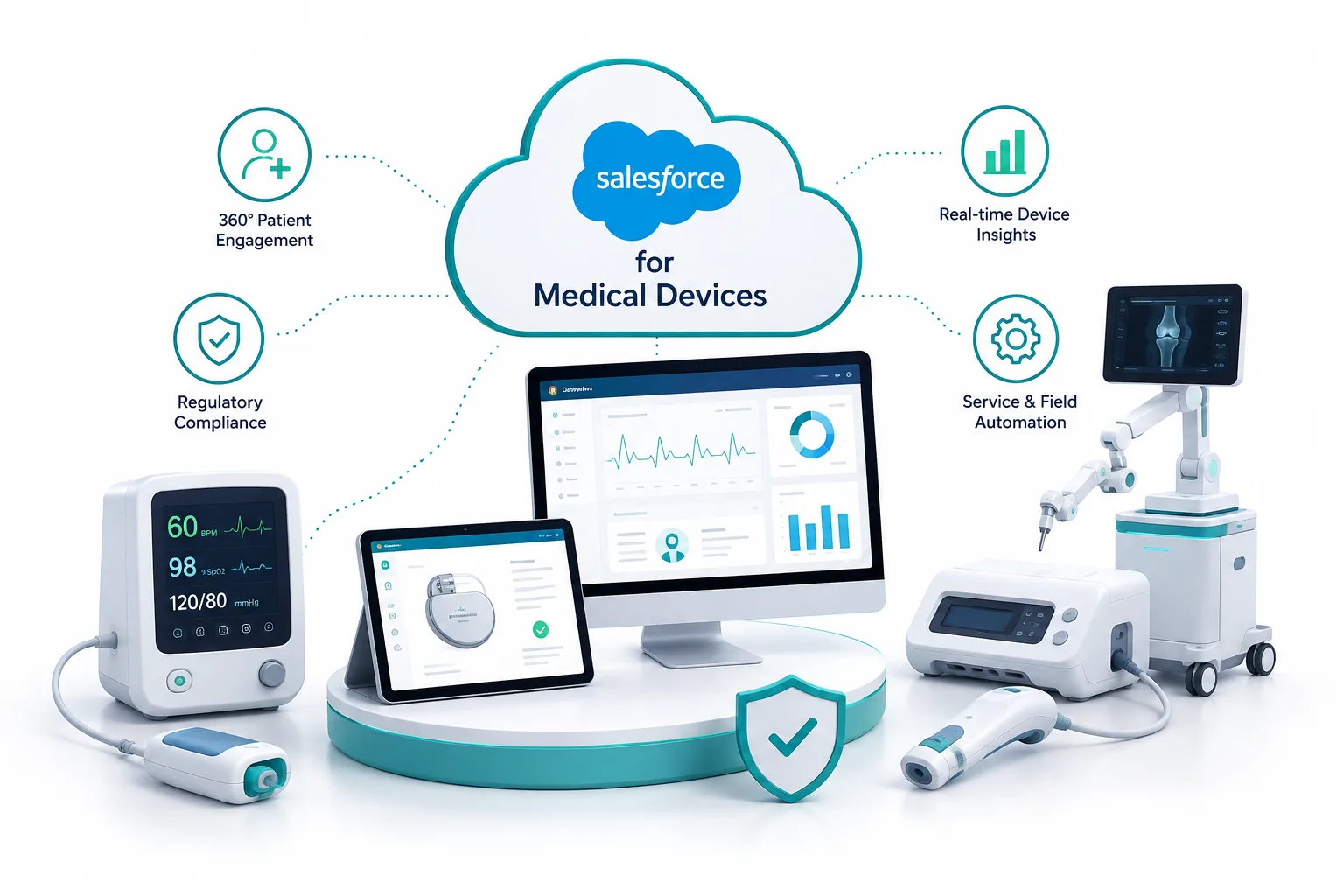
Medical device companies run on a lot of moving parts. Sales teams track long approval cycles, marketing has to prove ROI, clinical teams need trial data on hand, and support teams are expected to handle patient questions without missing a beat. When those functions run on separate systems, work gets duplicated, decisions slow down, and things fall through the cracks. That's the problem Salesforce for Medical Devices was built to fix.
The idea is simple: put clinical, commercial, and service data on one platform instead of scattering it across five. A sales rep shouldn't have to check one system for account history, another for compliance paperwork, and a third for open support tickets. When everything sits in one place, leadership can respond to market shifts, physician needs, and regulatory changes without waiting on someone to pull a report together.
SP Tech, a Salesforce Summit Partner, has worked with healthcare and MedTech organizations for years, with hundreds of clients across regulated industries. That matters because a generic Salesforce rollout won't hold up in this space. Distributor management, patient onboarding, clinical workflows, each one needs to reflect how a medical device company actually works, not a template built for retail.
The Business Case
Three problems come up again and again in MedTech: clinical trial data spread across platforms, no clear way to measure marketing ROI, and R&D reporting that's still mostly manual. Salesforce for Medical Devices tackles all three by connecting ERP systems, clinical platforms, and marketing tools into one ecosystem, usually through MuleSoft. That connection is what removes the quarterly scramble to reconcile numbers by hand.
Analytics is where the value really shows up. Dashboards link marketing spend directly to physician engagement and revenue, so executives can see what's working instead of guessing. Sales teams managing long, multi-stakeholder deals get the same benefit in reverse: better visibility into pipeline health means better forecasting and clearer priorities.
How SP Tech Handles Implementation
SP Tech starts with a business and data assessment, looking at existing workflows before any configuration begins. From there, the team builds out Salesforce for clinical, sales, marketing, and service processes specifically, connects third-party systems through MuleSoft, and trains internal teams so the system doesn't sit unused after launch. It's a structured process, not a quick technical setup.
Built to Last
Salesforce for Medical Devices isn't a one-time fix for a data problem. It's meant to hold up as product lines grow, as companies enter new markets, and as compliance requirements shift. Companies that work with an experienced partner like SP Tech tend to see faster adoption and fewer fixes after go-live, and the platform keeps paying off long after the initial rollout. For MedTech leaders weighing their CRM options, the real question isn't whether to invest in Salesforce. It's whether they've picked a partner who can implement it correctly.