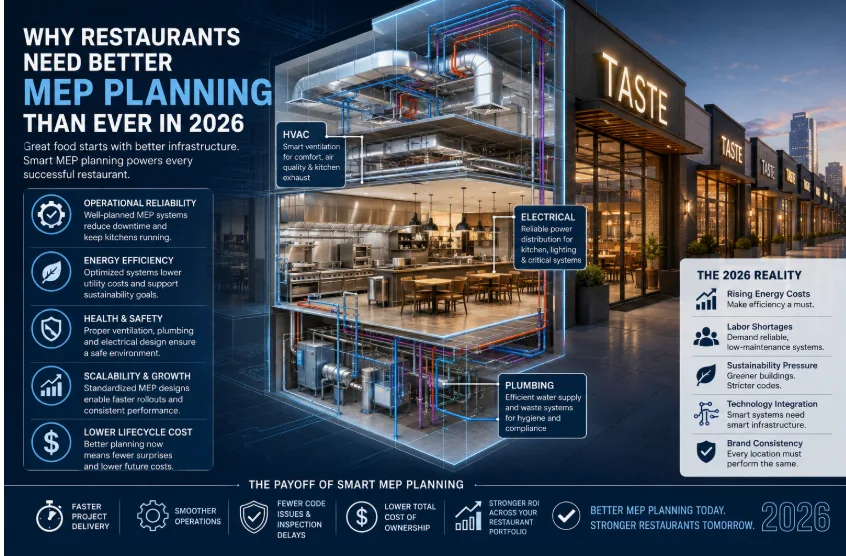
To operate a modern restaurant today goes beyond offering food, services, and location. The secret behind any prosperous restaurant is a sophisticated system of various components — HVAC system, electrical equipment, plumbing system, ventilation, and any other systems involved. Although many restaurant owners do not realize it, MEP engineering starts playing an increasingly significant role in restaurants of all types.
Today proper MEP engineering and planning become critical for operational efficiency, productivity of restaurants, and customer satisfaction regardless of the delivery or service option provided by a restaurant. Starting from 2026 food industry facilities will face stricter regulations, higher energy consumption, requirements for faster construction, and an increased level of electrification.
What Is MEP Engineering in Restaurant Design?
MEP stands for the designing and coordinating of:
● Mechanical system,
● Electric system,
● Plumbing system.
These systems create the backbone of each restaurant. In a restaurant, MEP systems affect:
● the working of the kitchen,
● the quality of comfort,
● the safety of food,
● the lighting,
● the efficiency of devices,
● and the preparedness for an emergency.
Proper MEP planning ensures that all the systems work harmoniously instead of making the fight with one another.
Why Restaurants Are Becoming More Demanding on Building Systems
The amount of equipment and tech used in modern restaurants has changed significantly over the past decade. In the present-day restaurant place, one can find:
● modern kitchen devices,
● online ordering systems,
● digital menu signs,
● advanced refrigeration systems,
● EV charging infrastructure,
● energy-saving HVAC systems,
● and automated operation.
At the same time, many chain restaurants grow at the fastest pace. This concerns especially the largest fast-food restaurant chains in the US, where scalability and uniformity became the most important operational goals.
The growth brings additional pressure on MEP systems, which must guarantee:
● high performance,
● reliable power supply,
● proper ventilation,
● compliance with regulations,
● and proper service for customers.
Why Better Electrical Design Services Matter in Restaurants
Restaurants require a lot from their electrical systems. In commercial kitchens, many power-hungry appliances are in use at once, such as:
● ovens,
● fryers,
● refrigeration units,
● HVAC machinery,
● lighting systems,
● and POS equipment.
If proper Electrical Design Services are not used, restaurants may experience:
● overloaded circuits,
● inconsistent operation of equipment,
● energy inefficiencies,
● and interruptions in operations.
Many restaurant operators do not realize how much coordination goes on behind the scenes to ensure that daily operations run smoothly. That is also why electrical problems in Restaurant environments are becoming more common as kitchens become more power-intensive and dependent on electricity.
Understanding Electrical Riser Diagrams in Restaurant Projects
With the complexity of restaurant construction projects rising, the need for electrical coordination is growing. In essence, an electrical riser diagram is a visual representation of how electrical power travels through a building. Thus, it can be considered a simple map for the electrical distribution process.
When it comes to restaurants, electrical riser diagrams serve to conduct:
● power distribution,
● appliance load coordination,
● aiding problem-solving,
● and construction coordination.
The necessity of this becomes even more apparent in cases of multi-tenant projects, franchise launching, food halls, and mixed-use properties. If anything is ignored in this regard, then unnecessary electrical conflicts arise, which could lead to missed deadlines and construction cost increase.
Why Voltage Drop Formula Calculations Matter More in Modern Restaurants
Today’s kitchens rely on electric energy. With the increase in loads, engineers need to factor in voltage drop.
Voltage drop is calculated according to the simple formula V = I X R which allows engineers to determine if an electrical system can carry out effective and safe electricity.
If voltage drop is not controlled, it can lead to:
● malfunction of devices,
● overheating,
● non-uniformity of light and short lifespans of equipment.
This is particularly crucial in:
● big restaurants,
● drive-thrus,
● various section kitchens,
● and restaurants with a high density of equipment.
Proper MEP planning will avoid issues which could emerge during operation.
Why HVAC Consulting Is Now a Major Restaurant Priority
HVAC systems have a direct impact on customer experience and kitchen functionality. Lack of ventilation or uneven airflow may:
- influence user experience in terms of comfort when dining.
- influence indoor air quality.
- impact employee productivity.
- cause problems with heat management in kitchens.
New-age HVAC consulting is aimed at balancing:
- airflow
- energy-efficiency
- comfort of people in the area
- performance of the operations.
In restaurants, HVAC consulting becomes even more critical due to the continuous generation of heat, grease, smoke, and humid air in kitchens. An ineffective HVAC system may incur higher operational costs and create inconvenience during dining for customers.
Why MEP Engineer Coordination Matters for Growing QSR Brands
The rate of development of restaurant brands intensifies the role of standardization. In growing fast-food chains, all operations must:
● stay consistent in kitchen work,
● provide uniform customer service,
● be predictable in functioning, and
● effectively save energy.
In this situation, the skillful MEP engineer becomes not only a necessity for construction.
Proper MEP coordination helps businesses:
● cut costs of alteration,
● simplify building process,
● ensure scalability, and
● make their outlets open faster.
As the restaurant industry develops in 2026, those who are willing to invest in intelligent planning will be in a strategic advantage.
The Future of Restaurant Infrastructure Is More Connected
Infrastructure development in the restaurant business has come on quite a bit because of:
● the use of electricity,
● energy regulations,
● use of smart equipment,
● and sustainability goals.
Many states are trying to use cleaner and more energy-efficient systems in commercial buildings. This can be one of the reasons why California is speeding up its electrification strategies in commercial spaces.
All restaurants that anticipate these changes will be in a better position for:
● the adaptability to long-term changes,
● the operational resilience,
● the adoption of energy-efficient technologies,
● and the ability to comply with future requirements.
Conclusion
The reality is that in order to be successful, restaurant operators must do much more than just prepare delicious food with effective marketing.
In order for any restaurant to function effectively, a network of HVAC, electrical, plumbing, and fire protection systems must be properly coordinated. As restaurants become more technologically advanced and more complicated in their operations, good MEP planning is no longer an option but a necessity.
For those involved in restaurants, investing in MEP engineering coordination early will bring results such as:
● less shock to the operating process,
● better customer service,
● improved scalability,
● and better long-term performance.