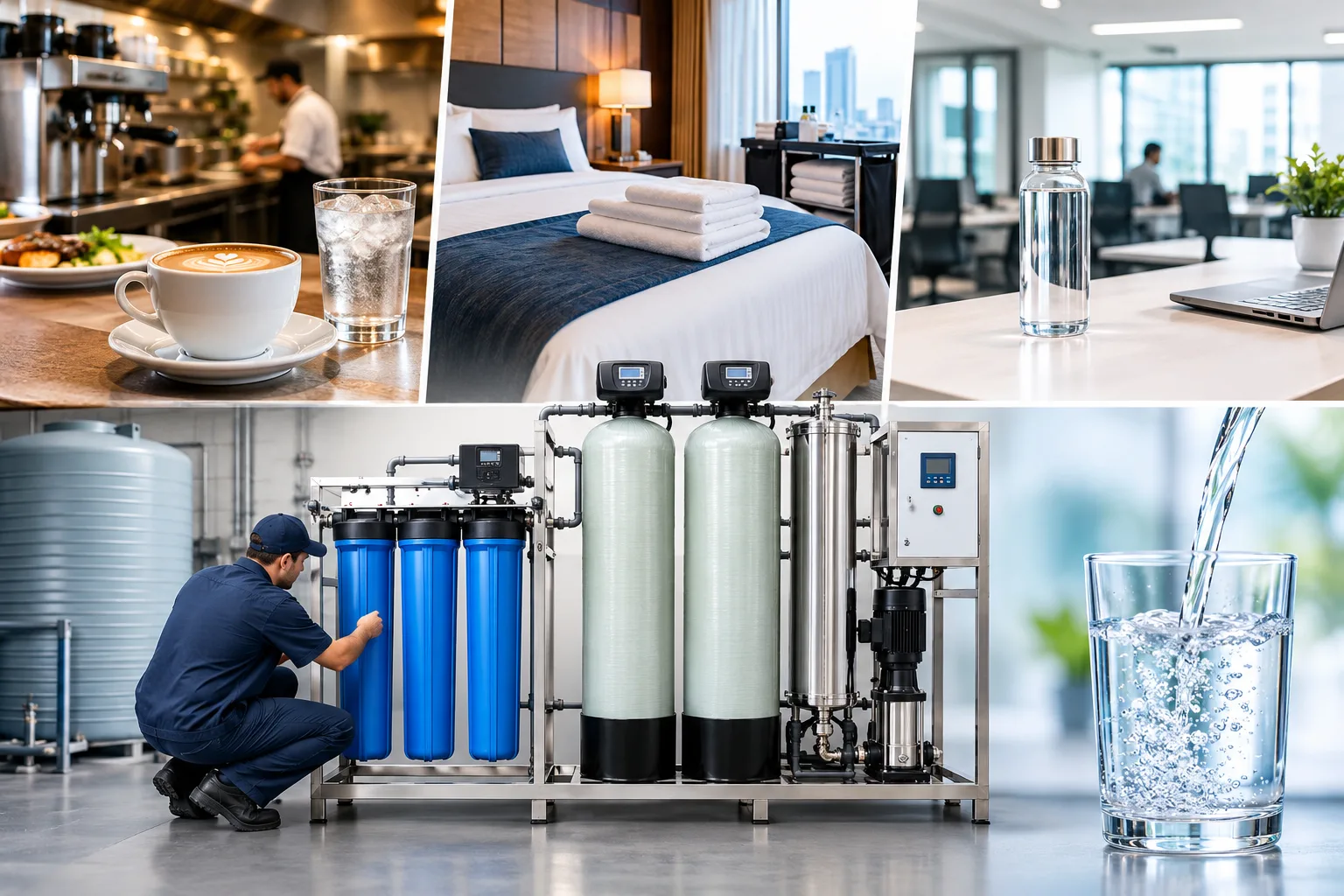
Ask a restaurant owner what their most-used ingredient is, and you'll hear flour, oil or salt. The real an commercial water filters swer is water. It's in the coffee, the ice, the soup stock, the steam oven and the dish machine. It runs through nearly every expensive piece of equipment in the building.
For years, most businesses treated water as a utility: it came out of the tap and nobody thought about it until something broke. That's changing. Restaurants, hotels and offices are putting real money into water treatment, and the reasons have less to do with health scares than with repair bills, energy costs and what customers notice.
Restaurants: customers taste the water
A cup of brewed coffee is almost entirely water, and so is a fountain drink. If the water tastes of chlorine, so does everything made with it.
Coffee is where this gets precise. The Specialty Coffee Association publishes a water standard for brewing: water free of chlorine and odor, with total dissolved solids between 75 and 250 parts per million and calcium hardness between 50 and 175. Water outside that range makes coffee taste flat or harsh. It also damages the machine, because the same minerals that upset flavor build up in the boiler.
The standard doesn't ask for pure water. It asks for water with the right minerals in it. A café on very soft water and a café on very hard water need different treatment to land in the same range, which is why a filter that works for one business can be wrong for the one next door.
Ice matters as much as coffee. It ends up in the glass, so it has to be made from safe drinking water, and cloudy or off-tasting ice is one of the first things a customer notices.
Hotels: guests, laundry and liability
Hotels use water on a different scale. Every occupied room means showers, towels and sheets. Hard water is rough on all of it. It leaves spots on glass and fixtures, makes linens stiff and gray over time, and forces the laundry to use more detergent. Research funded by the Water Quality Research Foundation found that softened water let testers cut laundry detergent by about half and wash in cooler water with the same or better results.
Then there's the risk nobody puts in the brochure. Legionella bacteria grow in building water systems, particularly in warm, stagnant water. The CDC lists cooling towers, hot tubs and decorative fountains among the devices that need attention, and hotels tend to have all three. CDC investigators found that 9 in 10 Legionnaires' disease outbreaks were caused by problems that better water management could have prevented.
Filtration alone doesn't control Legionella. That takes a water management program covering temperature, disinfectant levels and flushing. But scale and sediment give bacteria places to shelter, so cleaner water makes the rest of the program easier to run.
Offices: a small upgrade people use every day
Offices have simpler needs, and often the quickest payback. The traditional setup is bottled water: a delivery contract, heavy jugs, a storage closet full of spares and a stack of empties. A filtered system plumbed into the building supply replaces all of it with one filter change every few months.
There's a second reason. Office buildings can sit half-empty over weekends and holidays, and water that stands in pipes picks up taste from the plumbing. Staff notice. A filter at the point where people fill their bottles and make coffee fixes the part of the water system employees actually interact with, without touching the rest of the building.
What a system usually includes
Unlike the single cartridge under a home sink, commercial water filters are usually a series of stages, each handling one job:
- Sediment filtration catches sand, rust and grit before they reach valves and equipment.
- Carbon filtration removes chlorine, along with the tastes and odors that come with it.
- Water softening removes the hardness minerals that cause scale. Commercial softeners are sized for much higher flow than home units.
- Iron and sulfur filtration matters for businesses on well water, where staining and rotten-egg odor are common.
- Reverse osmosis strips out most dissolved solids for uses that need very pure water, like steam equipment, spot-free rinsing and some coffee programs.
Few businesses need every stage. Commercial water treatment systems are built to order, in the sense that the right combination depends on what's in the water and what the water is used for.
How to size it properly
The most common mistake is buying on price or tank size. A commercial water filter system that can't keep up with peak demand lets untreated water through at exactly the moment the kitchen is busiest. Work through these steps in order:
- Test the source water. Get hardness, iron, pH, chlorine and total dissolved solids from a lab. City water customers can start with the utility's annual report.
- List what the water feeds. A dish machine, an ice maker and an espresso machine each have a water specification from the manufacturer. Some warranties depend on meeting it.
- Measure peak flow, not average use. Size for the busiest hour, when everything runs at once.
- Check pressure, drain access and floor space. Softeners and backwashing filters need a drain and room for tanks.
- Plan the maintenance. Know who changes filters, how often, and what it costs per year. An unmaintained filter is worse than none.
The bottom line
Businesses aren't buying water treatment because it's fashionable. They're buying it because scale shortens the life of equipment that costs thousands to replace, because energy isn't getting cheaper, and because customers can taste the difference in a cup of coffee. The businesses that get the most from it start with a water test and a list of equipment, and let those two things decide what goes on the wall.