
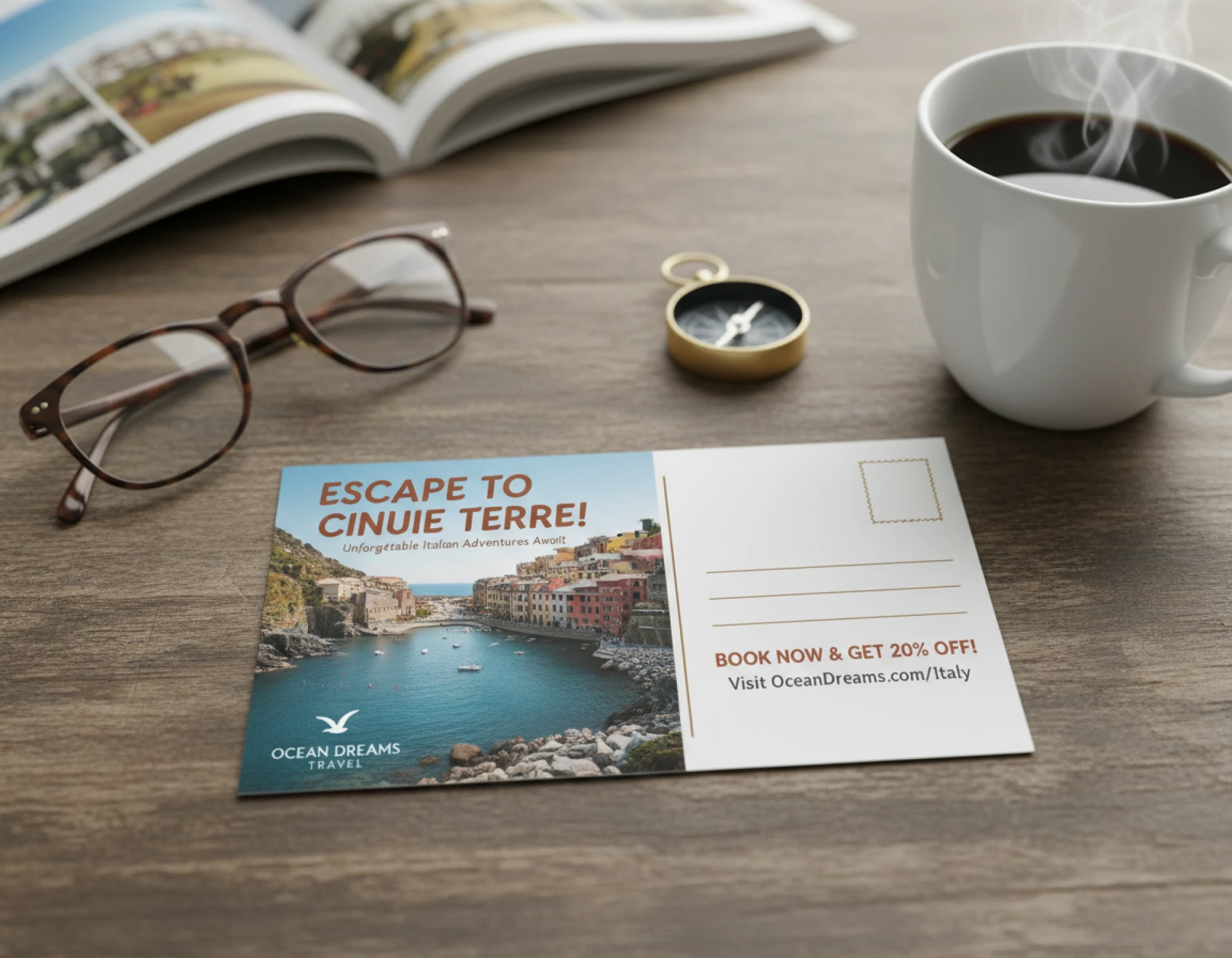
If you look at modern marketing in the UK, everything feels digital-first now.
Ads are on Instagram, TikTok, Google. Email funnels run in the background. Retargeting follows users everywhere. Even small local businesses are thinking in clicks, impressions, and conversions.
So printed postcards… they feel almost too simple for this world.
And yet, they’re still here.
Not just surviving — in many cases, quietly outperforming expectations.
That sounds like a contradiction until you look at how people actually behave, not how marketing dashboards suggest they behave.
Because online attention is everywhere, but attention itself is thinner than ever.
And postcards operate in a completely different space.
Not online. Not competing. Just existing in the real world where decisions still get made.
Digital marketing didn’t replace postcards — it changed their role
A common mistake is thinking print and digital are in competition.
They’re not.
Digital channels are where people discover things.
Postcards are often where people remember them.
That distinction matters more than it sounds.
Someone might scroll past an ad in half a second and forget it instantly. But if the same message shows up later in their physical space — on a table, in their hand, near their daily routine — it hits differently.
Not louder. Just more real.
That “realness” is what gives postcards their staying power in an online-heavy world.
People don’t trust screens the way they used to
This is something marketers don’t always admit openly.
Users are more skeptical now.
Not because they’re irrational — but because they’ve learned how digital systems work.
They know ads are targeted. They know content is boosted. They know emails are automated. They know every click is tracked.
So even when a message is good, there’s a small mental barrier:
“Is this just another ad?”
Printed postcards don’t trigger that same reaction as strongly.
They feel slower, more intentional. Like someone actually decided to send something rather than just “target” you.
That small psychological gap changes how the message is received.
Attention online is fast — offline attention is sticky
Online attention is more like scanning than reading.
You see something, decide instantly, and move on.
Postcards behave differently.
Even when someone doesn’t plan to read them, they often still pick them up, turn them over, leave them lying around.
That physical interaction matters more than people think.
Because once something is physically present in your environment, it keeps re-entering your attention without effort.
You don’t “re-target” it — it just stays there.
UK marketing behaviour makes postcards more relevant than expected
The UK is actually a strong environment for postcard printing, especially in hybrid campaigns.
There are a few reasons for that:
- Direct mail infrastructure is still reliable
- Local service businesses depend heavily on trust-based marketing
- Urban areas allow efficient distribution
- Consumers are used to receiving physical communication from brands
- Offline-to-online purchase journeys are still very common
So even in a digital-heavy market, the path to conversion often isn’t fully digital.
It starts online… but it finishes offline.
And postcards sit right in that transition point.
Postcards work best when they don’t try to behave like ads
One of the biggest mistakes brands make is treating postcards like miniature billboards.
They try to squeeze too much in:
- too many messages
- too many offers
- too many design elements
- too many calls-to-action
But postcards don’t have the space — or the attention window — for that kind of load.
What actually works is almost the opposite approach.
One idea. One message. One action.
Everything else just supports it quietly in the background.
When postcards are simple, they’re not weaker. They’re just easier to process.
And ease is what creates response.
There’s a physical psychology that digital marketing can’t replicate
This part is often overlooked.
A postcard isn’t just seen — it’s handled.
That changes how the brain evaluates it.
Weight, texture, finish, even how stiff or soft it feels… all of that quietly influences perception.
People don’t consciously think:
“This feels high quality, so I trust it more.”
But the brain does register it at a lower level.
That’s why two postcards with identical messaging can perform completely differently depending on print quality.
One feels disposable. The other feels deliberate.
And deliberate things get taken more seriously.
Postcards don’t fight for attention — they interrupt reality
Digital ads live inside a feed. Everything is competing.
Postcards don’t have that problem.
They arrive in a real-world environment where nothing is competing in the same format.
A desk. A kitchen counter. A pile of mail. A notice board.
It’s not about “standing out in a feed.”
It’s about breaking routine for a second.
That interruption is often enough to create awareness — and sometimes, action.
Why postcards are still strong in conversion-driven campaigns
Postcards are not about mass hype.
They’re about timing.
They work best when:
- someone already saw the brand online
- interest exists but hasn’t converted
- reminders are needed in a non-intrusive way
- trust needs reinforcement before purchase
In those moments, postcards don’t replace digital marketing.
They complete it.
They act like the second nudge — the one that happens after the initial interest fades slightly but hasn’t disappeared.
The quiet advantage: postcards don’t disappear
One thing digital campaigns can’t really compete with is persistence.
An ad disappears when you scroll.
An email gets buried.
A notification is gone in seconds.
But a postcard stays.
It sits there. Sometimes for days. Sometimes longer.
That continued presence creates repeated exposure without extra cost or effort.
And repetition, even subtle repetition, builds familiarity.
Familiarity builds trust.
And trust drives decisions more than most metrics suggest.
Where postcard printing fits in a modern UK strategy
Postcards don’t replace digital marketing.
That would be the wrong way to look at it.
Instead, they support it in places where digital alone struggles:
- when attention is overloaded
- when trust needs reinforcement
- when decisions are delayed
- when brands need physical presence
- when campaigns rely on memory, not just clicks
In that sense, postcards aren’t “old marketing.”
They’re stabilising marketing.
They hold attention in the physical world while digital systems handle discovery.
Final thought: postcards survive because human behaviour hasn’t changed as much as marketing has
Marketing keeps evolving.
Platforms change. Algorithms shift. Formats come and go.
But human behaviour is slower to change.
People still notice physical things.
They still trust what they can hold.
They still remember what stays in their environment.
That’s why printed postcards haven’t disappeared in an online-first UK market.
Not because they’re competing with digital.
But because they operate in a part of attention that digital can’t fully reach.
At I YOU PRINT, this is usually treated less like “print marketing” and more like real-world attention placement — where the goal isn’t to interrupt scrolling, but to exist where decisions actually happen.