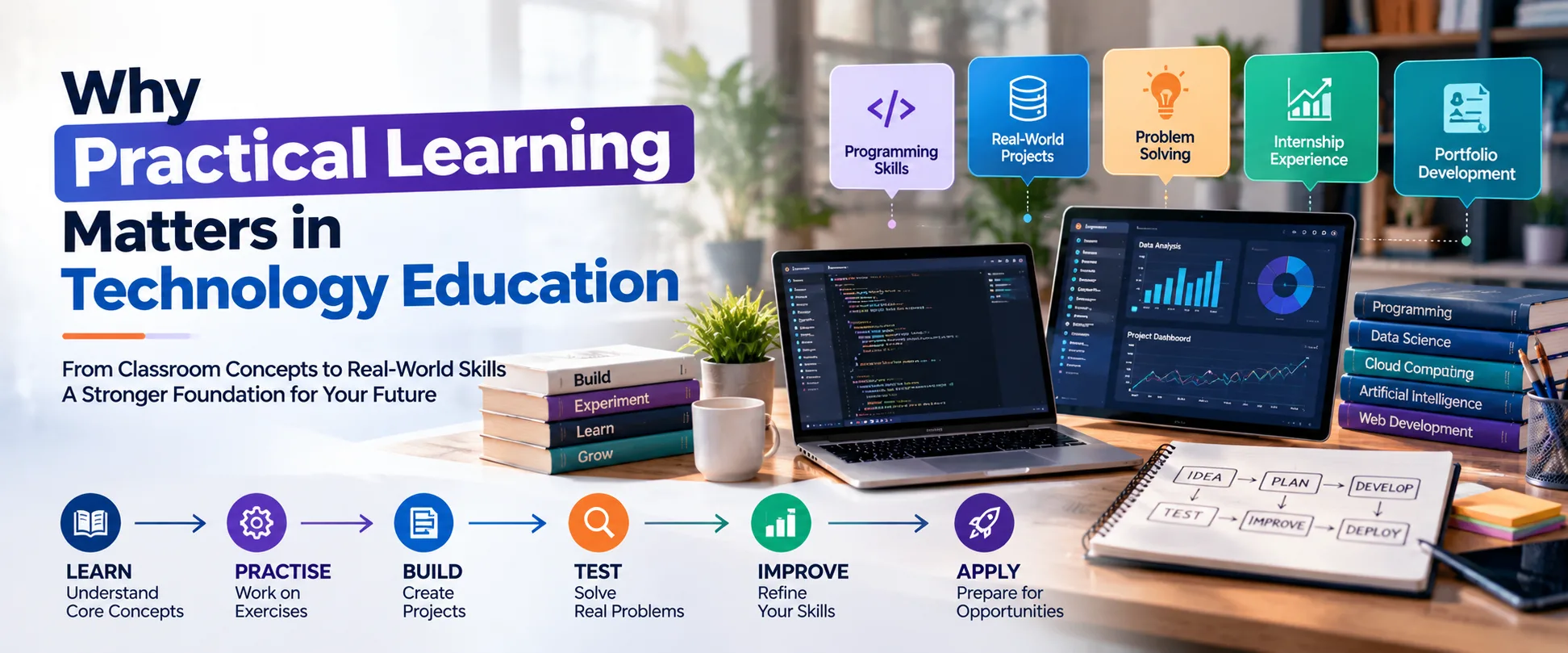
Technology education is not only about understanding concepts from textbooks. Students also need opportunities to apply what they learn through projects, programming exercises, laboratory work, problem-solving activities, and real-world applications.
Whether a student is interested in computer science, artificial intelligence, data science, cloud computing, software development, or another technology field, practical learning can help connect academic knowledge with real applications.
What Is Practical Learning?
Practical learning means applying concepts instead of only studying them theoretically.
For a technology student, this can include:
- Writing and testing code
- Building software applications
- Working with databases
- Analysing datasets
- Creating websites
- Developing cloud-based projects
- Testing applications
- Working with development tools
- Solving technology-related problems
The goal is not simply to complete an assignment. Students should understand how the technology works and why it is being used.
Why Is Practical Learning Important?
Technology is a skill-based field. Students can understand a programming concept theoretically, but regular practice helps them become more comfortable using it.
For example, reading about databases can explain how data is stored and retrieved. Building a small database application allows students to experience queries, data relationships, errors, and application integration.
This type of experience can make classroom concepts easier to understand.
Practical Learning Helps Students Understand Concepts
Some technology topics can be difficult to understand through theory alone.
Programming, algorithms, databases, networking, artificial intelligence, and cloud computing all involve concepts that become clearer when students apply them.
A student learning programming, for example, may understand loops and functions from a textbook. Building a small application gives them an opportunity to use those concepts together.
The same principle applies to other areas of technology.
Projects Turn Learning Into Experience
Projects are one of the simplest ways for students to gain practical experience.
A project can start with a basic problem and gradually become more advanced.
Examples include:
- Student management systems
- Personal portfolio websites
- Expense tracking applications
- Data dashboards
- Attendance analysis systems
- Recommendation systems
- Simple AI applications
- Cloud-based applications
Students interested in AI and Data Science can explore BCA AI and Data Science project ideas for examples of project areas they can consider.
Students interested in Cloud Computing can also explore BCA Cloud Computing final-year project ideas.
Practical Learning Builds Problem-Solving Skills
Technology work often involves solving problems that do not have an immediate answer.
A program may produce an unexpected result. A database query may not work correctly. A website may have a technical issue. A project may require a different approach than originally planned.
Working through these problems helps students develop logical thinking and troubleshooting skills.
These skills are useful across many technology fields.
Students Can Build a Technical Portfolio
Practical projects can also become part of a student's portfolio.
A portfolio can include:
- Academic projects
- Personal projects
- GitHub repositories
- Websites
- Applications
- Data analysis projects
- AI experiments
- Technical presentations
- Internship work
Students do not need dozens of projects. A few well-developed projects that they understand clearly can be more useful than a large collection of copied work.
Practical Skills Can Support Internship Preparation
Internships can be easier to approach when students already have some practical experience.
Students can use their projects to demonstrate what they have learned and discuss how they solved specific problems.
For example, a student applying for a software development internship could show a web application they built. A Data Science student could explain a data analysis project. A Cloud Computing student could discuss a deployment project.
Practical work gives students examples they can discuss during interviews.
Choosing the Right Technology Learning Path
Students should first understand their interests before choosing a technology specialization.
Someone interested in programming and software may explore computer science or IT. A student interested in data can explore Data Science. Those interested in intelligent systems can consider Artificial Intelligence and Machine Learning, while students interested in infrastructure can explore Cloud Computing.
Students who are still comparing options can explore different technology courses after 12th.
They can also review broader IT and computer courses to understand the range of available learning paths.
Practical Learning Does Not Replace Fundamentals
Practical learning is important, but students should not ignore theoretical foundations.
A strong technology education combines both.
Students need to understand concepts such as:
- Programming fundamentals
- Algorithms
- Data structures
- Databases
- Computer networks
- Operating systems
- Software development principles
Once the foundation is clear, practical work can help students apply it.
How Students Can Start Practical Learning
Students do not need expensive equipment or complicated projects to begin.
A simple approach is:
Step 1: Learn one fundamental concept.
Step 2: Practise it with small exercises.
Step 3: Build a small project.
Step 4: Identify and fix problems.
Step 5: Document what was learned.
Step 6: Gradually increase project complexity.
This approach can be followed throughout a degree.
The Role of Educational Institutions
Educational institutions can support practical learning by providing laboratories, project-based assignments, technical workshops, industry interaction, internships, and opportunities for students to experiment.
A strong learning environment should encourage students to ask questions and apply concepts rather than focusing only on examinations.
Students exploring technology education can also review the MH Cognition learning programs to explore different technology-focused study areas.
Final Thoughts
Practical learning can make technology education more meaningful by allowing students to apply what they learn.
Programming exercises, projects, laboratory activities, internships, and personal experiments can help students develop technical confidence and problem-solving abilities.
The best approach is to combine strong fundamentals with consistent practical work.
Students do not need to become experts immediately. Learning one concept, applying it to a small problem, and gradually building more advanced projects can create a strong foundation for continued technology learning.