A Digital Marketing Course can help beginners understand how businesses find customers online and turn people's interest into meaningful enquiries or sales. Think about the last time you searched for a product, watched a brand's video or visited a website after seeing an advertisement. Each of these experiences involved some form of digital marketing, even if you did not notice it at the time.
For businesses, being online is only the first step. They also need to make their products easy to discover, share information that people find useful and give potential customers a reason to trust them. This is why digital marketing involves more than uploading social media posts or paying for advertisements. It requires planning, creativity and an understanding of how people behave online.
What Does Digital Marketing Actually Involve?
Imagine a small business that sells handmade jewellery. The owner has attractive products and a website, but very few people visit the site. Simply uploading more products may not solve the problem. The business needs to understand how potential customers search for jewellery, which platforms they use and what information helps them make a purchase.
The owner might improve the website's search visibility, share product videos on Instagram and publish a guide about choosing jewellery for different occasions. Customers who have shown an interest could receive occasional email updates about new collections.
This is how different digital marketing channels work together. The goal is not to use every available platform but to choose the ones that make sense for the business and its audience.
Why SEO Is an Important Digital Marketing Skill
Search engine optimisation, or SEO, helps websites become more visible in relevant search results. When someone searches for a service or asks a question on Google, they are usually looking for a particular answer or solution. Businesses that understand this behaviour can create pages that respond to those needs.
SEO begins with research. Marketers investigate the phrases people use, examine what information they expect to find and plan content around those requirements. They also work on page titles, headings, internal links, website speed and other factors that affect the experience of visitors and search engines.
For example, a training provider might publish an article answering common questions about learning a new professional skill. If the article provides useful information and is properly optimised, it may attract visitors who are already interested in that subject.
SEO does not deliver guaranteed rankings overnight. Results depend on factors such as competition, content quality, website health and the needs of searchers. Learning how to research keywords, improve pages and monitor results gives marketers a practical way to work towards better organic visibility.
Social Media Marketing Is More Than Regular Posting
Many businesses create social media accounts because their competitors are already using them. However, posting every day without a clear purpose can consume time without producing useful results.
A better approach is to understand what the audience wants to see. A technology training company, for instance, might share short videos explaining industry concepts, carousel posts containing beginner-friendly tips and images announcing upcoming learning opportunities.
There is another part of social media marketing that is easy to overlook: conversations. Replying to comments, answering genuine questions and paying attention to feedback can help a business understand what its audience cares about.
Likes and views can provide useful signals, but they do not tell the whole story. Depending on the goal, marketers may also need to measure profile visits, website clicks, enquiries or registrations.
Understanding Paid Advertising and PPC
Sometimes a business needs to reach a specific audience within a limited period. Paid advertising can help, but spending money on ads does not automatically mean the campaign will succeed.
Pay-per-click advertising, commonly called PPC, allows advertisers to pay when someone clicks on an advertisement. Google Ads is one platform businesses can use to reach people searching for particular products or services.
Before launching a campaign, marketers need to decide what they want to achieve. Is the aim to generate enquiries, sell a product, encourage registrations or introduce a new service? That decision affects the choice of keywords, advertising message, landing page and budget.
Marketers therefore examine costs, clicks, conversions and other relevant measurements to understand campaign performance. Careful monitoring helps them identify where changes may be needed instead of continuing to spend money without a clear reason.
Content and Email Marketing Help Build Trust
People do not always make a decision the first time they come across a business. They may want to compare options, understand a service or find answers to questions before taking the next step.
Content marketing helps businesses provide that information through articles, guides, videos, case studies and other useful resources. Rather than constantly asking people to buy something, good content gives them a reason to spend time with the brand.
For example, a company offering website services could publish a guide explaining common website mistakes and how to avoid them. Readers receive practical information while learning about the problems the company can help solve.
Email marketing can continue that conversation with people who have agreed to receive communications. Businesses may share useful updates, newsletters or information about relevant services. Emails should be relevant to the recipient, respect privacy requirements and provide a straightforward way to unsubscribe.
Both approaches work best when the information is genuinely useful. Readers are more likely to value content that answers their questions than material that repeats promotional claims.
Why Analytics and Conversion Optimisation Matter
A marketing campaign can look successful at first glance but still fail to achieve its main objective. A website may attract hundreds of visitors, for example, yet receive very few enquiries. Without checking the data, it can be difficult to understand what is happening.
Analytics helps marketers examine where visitors come from, which pages they view and what actions they take. Tools Google Analytics and Google Search Console provide different insights into website activity and search performance.
Suppose visitors regularly open a service page but rarely complete the enquiry form. A marketer could review whether the form is too long, the instructions are unclear or important information is missing. Testing a simpler version may help reveal whether the changes improve results.
This process is known as conversion rate optimisation. It involves identifying possible obstacles and making informed improvements to encourage visitors to complete a desired action.
The important thing is to avoid making decisions based only on assumptions. Data does not answer every question, but it can show where further investigation is worthwhile.
How Practical Training Helps Beginners
Learning digital marketing from articles and videos is a useful way to understand the basics. However, the real challenges often appear when you try to apply what you have learned.
You might find that a keyword you selected attracts the wrong audience, a social media post receives little engagement or an advertising campaign spends its budget without generating enquiries. These situations help explain why marketers need to review their work and adjust their approach.
A Digital Marketing Course can provide a structured way to explore these areas, particularly for people who are new to the field. Practical assignments, campaign exercises and project work can help learners connect concepts with the tasks they may encounter in a working environment.
When comparing courses, look beyond the title. Check which topics are covered, whether learners get opportunities to practise, how the teaching is delivered and what support is available. The right programme should help you understand not only how to use marketing tools but also why particular decisions are made.
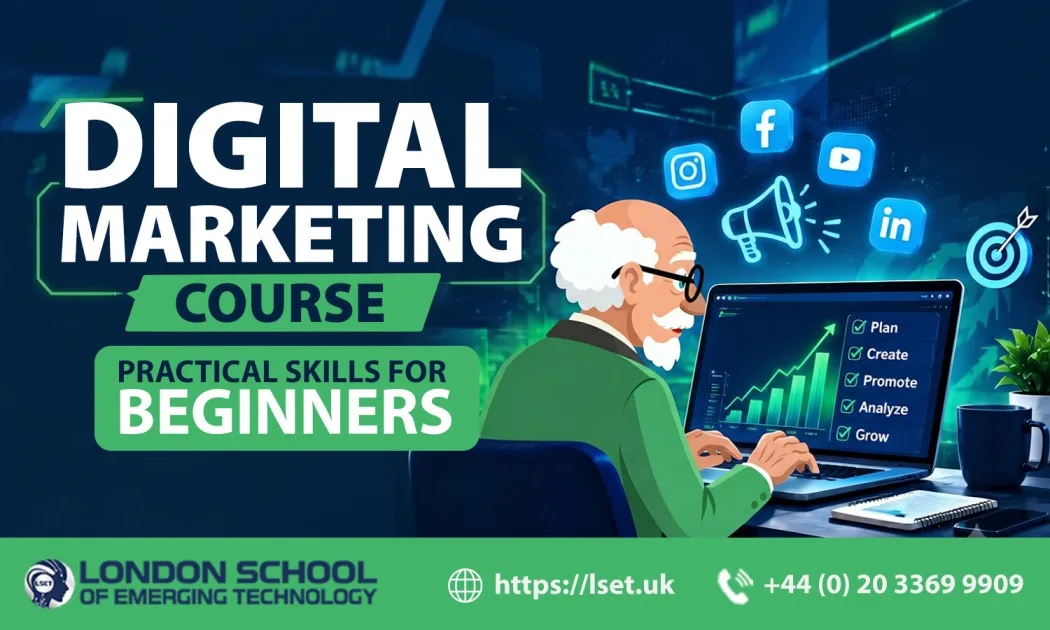
The London School of Emerging Technology (LSET) offers digital marketing training covering subjects such as SEO, social media marketing, PPC, content marketing, email marketing, analytics and conversion optimisation. People interested in the programme can review the official course page to understand its curriculum and practical learning approach before deciding whether it matches their goals.
Conclusion
Digital marketing brings together several activities that help businesses reach people, share useful information and understand customer behaviour. SEO helps improve discoverability, social media creates opportunities for communication, paid advertising supports targeted promotion, and analytics helps businesses evaluate their efforts.
For someone entering the field, trying to learn every tool at once can feel overwhelming. It is more useful to start with the fundamentals, practise one skill at a time and gradually understand how the different channels support each other.
A Digital Marketing Course can be a starting point for developing that knowledge and gaining practical experience. What matters most is the ability to understand a problem, choose an appropriate strategy, measure the outcome and learn from the results. These habits are useful not only when starting a career in digital marketing but also when helping a business improve its online presence.