Mobile payments refer to financial transactions completed through a smartphone, smartwatch, or tablet—without using cash or a physical card. Customers can pay by tapping, scanning, or clicking, making mobile payments one of the fastest-growing payment methods in the U.S.
Common examples include:
- NFC Tap-to-Pay
- QR Code Payments
- Digital Wallets (Apple Pay, Google Pay, Samsung Pay)
- Text-to-Pay / Pay-by-Link / PayNow links
- In-App Payments
- Mobile POS terminals
Mobile payment services are no longer optional. Customers expect businesses to offer fast, contactless, and secure ways to pay.
Why Mobile Payments Matter for Businesses in 2026
Mobile payments have evolved from a convenience into a competitive advantage. In 2026, American shoppers increasingly prefer mobile-first checkouts.
Businesses benefit through:
✔ Faster checkout times
✔ Higher customer satisfaction
✔ Acceptance of multiple payment methods
✔ Lower operational friction
✔ Better fraud protection
✔ Seamless omnichannel experiences
Whether you operate retail, food service, services, healthcare, or events—mobile payments help you close more sales, faster.
How Mobile Payments Work
While mobile payments feel instant, a secure process happens behind the scenes:
1. Payment Initiation
The customer taps, scans, or clicks a mobile payment option.
2. Authentication
Face ID, fingerprint, PIN, or device passcode confirms identity.
3. Tokenization
Actual card numbers are replaced with encrypted tokens.
4. Authorization
The issuing bank authorizes the transaction.
5. Settlement
Funds move to the merchant’s account.
This multilayered process makes mobile payments among the safest payment methods available in 2026.
Types of Mobile Payments (2026 Overview)
⭐ 1. NFC Tap-to-Pay
Uses Near Field Communication (NFC) technology.
Best For:
Retail, cafes, restaurants, salons, transportation
Works With:
Smartphones, smartwatches, contactless cards
Examples:
- Apple Pay
- Google Pay
- Samsung Pay
⭐ 2. QR Code Payments
Customers scan a QR code to open a payment page.
Best For:
Events, takeout restaurants, markets, service providers
Convenient when NFC is unavailable or unnecessary.
⭐ 3. Mobile Wallet Payments
Digital wallets store encrypted payment information.
Popular Wallets:
- Apple Pay
- Google Pay
- PayPal
- Venmo
These provide fast checkout—especially for mobile-first customers.
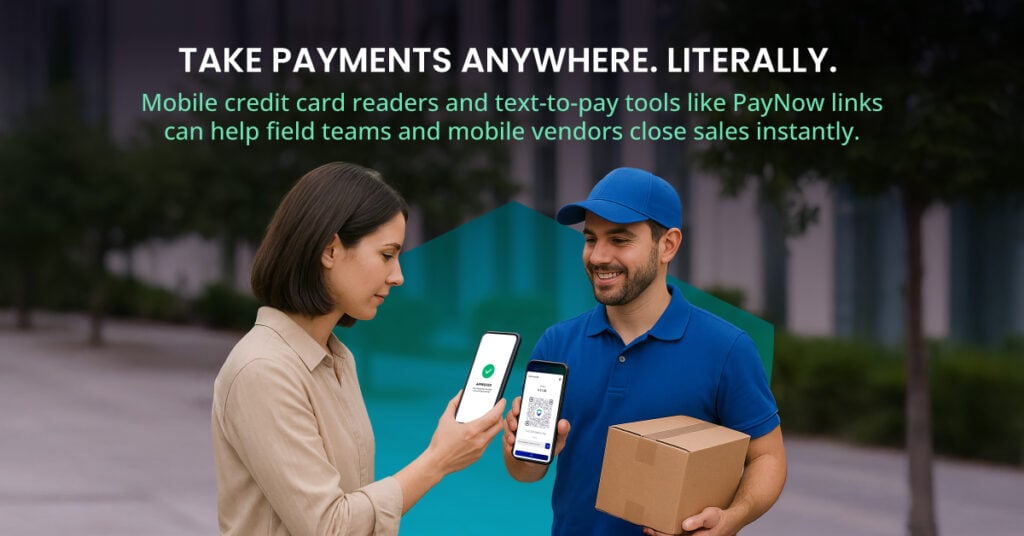
⭐ 4. Pay-By-Link / Text-to-Pay /PayNow Links
The merchant sends a payment link via:
- SMS
- Social media DMs
Customers complete the payment through their phone browser.
⭐ 5. Virtual Terminals
Merchants enter customer card information manually in a secure browser-based terminal.
Ideal for phone orders, remote billing, and service-based businesses.
Best Mobile Payment Systems in the U.S. (2026)
A great mobile payment system should offer:
✔ NFC + QR + Wallet payments
✔ Text-to-Pay
✔ Inventory & reporting
✔ PCI compliance
✔ Flexible integrations
✔ Mobile POS hardware
Top Mobile Payment Systems in 2026:
- Valor PayTech – Best all-in-one mobile & POS solution
- Square – Ideal for retail & mobile vendors
- Stripe Terminal – Strong for developers & omnichannel brands
- PayPal Zettle – Simple mobile POS for small merchants
Valor PayTech leads for businesses that want unified online + in-person + mobile solutions.
Best Mobile Payment Apps for Small Businesses (2026)
Small businesses need apps that provide:
- Easy onboarding
- Simple invoicing
- Real-time reporting
- Integrated customer profiles
- Low fees
- Mobile POS compatibility
Top Choices:
⭐ Valor PayTech App – Flexible NFC + QR + Pay-by-Link + virtual terminal
⭐ Square POS App – User-friendly, great for vendors
⭐ PayPal Zettle App – Ideal for occasional sellers
⭐ Stripe Dashboard App – Great for online-first brands
For the most complete solution, Valor PayTech provides both mobile checkout and deep reporting for business growth.
Read more