Manufacturing orders rarely get delayed because of one problem alone. In many factories, missed delivery deadlines are the result of several operational challenges happening at the same time. Raw materials arrive late, production schedules change unexpectedly, machines experience downtime, inventory records become inaccurate, and departments struggle to coordinate their activities.
For manufacturers, these problems can affect much more than delivery timelines. They can increase operating costs, reduce production capacity, affect customer relationships, and put pressure on profit margins.
The challenge becomes even greater when businesses depend on spreadsheets, disconnected software, manual reporting, or outdated systems to manage daily operations.
This is where Manufacturing ERP software can make a meaningful difference. By connecting production planning, inventory, procurement, quality management, maintenance, and financial information, an ERP system helps manufacturers gain better control over their operations.
In this guide, we explore seven common reasons manufacturing orders get delayed, how these problems affect business performance, and how the right ERP solution can help manufacturers improve production efficiency and delivery reliability.
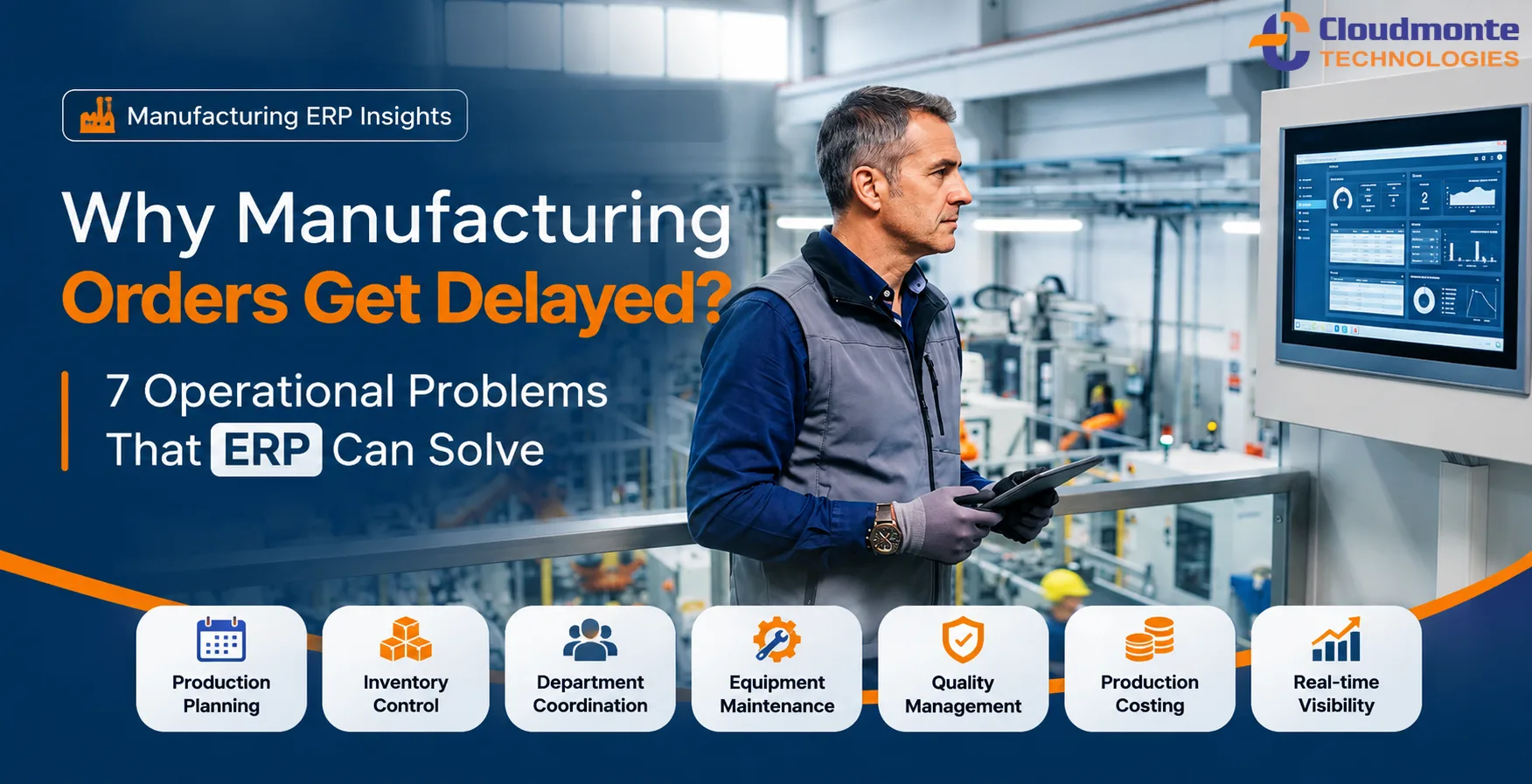
Quick Answer: Why Do Manufacturing Orders Get Delayed?
Manufacturing orders commonly get delayed because of:
- Poor production planning and scheduling.
- Raw material shortages and inaccurate inventory records.
- Disconnected departments and manual data entry.
- Unexpected machine breakdowns and maintenance issues.
- Quality defects, rework, and production waste.
- Inaccurate production costing and resource planning.
- Limited real-time visibility into manufacturing operations.
An integrated manufacturing ERP system helps address these challenges by connecting business processes, improving information flow, and giving decision-makers better visibility into production activities.
1. Poor Production Planning and Scheduling
One of the biggest challenges in manufacturing is planning production according to actual business requirements.
Manufacturers must consider customer orders, available materials, machine capacity, workforce availability, production priorities, and delivery commitments. When these factors are managed separately, production schedules can quickly become inaccurate.
For example, a factory may accept several customer orders without checking whether the required machines, materials, and production capacity are available. As a result, production teams may struggle to complete orders within the promised timelines.
How it affects manufacturing operations
- Production schedules frequently change.
- Machines and workers are not utilised efficiently.
- Urgent orders interrupt existing production plans.
- Delivery commitments become difficult to maintain.
- Production managers spend more time coordinating activities.
How ERP helps
Manufacturing ERP software provides tools for production planning, scheduling, work orders, and resource management.
Depending on the ERP system and configuration, manufacturers can:
- Plan production based on customer demand.
- Monitor work orders and production progress.
- Coordinate resources and machine capacity.
- Track planned versus actual production.
- Identify potential scheduling conflicts earlier.
With better production visibility, managers can make more informed decisions and coordinate manufacturing activities more effectively.
2. Raw Material Shortages and Inaccurate Inventory Records
A production line cannot operate efficiently without the materials required to manufacture products.
However, many manufacturers struggle to maintain accurate inventory records. Materials may be available physically but missing from system records. In other situations, inventory records may show sufficient stock even when materials are unavailable or already allocated to other production orders.
This creates uncertainty for procurement and production teams.
For example, if a manufacturer needs 500 units of a component to complete an order but the actual available quantity is only 320, production may stop until the remaining materials arrive.
How it affects manufacturing operations
- Production orders remain incomplete.
- Procurement teams place emergency purchase orders.
- Excess inventory increases storage costs.
- Working capital gets blocked in unnecessary stock.
- Delivery schedules become unpredictable.
How ERP helps
An integrated ERP system connects inventory management, procurement, and production planning.
Manufacturers can use it to:
- Monitor stock levels across warehouses.
- Track material movements and consumption.
- Set minimum stock and replenishment rules.
- Manage purchase orders and supplier information.
- Check material availability before production begins.
- Improve coordination between procurement and production teams.
Better inventory visibility helps manufacturers make purchasing decisions based on actual requirements rather than assumptions.
3. Disconnected Departments and Manual Data Entry
In many manufacturing companies, different departments use separate tools to manage their activities.
The sales team maintains customer orders in one system, procurement manages suppliers in another, inventory records are maintained in spreadsheets, and finance uses separate accounting software.
The problem is not necessarily that these systems are ineffective individually. The problem is that information does not always move smoothly between them.
For example, when a customer changes an order quantity, the production, procurement, inventory, and finance teams may not receive the updated information at the same time.
How it affects manufacturing operations
- Teams work with outdated information.
- Employees repeatedly enter the same data.
- Communication gaps create operational confusion.
- Order changes are not reflected across departments.
- Managers struggle to get a complete business overview.
How ERP helps
An integrated ERP platform brings important business processes together within a connected system.
It can connect:
- Sales and customer orders.
- Purchase and supplier management.
- Inventory and warehouse operations.
- Production planning and execution.
- Finance and accounting.
- Reporting and business analytics.
When information is shared across connected business functions, teams can work with more consistent data and reduce unnecessary manual coordination.
4. Unexpected Machine Breakdowns and Maintenance Issues
Manufacturing equipment plays a critical role in meeting production targets.
When a machine breaks down unexpectedly, the impact can extend beyond the equipment itself. Production schedules may change, pending orders may be delayed, and employees may need to reorganise their work.
The problem becomes more serious when maintenance is performed only after equipment fails.
Without proper maintenance records and planning, manufacturers may find it difficult to identify recurring equipment issues or coordinate maintenance activities with production schedules.
How it affects manufacturing operations
- Unplanned production interruptions.
- Increased maintenance and repair expenses.
- Missed production targets.
- Underutilisation of available resources.
- Delays in customer order fulfilment.
How ERP helps
Depending on the selected modules and system configuration, ERP solutions can support maintenance management through:
- Equipment and asset records.
- Preventive maintenance schedules.
- Maintenance work orders.
- Breakdown and repair history.
- Maintenance activity tracking.
- Coordination between maintenance and production teams.
Some manufacturing environments also integrate equipment and IoT data to support more advanced monitoring and predictive maintenance strategies.
The objective is to move towards better maintenance planning rather than depending entirely on emergency repairs.
5. Quality Issues, Defects, and Production Rework
Producing the required quantity is not enough. Manufacturers must also ensure that products meet defined quality standards.
Quality problems can occur because of incorrect raw materials, inconsistent production processes, machine calibration issues, human errors, or insufficient inspection procedures.
When defects are identified late in the production process, manufacturers may need to rework products, replace materials, or restart production activities.
This can affect both manufacturing costs and delivery commitments.
How it affects manufacturing operations
- Increased material wastage.
- Higher rework and inspection costs.
- Delayed customer orders.
- Product rejections and returns.
- Difficulty identifying recurring quality problems.
How ERP helps
Manufacturing ERP systems can support quality management through configurable quality checks, inspection records, material traceability, and production tracking.
Businesses can:
- Define quality inspection requirements.
- Record inspection results.
- Track rejected and approved materials.
- Maintain quality-related records.
- Identify recurring production issues.
- Improve coordination between quality and production teams.
For industries with strict traceability requirements, the appropriate ERP configuration can also help connect material batches, production activities, and finished products.
6. Inaccurate Production Costing and Resource Planning
A manufacturing business may complete orders on time and still experience profitability problems.
Why? Because the actual cost of manufacturing a product may be higher than expected.
Production costs involve several elements, including raw materials, labour, machine operations, overhead expenses, packaging, and other manufacturing-related costs.
When these costs are tracked separately or updated manually, managers may struggle to understand the actual cost of individual products or production orders.
How it affects manufacturing operations
- Incorrect product pricing decisions.
- Unexpected increases in manufacturing expenses.
- Difficulty identifying cost overruns.
- Poor resource allocation.
- Limited understanding of product profitability.
How ERP helps
ERP systems can help manufacturers connect production activities with material consumption, operational costs, and financial records.
Depending on the solution, businesses can:
- Maintain bills of materials (BOMs).
- Track material consumption.
- Monitor planned and actual production costs.
- Record labour and operational expenses.
- Analyse manufacturing cost variances.
- Improve financial reporting.
Better cost visibility allows management to investigate where expenses are increasing and make more informed operational decisions.
7. Lack of Real-Time Visibility into Manufacturing Operations
Manufacturing managers need accurate information to make timely decisions.
They need to know which orders are pending, which production activities are in progress, whether materials are available, how much stock is held, and whether delivery commitments are at risk.
When this information is spread across spreadsheets, emails, and disconnected systems, getting a reliable operational overview becomes difficult.
Managers may only discover a problem after a delivery deadline has already been missed.
How it affects manufacturing operations
- Delayed management decisions.
- Limited production performance visibility.
- Difficulty monitoring pending orders.
- Poor coordination between departments.
- Problems identifying operational bottlenecks.
How ERP helps
An ERP system provides a connected information environment where authorised users can access relevant operational data and reports.
Manufacturers can use dashboards and reporting tools to monitor:
- Production order status.
- Inventory availability.
- Purchase order progress.
- Production performance.
- Quality inspection results.
- Manufacturing costs.
- Sales and delivery information.
With timely information, managers can identify operational issues earlier and take corrective action.
How Manufacturing ERP Software Helps Prevent Order Delays
The seven challenges discussed above are closely connected. A material shortage can interrupt production planning. A machine breakdown can affect delivery schedules. Poor communication can delay procurement. Quality issues can increase production costs.
Solving these problems individually may provide temporary improvements, but manufacturers often need a more connected approach.
A manufacturing ERP system integrates important business functions so that information can flow between departments.
Here is how the major ERP capabilities support manufacturing operations:
| Manufacturing challenge | Relevant ERP capability | Business benefit |
|---|---|---|
| Production delays | Production planning and scheduling | Better production coordination |
| Material shortages | Inventory and procurement management | Improved material availability |
| Disconnected departments | Integrated business processes | Better information sharing |
| Machine breakdowns | Maintenance management | More structured maintenance planning |
| Quality defects | Quality management and traceability | Better quality control |
| Cost overruns | Manufacturing costing and financial management | Improved cost visibility |
| Limited visibility | Dashboards and reporting | Better operational decisions |
The exact functionality depends on the ERP platform, selected modules, implementation scope, and business requirements.
Odoo ERP vs. Microsoft Dynamics 365: Which Is Suitable for Manufacturers?
Choosing an ERP system is an important business decision. The right platform depends on manufacturing complexity, business size, operational requirements, integration needs, and long-term growth plans.
Two ERP ecosystems manufacturers may consider are Odoo ERP and Microsoft Dynamics 365.
Odoo ERP for Manufacturing Businesses
Odoo provides an integrated suite of business applications, including manufacturing, inventory, purchase, sales, accounting, and quality management.
Its manufacturing capabilities can help businesses manage:
- Bills of Materials (BOMs).
- Manufacturing orders.
- Work centers and operations.
- Production planning.
- Material requirements.
- Quality checks.
- Maintenance activities.
Odoo can be a suitable option for manufacturers looking for an integrated and configurable business management platform.
Microsoft Dynamics 365 for Manufacturing Businesses
Microsoft Dynamics 365 offers ERP capabilities through products such as Dynamics 365 Business Central and Dynamics 365 Supply Chain Management.
Depending on the selected product and implementation scope, manufacturers can use these solutions to support:
- Production and supply chain planning.
- Inventory and warehouse management.
- Procurement and sourcing.
- Financial management.
- Manufacturing operations.
- Business reporting and analytics.
- Integration with other Microsoft business applications.
Business Central and Supply Chain Management serve different operational requirements, so manufacturers should evaluate which product aligns with their business processes.
How Should You Choose?
Before selecting an ERP platform, consider:
- The complexity of your manufacturing processes.
- Your current production planning requirements.
- The number of warehouses and locations.
- Inventory and procurement requirements.
- Quality and traceability needs.
- Existing software and integration requirements.
- Budget, scalability, and future business plans.
The best ERP is not necessarily the one with the most features. It is the one that addresses your actual operational challenges and supports your business goals.
How Cloudmonte Helps Manufacturers Improve Business Operations
Implementing ERP software is not simply about installing a new system. It involves understanding existing processes, identifying operational gaps, configuring the right solution, integrating business applications, and preparing employees to use the system effectively.
Cloudmonte Technologies provides ERP consulting and implementation services focused on helping businesses improve operational efficiency through Odoo ERP and Microsoft Dynamics 365.
For manufacturing organizations, Cloudmonte can help assess business requirements and explore suitable solutions for:
- Production planning and process management.
- Inventory and warehouse operations.
- Procurement and supplier management.
- Manufacturing workflow automation.
- Quality and operational tracking.
- Financial and business reporting.
- ERP integration, customization, and support.
The implementation approach should be based on your existing processes, business priorities, and long-term requirements rather than a one-size-fits-all software setup.
Explore Cloudmonte's Manufacturing ERP Solutions to understand how integrated ERP capabilities can support your manufacturing operations.
Frequently Asked Questions About Manufacturing Order Delays
1. Why do manufacturing orders get delayed?
Manufacturing orders can get delayed because of poor production planning, raw material shortages, inaccurate inventory records, machine breakdowns, quality issues, and communication gaps between departments. Disconnected systems can make these problems harder to identify and resolve.
2. How can ERP software reduce manufacturing delays?
ERP software connects production planning, inventory, procurement, maintenance, quality management, and other business processes. This helps manufacturers improve coordination, access more consistent information, monitor production activities, and identify potential problems earlier.
3. What is the best ERP software for the manufacturing industry?
The right manufacturing ERP depends on business size, production complexity, inventory requirements, integration needs, and budget. Odoo ERP and Microsoft Dynamics 365 are two options worth evaluating. Manufacturers should compare their actual requirements before selecting a platform.
4. Can ERP software help prevent raw material shortages?
Yes. ERP inventory and procurement capabilities can help monitor stock levels, material consumption, purchase requirements, and replenishment activities. When connected with production planning, these capabilities help businesses make better material availability decisions.
5. How does ERP improve production planning?
ERP systems can help manufacturers manage production orders, bills of materials, work centres, resource requirements, and scheduling activities. This provides better visibility into production requirements and helps teams coordinate manufacturing operations.
6. Is ERP suitable for small and medium-sized manufacturing companies?
Yes. ERP solutions can be suitable for small and medium-sized manufacturers when the selected platform and implementation scope match their operational requirements. Businesses should evaluate current needs, expected growth, implementation costs, and scalability.
7. How long does manufacturing ERP implementation take?
Implementation time varies according to business size, process complexity, data migration, integrations, customization, and employee training requirements. A focused implementation may take less time than a multi-site, highly customized manufacturing transformation. A proper assessment is needed to estimate the timeline.
8. What should manufacturers consider before implementing ERP?
Manufacturers should evaluate their existing processes, production workflows, inventory accuracy, reporting requirements, integration needs, employee readiness, budget, and implementation objectives. Defining these requirements before selecting an ERP system can help reduce implementation risks.
Final Thoughts: Turn Manufacturing Challenges into Operational Improvements
Manufacturing order delays are often symptoms of deeper operational problems. Poor production planning, inaccurate inventory records, equipment downtime, quality issues, and disconnected departments can all affect a company's ability to deliver orders on time.
Addressing these challenges requires more than isolated software tools or manual coordination. Manufacturers need accurate information, connected workflows, and better control over their operations.
A well-planned ERP implementation can help bring these processes together, improve operational visibility, and support better business decisions.
If your manufacturing business is experiencing production delays, inventory challenges, or disconnected workflows, it may be time to evaluate your current systems.
Ready to improve your manufacturing operations?
Talk to Cloudmonte Technologies about your manufacturing ERP requirements and explore how Odoo ERP or Microsoft Dynamics 365 could support your business.