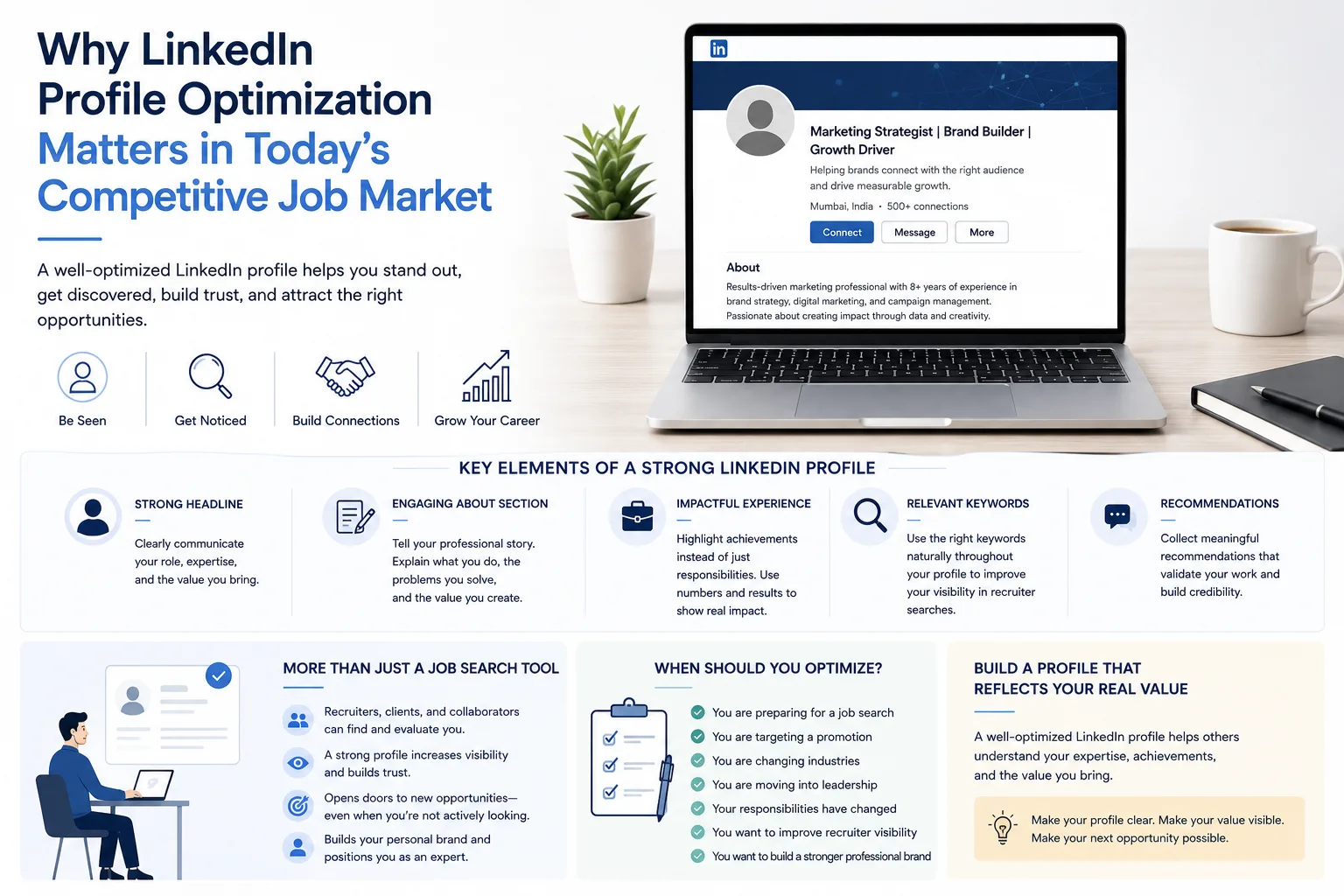
A LinkedIn profile is more than an online version of a resume. For many professionals, it is one of the first places recruiters, hiring managers, clients, and potential business connections go when they want to learn more about someone professionally.
Yet many profiles fail to communicate the full value of the person behind them. The profile may contain an accurate job title and employment history, but still lack the context, positioning, keywords, and achievements needed to make the professional stand out.
This is where a professional LinkedIn Profile Optimization Service can make a meaningful difference.
Your LinkedIn Profile Is Part of Your Professional Brand
A professional's online presence increasingly influences how others perceive their expertise. When someone searches for your name or discovers your profile through a professional network, your LinkedIn profile can shape their first impression.
A strong profile should quickly communicate:
- What you do
- What you specialize in
- What experience you bring
- What results you have achieved
- What type of opportunities you are interested in
Simply listing job titles does not always answer these questions.
For example, a title such as “Marketing Manager” tells a reader very little about the scale or impact of the role. Adding information about team leadership, campaign performance, revenue contribution, market reach, or strategic responsibilities provides much stronger context.
Why Generic LinkedIn Profiles Often Get Overlooked
Many professionals create their LinkedIn profile once and rarely update it afterward. As their responsibilities, skills, and achievements change, the profile remains almost identical.
This can create a gap between what a professional actually does and what their LinkedIn profile communicates.
Another common issue is using generic language. Phrases such as “results-oriented professional,” “experienced leader,” or “responsible for managing projects” appear on countless profiles.
These statements may sound professional, but they do not necessarily explain what makes one candidate different from another.
A stronger profile uses specific achievements, responsibilities, expertise, and measurable outcomes to create a clearer professional identity.
The Importance of a Strong LinkedIn Headline
The headline is one of the most visible sections of a LinkedIn profile. It appears in search results, connection requests, comments, and other areas across the platform.
Because of this visibility, using the headline only for a job title can be a missed opportunity.
A stronger headline can communicate a combination of professional role, specialization, expertise, and value.
Instead of simply writing:
Marketing Manager at ABC Company
a professional might communicate their focus more clearly through something like:
B2B Marketing Leader | Demand Generation | Brand Strategy | Revenue Growth
The objective is not to fill the headline with keywords. It is to make the profile easier to understand while naturally incorporating relevant professional terms.
Your About Section Should Tell a Professional Story
The About section gives professionals more space to explain their background, strengths, and career direction.
However, many users either leave it blank or fill it with a generic summary that could apply to almost anyone.
An effective About section should answer important questions such as:
- What do you specialize in?
- What problems do you solve?
- What experience has shaped your expertise?
- What achievements demonstrate your capabilities?
- What opportunities or professional conversations are you interested in?
A well-structured section can make the profile feel more personal while still maintaining a professional tone.
Experience Should Demonstrate Impact
One of the most important improvements professionals can make is changing the way their work experience is described.
Instead of simply listing responsibilities, the experience section should communicate outcomes whenever possible.
For example:
Weak:
Managed a team and handled multiple client projects.
Stronger:
Led a 10-member project team and delivered 20+ client initiatives across multiple markets while improving project completion timelines.
The second version gives the reader context about scale and impact.
This type of detail helps recruiters understand not only what someone was responsible for but also the level at which they operated.
Keywords Can Improve Professional Discoverability
Recruiters often search LinkedIn using specific job titles, skills, technologies, industries, and areas of expertise.
If relevant terminology is missing from a profile, the professional may be less likely to appear in searches related to their experience.
This does not mean adding every possible keyword to a profile. Keyword usage should remain relevant and natural.
Important areas may include the headline, About section, experience descriptions, skills section, and other relevant profile fields.
A thoughtful LinkedIn Profile Optimization Service can help identify the terminology that aligns with a professional's target roles and industry while keeping the profile readable.
Skills and Recommendations Add Credibility
The Skills section provides another opportunity to reinforce professional expertise.
However, simply adding a large number of unrelated skills does not necessarily strengthen a profile. The most relevant skills should support the professional's target direction.
Recommendations can also provide valuable third-party validation. A thoughtful recommendation from a manager, colleague, client, or business partner can provide context that a self-written profile cannot.
Together, relevant skills and credible recommendations can strengthen the overall impression of professional expertise.
LinkedIn Optimization Is Not Only for Job Seekers
It is easy to assume that LinkedIn optimization is only necessary when someone is actively searching for a job.
In reality, professionals can benefit from maintaining a strong profile even when they are not looking to change positions.
Recruiters may discover passive candidates, potential clients may research service providers, and industry professionals may look at profiles before starting a conversation or collaboration.
A well-positioned profile therefore works as an ongoing professional asset rather than simply an application document.
When Should You Consider Profile Optimization?
A LinkedIn profile may benefit from optimization when:
- You are preparing for a job search
- You are targeting a promotion
- You are changing industries
- You are moving into leadership
- Your responsibilities have changed significantly
- Your profile does not reflect your current experience
- You want to improve recruiter visibility
- You are building a stronger professional brand
Even experienced professionals can have gaps in their profiles because they are often too close to their own work to recognize which details need additional context.
Building a Profile That Reflects Your Real Value
The purpose of LinkedIn optimization is not to make a profile sound impressive without substance. It is to make the existing experience easier to understand.
Your professional history already contains valuable information. The challenge is identifying the right details and presenting them in a way that connects your experience with the opportunities you want.
A strong profile combines accurate information with strategic positioning. It should make your professional identity clear while giving recruiters and other visitors enough context to understand your capabilities.
Professional LinkedIn Profile Optimization Service providers can help identify gaps in positioning, strengthen key sections, improve keyword relevance, and make professional achievements easier to recognize.
CareerZeno offers career-focused support, including LinkedIn profile optimization, to help professionals present their experience more effectively and build a stronger professional presence.
Ultimately, LinkedIn is not simply a place to record where you have worked. It is an opportunity to communicate what you know, what you have accomplished, and where your professional expertise can create value. When those elements are presented clearly, your profile can become a much stronger part of your overall career strategy.