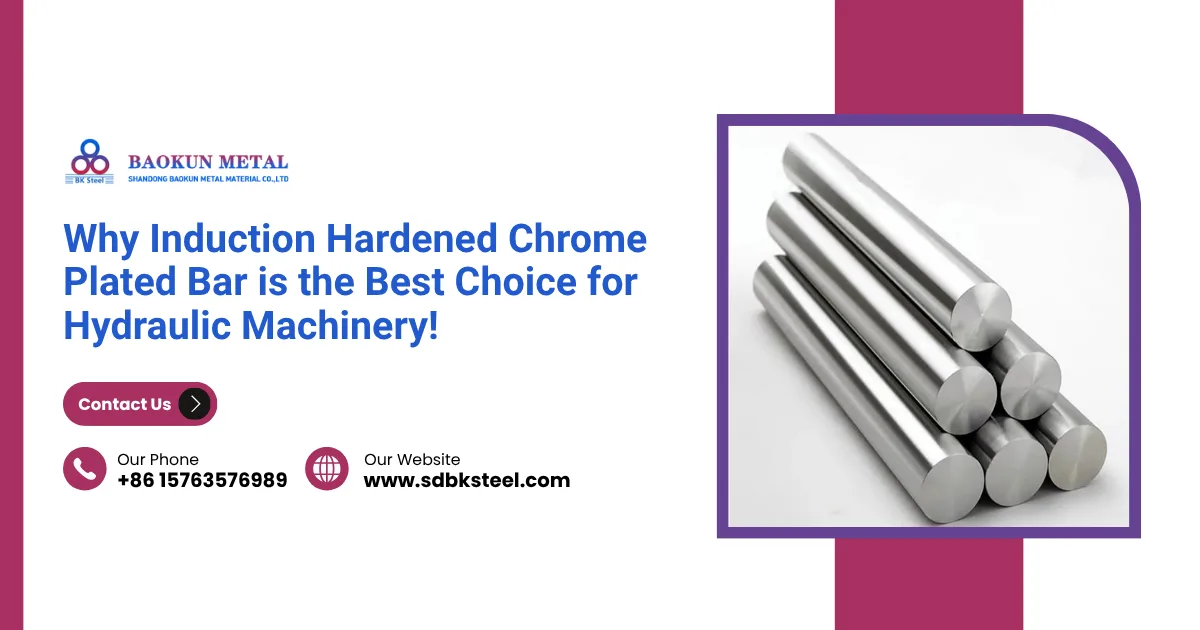
In the world of hydraulic machinery, every component must meet rigorous standards for strength, durability, and performance. Whether you’re dealing with massive construction excavators or precision industrial automation systems, the failure of just one part can spell costly downtime or even catastrophic damage. Among the components most critical to hydraulic performance and reliability is the Induction Hardened Chrome Plated Bar.
At Shandong Baokun Metal Material Co. Ltd, we have seen firsthand how the right choice of piston rod or guide bar can transform hydraulic equipment—making it robust, safe, and long-lasting. With decades of industry experience, we can confidently say that, for demanding hydraulic applications, nothing compares to the Induction Hardened Chrome Plated Bar.
1. What is an Induction Hardened Chrome Plated Bar?
The Induction Hardened Chrome Plated Bar is a high-strength, wear-resistant steel bar to which a hard chrome layer has been applied. However, not all chrome bars are made equal. The secret to the superior performance of this bar lies in two key processes:
-Induction Hardening:
After initial machining, the bar undergoes a targeted heat treatment using electromagnetic induction. The outer surface is rapidly heated and cooled, creating a hardened “shell” while leaving the core tough and shock-resistant.
-Chrome Plating:
Next, the bar receives a thick layer of industrial chrome via electroplating. This hard, anti-corrosive layer delivers optimal wear resistance and a mirror-smooth finish—essential for hydraulic seals and linear motion.
In essence, the Induction Hardened Chrome Plated Bar features an ultra-hard, high-strength outer layer for resisting wear and impacts, coupled with outstanding surface properties that support the longevity and efficiency of hydraulic machinery cylinders and actuators.
2. The Manufacturing Process: Precision Meets Strength
Understanding the manufacturing process is vital for recognizing the unique value of the Induction Hardened Chrome Plated Bar.
A. Steel Selection:
Production starts with high-quality, medium carbon steel (often C45, 1045, or 42CrMo4), carefully selected for both machinability and strength.
B. Rough Machining:
The bar is cut, straightened, and rough-ground to close dimensional tolerances.
C. Induction Hardening:
- The bar is subjected to high-frequency electromagnetic fields, heating the surface rapidly to temperatures of 800–1000°C (1470–1830°F).
- Almost immediately, the bar is cooled (quenched) using water or oil jets, creating a martensitic structure at the surface.
- This hardened shell is typically 1.5–6 mm deep, achieving a surface hardness of 50–60 HRC.
D. Centerless Grinding:
The bar is then precisely ground to achieve required diameters and straightness.
E. Chrome Plating:
Through electroplating, a 20–40 micron layer of hard chrome is deposited to enhance wear and corrosion protection.
Also Read: Why Choose Induction Hardened Chrome Plated Bar for Heavy-Duty Applications?
F. Final Polishing:
Precision grinding and polishing produce a mirror-like surface finish (Ra ≤ 0.2 μm), ideal for hydraulic seal and bearing interfaces.
G. Inspection and Quality Control:
Each Induction Hardened Chrome Plated Bar undergoes thorough testing for hardness, chrome thickness, straightness, surface finish, and concentricity.
At Shandong Baokun Metal Material Co. Ltd, every step is monitored under ISO quality standards to ensure a consistent, reliable end product.
3. Technical Advantages of Induction Hardened Chrome Plated Bar
A. Superior Surface Hardness
- The induction-hardened layer achieves a hardness of up to 60 HRC (Rockwell Hardness).
- This prevents dents, scratches, and scoring—even under high cyclic loads and with contaminants present in the hydraulic fluid.
B. Wear and Abrasion Resistance
- Combined with the hard chrome surface, wear from seals, bushings, and environmental grit is minimized.
- This results in much longer service life for the bar, the cylinder seals, and the hydraulic system as a whole.
C. Corrosion Protection
- The chrome plating acts as a strong barrier against oxidation, moisture, and corrosive hydraulic fluids (providing thousands of hours of salt spray resistance).
- For especially harsh conditions, double-layer or nickel-chrome options are available.
D. High Load and Impact Resistance
- The tough, “springy” core of the bar absorbs shocks and cyclic loads without bending or fracturing—making it perfect for heavy equipment and dynamic operations.
E. Straightness and Precision
- Tight tolerances (often ≤ 0.1 mm/m straightness) and smooth, consistent diameters are paramount for hydraulic pistons and linear motion.
- The refined surface reduces friction and maintains seal integrity, preventing leaks and loss of hydraulic power.
F. Fatigue Life
- Induction hardening improves fatigue resistance remarkably.
- As a result, the Induction Hardened Chrome Plated Bar can withstand millions of cycles in demanding hydraulic applications before any loss of performance.
5. Applications: Where Does Induction Hardened Chrome Plated Bar Shine?
This advanced bar is found across every hydraulic-intensive industry, powering essential machinery such as:
- Hydraulic Cylinder Rods: Main use in agricultural, construction, mining, and mobile equipment.
- Pneumatic Cylinder Rods: For wear-critical uses in factory automation.
- Linear Guide Bars: In precision manufacturing or machining centers.
- Telescopic Cylinders: For cranes, dump trucks, and aerial platforms.
- Injection Molding Machines: Where high cycle rates require extreme wear resistance.
- Marine Hydraulics: Exposed to salt spray and harsh wet environments.
- Railway and Defense: For rugged actuators in transport and heavy vehicles.
Where powerful, reliable hydraulic actuation is required, the Induction Hardened Chrome Plated Bar is the industry’s top choice.
6. How to Specify the Right Induction Hardened Chrome Plated Bar for Your Equipment
Selecting the best bar for your machinery involves several key steps:
A. Confirm Size Requirements:
- Outside diameter, length, and straightness (critical for cylinder fit and piston alignment).
- Standard sizes range from 10mm to over 200mm, with custom options available.
B. Determine Hardness and Depth:
- Higher loads or impact? Specify deeper induction hardening (up to 6 mm or more), and check required Rockwell levels.
C. Specify Chrome Layer and Finish:
- Standard chrome thickness is 20–30 microns; thicker for especially abrasive or salty environments.
- Surface roughness (Ra) ≤ 0.2 μm for best seal compatibility.
D. Match Material to Application:
- Most use medium-carbon steel (C45/1045); high-stress jobs may warrant alloy steel (42CrMo4).
- For corrosive or food-grade applications, consider stainless substrate or nickel-chrome coatings.
E. Ask About Testing & Certification:
- Demand certificates for hardness tests, plating thickness, and straightness.
- At Baokun, every bar is traceable and tested to ISO standards.
F. Specify End Machining:
-Ready-to-install bar ends, threaded, grooved, or with mounting holes.
Working with a trusted partner like Shandong Baokun Metal Material Co. Ltd ensures your bars are optimized for your exact requirements—no unnecessary overspending and maximum reliability.
7. Installation and Maintenance Tips
A high-quality Induction Hardened Chrome Plated Bar will only deliver its full value when installed and cared for correctly:
Installation Tips:
- Inspect bars for nicks, rust, or contamination before use.
- Always keep bars clean and covered until just before assembly.
- Lubricate seals and use the correct fluid—poor lubrication can defeat even the best surface finish.
- Align rods carefully—misalignment causes side-loading, wear, and premature failure.
Maintenance Tips:
- Clean rods regularly, especially if exposed to dirt or chemicals.
- Inspect for surface damage periodically—catching a chip early can save a cylinder!
- Watch for seal leaks or fluid discoloration, indicators of wear or contamination.
- Apply corrosion inhibitor if cylinders sit idle in damp conditions.
8. Potential Pitfalls and How to Avoid Them
Despite their excellence, improper selection or handling can reduce the performance of your Induction Hardened Chrome Plated Bar:
- Undersized or overtight tolerances: Can cause jammed or loose pistons—discuss needed tolerances with your supplier.
- Thin chrome or improper hardening: Risks early surface wear—always request test certificates for each batch.
- No end protection: Uncapped bars can suffer from rust or physical damage during handling—always store carefully and use manufacturer’s packaging.
9. Why Shandong Baokun Metal Material Co. Ltd is Your Best Partner
As a global leader in hydraulic bar technology, Shandong Baokun Metal Material Co. Ltd offers:
- Industry-leading QC with full test documentation
- World-class machining and polishing facilities
- Custom end-finishing, threading, and ready-to-install options
- A wide range of diameters and materials for all application needs
- Expert technical advice—helping you avoid over- or under-specification
- Fast, global delivery with safe packaging
In summary, the Induction Hardened Chrome Plated Bar is the undisputed champion when it comes to combining strength, toughness, wear resistance, and longevity in hydraulic machinery cylinders and actuators. Its specialized production process ensures you benefit from a component that withstands intense mechanical action, resists corrosion, and delivers decades of reliable motion.
Frequently Asked Questions (FAQ)
Q1: How does induction hardening differ from case hardening or through hardening?
A: Induction hardening heats only the surface quickly, leaving a hard shell and tough core, while case hardening uses chemical diffusion and through hardening hardens the entire cross-section. Induction hardening is faster, more precise, and retains core ductility—ideal for hydraulic rods.
Q2: Is the Induction Hardened Chrome Plated Bar suitable for marine use?
A: Yes, especially when paired with thicker chrome or a nickel-chrome underlayer. For maximum life, consider stainless steel induction-hardened chrome bars.
Q3: Can these bars be re-chromed or repaired?
A: Yes, if surface wear is limited and the core is undamaged. Bars are commonly reground and re-plated in cylinder refurbishment shops.
Q4: What are typical lifetime expectations?
A: In well-specified, clean hydraulic systems, bars can last tens of thousands of cycles, or many years. In aggressive or dirty conditions, surface inspection and maintenance frequency will dictate longevity.
Q5: Can I cut and machine induction hardened chrome plated bars?
A: Yes, but special hard metal cutters are required. Preferably, order bars with end machining already completed—this is a service Shandong Baokun Metal Material Co. Ltd offers.
Q6: Does the core remain ductile after induction hardening?
A: Absolutely. The unique advantage is a hard, wear-resistant shell and a strong-yet-tough core that absorbs impact without cracking.
Q7: How can I verify the quality of my bar?
A: Insist on hardness, plating thickness, straightness, and material certificates from your supplier.