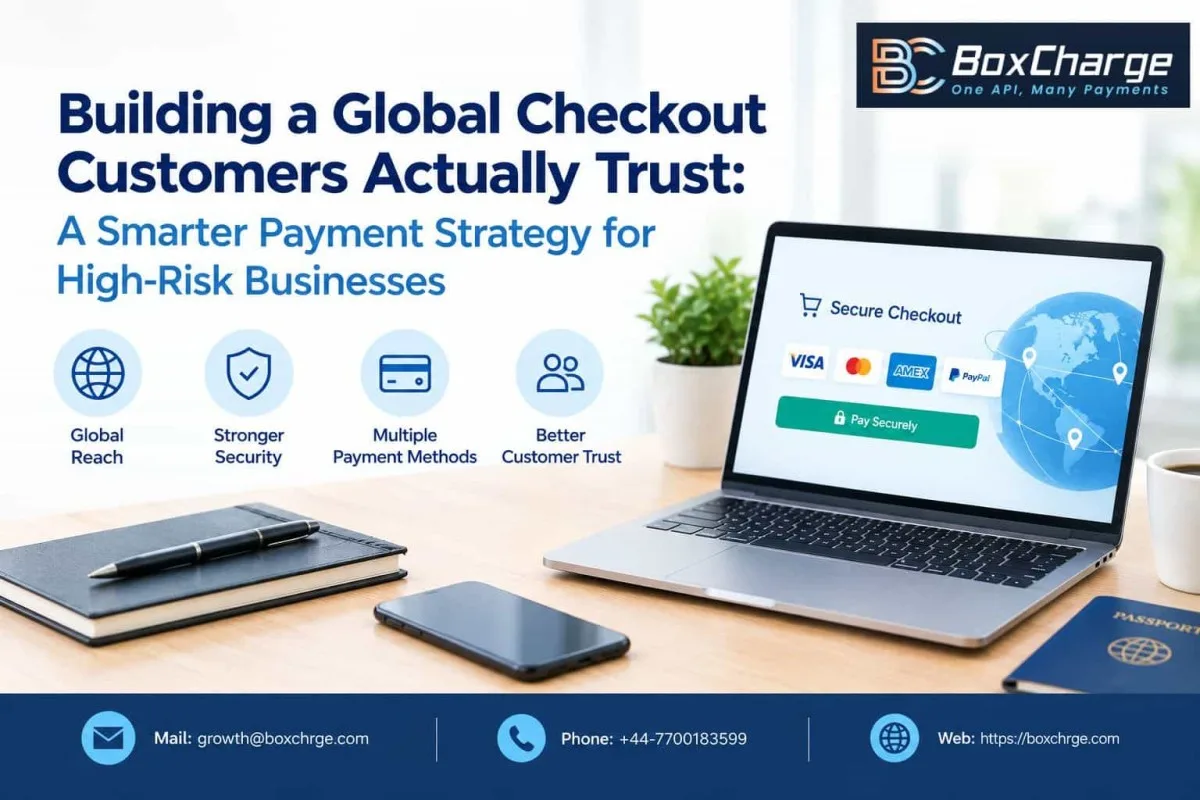
A global checkout experience can make the difference between winning an international customer and losing a sale at the final step in high-risk mechant businesses. For businesses selling across borders, accepting a payment is no longer just about processing a card. Customers expect familiar payment methods, transparent currency conversion, secure transactions, and a checkout process that works without unnecessary friction.
For high-risk merchants, the challenge is even greater. Businesses operating in online gaming, forex trading, travel, subscription services, nutraceuticals, and adult entertainment often face stricter underwriting requirements, higher chargeback exposure, and limited payment processing options.
Expanding into international markets requires more than translating a website or displaying prices in euros and US dollars. It requires a payment infrastructure that customers trust and that can support the commercial realities of cross-border trade.
Why Global Checkout Trust Matters More Than Ever
Consider a British customer purchasing a subscription from a US-based company. The product looks legitimate, but the checkout displays prices only in dollars, provides no clear information about recurring charges, and declines the customer's card without explanation.
The customer may abandon the purchase, contact their bank, or assume the website is unreliable. The business loses revenue despite having a product the customer wanted.
Similar situations occur across the UK, the United States, Canada, Australia, and European markets. A checkout that feels unfamiliar or unpredictable can create doubts at the precise moment a customer is ready to pay.
A trustworthy international checkout should provide:
- Clear pricing and transparent currency conversion.
- Recognisable and locally relevant payment methods.
- Secure payment authentication and data protection.
- Straightforward refund, cancellation, and subscription terms.
- Consistent communication about payment status and transaction failures.
These details help reduce avoidable friction while giving customers greater confidence in the business.
Local Payment Preferences Can Make or Break International Sales
One of the most common mistakes in international expansion is assuming that customers everywhere prefer the same payment methods.
Credit and debit cards remain important across many markets, but local expectations differ. Customers in the Netherlands may prefer iDEAL, while UK consumers are familiar with bank transfers and digital wallets. In Australia, cards and digital wallets are widely used, while customers across European markets may expect locally established bank-payment options.
A business that supports only one payment method can unintentionally exclude customers who are willing to buy but uncomfortable with the available checkout options.
This challenge is particularly relevant to high-risk merchants. A gaming operator entering Australia, a forex platform targeting UK clients, or a subscription business expanding into Germany must consider local payment preferences alongside provider availability and regulatory requirements.
The practical solution is to select a payment gateway or payment service provider that supports the intended markets, relevant currencies, and appropriate payment methods.
However, local availability alone is not enough. Merchants should also assess settlement timelines, processing fees, fraud controls, chargeback procedures, and the provider's policies for their specific industry.
Why High-Risk Merchants Face More Checkout Challenges
For high-risk businesses, a failed transaction can have consequences beyond a single lost sale.
An online gaming operator may experience a surge in declined deposits during a busy weekend. A forex platform may struggle with payment acceptance across different customer regions. A subscription merchant may see recurring payments fail when cards expire, or issuers reject subsequent transactions.
These situations create operational pressure because the business must manage customer complaints, investigate declines, monitor chargebacks, and protect revenue at the same time.
High-risk merchants may also encounter additional onboarding checks, rolling reserves, settlement delays, transaction limits, and stricter monitoring requirements. Not every provider supports every business category, and approval depends on factors such as the merchant's business model, jurisdiction, transaction history, and compliance procedures.
Choosing a provider based solely on advertised transaction fees can therefore be an expensive mistake.
Instead, businesses should ask whether the provider has experience with their industry, supports their target countries, offers transparent reserve and settlement terms, and can explain how disputes and suspicious transactions are handled.
The goal is not simply to find a processor that accepts payments. It is to build a payment setup that can operate reliably under real commercial conditions.
Security Should Reassure Customers Without Creating Unnecessary Friction
Customers want to know their financial information is protected. At the same time, repeated authentication requests, unexplained declines, and complicated verification steps can interrupt legitimate purchases.
A well-designed checkout balances security with usability.
Tools such as EMV 3-D Secure, tokenisation, fraud screening, and risk-based authentication can help merchants protect transactions. Their effectiveness depends on implementation, configuration, and the quality of the available data.
For businesses serving customers in the European Economic Area and the UK, Strong Customer Authentication requirements under applicable payment regulations may also influence the checkout journey.
For example, a legitimate customer making an online purchase may be asked to complete an additional authentication step. If the process is confusing or fails on a mobile device, the customer may abandon the transaction.
Merchants should work with their payment providers to understand authentication requirements, configure appropriate exemptions where legally available, and monitor both fraud rates and legitimate payment acceptance.
Security should be visible through clear communication and dependable processes, not unnecessary obstacles.
Payment Routing and Approval Rates Deserve Closer Attention
A global checkout can look polished and still perform poorly if its payment infrastructure cannot handle different issuers, currencies, and transaction patterns.
Payment routing can help eligible merchants direct transactions through suitable acquiring connections based on factors such as geography, payment method, cost, or historical performance. Where supported, intelligent routing and payment retries may help recover some legitimate transactions that would otherwise fail.
However, routing does not guarantee higher approval rates. Results depend on issuer decisions, acquiring relationships, transaction quality, local regulations, and the merchant's risk profile.
Before selecting a payment platform, businesses should examine reporting capabilities, decline codes, retry controls, reconciliation tools, and integration options.
Useful performance indicators include:
- Authorisation and payment conversion rates by country.
- Decline rates by issuer, payment method, and transaction type.
- Chargeback and fraud rates.
- Checkout abandonment and authentication failures.
- Settlement speed, reserve deductions, and total processing costs.
Reviewing these metrics regularly helps merchants identify whether a problem comes from checkout design, customer payment preferences, fraud controls, or the underlying processing arrangement.
How to Choose the Right Global Payment Partner
The right payment partner should support both the merchant's current needs and its planned expansion.
Before signing an agreement, evaluate the following:
1. International coverage: Confirm that the provider supports your target markets, settlement currencies, and intended customer payment methods.
2. High-risk industry experience: Ask about underwriting criteria, prohibited activities, reserve requirements, transaction limits, and ongoing monitoring.
3. Transparent pricing: Review processing fees, currency conversion charges, cross-border fees, chargeback costs, and potential reserve deductions.
4. Technical flexibility: Check API documentation, checkout customisation, fraud tools, reporting, and compatibility with your existing commerce platform.
5. Reliable support: Understand escalation procedures for payment outages, delayed settlements, account reviews, and sudden increases in declined transactions.
6. Compliance and data security: Verify the provider's relevant regulatory status, security practices, and responsibilities for payment data and customer authentication.
A provider's reputation matters, but the contractual terms and practical capabilities matter just as much.
Build a Checkout That Supports Long-Term International Growth
Global expansion creates opportunities, but every new market introduces different customer expectations, payment behaviours, and operational risks. A checkout that works well in the United States may need adjustments before it can deliver the same experience in the UK, Australia, or Germany.
For high-risk merchants, the stakes are particularly high because payment restrictions, chargebacks, and settlement uncertainty can affect both customer relationships and cash flow.
The strongest strategy combines local payment options, transparent pricing, appropriate fraud prevention, reliable processing connections, and a payment partner that understands the merchant's business model.
Before entering another market, review your current checkout conversion, approval rates, settlement terms, and customer complaints. Identify where customers experience friction and prioritise improvements based on measurable results.
A trusted global checkout is not just a payment feature. It is a commercial advantage. Businesses that make international payments secure, understandable, and convenient are better positioned to build customer confidence, protect revenue, and scale sustainably across borders. Talk to the Fintech Expert Today