
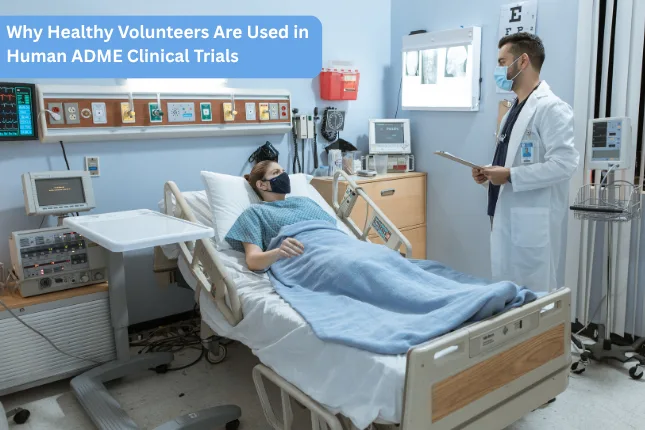
When a new drug is being developed, researchers need to understand what happens to it after it enters the human body. How much of the drug is absorbed? How is it broken down? Where does it go, and how does the body remove it? These questions are important for understanding a drug's safety, behavior, and potential use in patients.
This is where human ADME studies play an important role. ADME stands for Absorption, Distribution, Metabolism, and Excretion. These studies help researchers understand how the body processes an investigational drug, often using a human mass balance study to track the drug and its metabolites.
In many human ADME clinical trials, healthy volunteers are selected to help answer these questions. Their participation allows researchers to study how a drug behaves without some of the additional factors that may come with an existing disease or its treatment.
But why are healthy volunteers preferred, and how are they selected for these studies? Let's take a closer look.
What Are Human ADME Clinical Trials?
Human ADME clinical trials investigate how an investigational drug moves through the body. They are an important part of early clinical development because the results help researchers understand the drug's pharmacokinetic profile.
ADME includes four main processes:
- Absorption: How the drug enters the bloodstream after administration.
- Distribution: How the drug moves from the bloodstream into different tissues and organs.
- Metabolism: How the body changes or breaks down the drug, often through enzymes in the liver.
- Excretion: How the drug and its metabolites leave the body, commonly through urine or feces.
A human ADME study may measure drug concentrations in blood and analyze collected urine and feces to understand how much of the administered dose is recovered and how the drug is eliminated.
In radiolabeled mass balance studies, a small amount of a radioactive label, often carbon-14, is incorporated into the drug molecule. This allows researchers to track drug-related material and investigate its metabolic pathways.
Why Are Healthy Volunteers Used in Human ADME Studies?
Healthy volunteers are commonly used because they help researchers study a drug's behavior under more controlled conditions. This can make it easier to understand the results and identify factors that influence drug absorption, metabolism, and elimination.
Here are the main reasons healthy volunteers are often selected for human ADME clinical trials.
1. To Understand How the Drug Behaves in the Human Body
Before researchers can fully understand how a drug may work in patients, they need reliable information about how the body processes it.
Healthy volunteers allow researchers to study drug absorption, distribution, metabolism, and excretion without some of the complications associated with an underlying disease.
For example, a person with a liver condition may process certain drugs differently from someone with normal liver function. By studying an investigational drug in an appropriate healthy population, researchers can establish an initial understanding of its pharmacokinetic behavior.
This information helps build a clearer picture of how the drug behaves in humans and supports decisions about further clinical studies.
2. To Reduce the Influence of Other Medical Conditions
Existing health conditions can affect how a drug is absorbed, metabolized, or eliminated. Kidney disease, liver impairment, and other medical conditions may change drug exposure and make it more difficult to determine why certain results occur.
Healthy volunteers are generally screened for relevant medical conditions before enrollment. This helps reduce some sources of variability and makes it easier to interpret study findings.
However, healthy volunteers do not eliminate every possible source of variation. Differences in genetics, age, body composition, and other factors can still influence drug metabolism and pharmacokinetics.
The goal is to create suitable study conditions while accounting for the factors that may affect the results.
3. To Study Drug Metabolism and Elimination More Clearly
One of the main goals of a human ADME study is to understand how a drug is broken down and removed from the body.
Researchers may need to identify the major metabolites formed after administration and determine whether the drug is eliminated mainly through urine, feces, or other pathways.
Healthy volunteers can help researchers investigate these processes without some of the additional influences that may occur in a patient population.
In a human radiolabeled mass balance study, blood, urine, and fecal samples may be collected over a defined period. The samples are analyzed to measure drug-related material and help determine how much of the administered dose has been recovered.
These findings can help researchers understand the drug's metabolic pathways and identify metabolites that may need further investigation.
4. To Generate Reliable Pharmacokinetic Data
Pharmacokinetics describes how drug concentrations change over time in the body. It is an important part of clinical pharmacology and drug development.
Human ADME clinical trials may measure parameters such as:
- Maximum drug concentration in the blood.
- Time taken to reach maximum concentration.
- Overall drug exposure over a defined period.
- The time required for drug concentrations to decline.
- The proportion of drug-related material recovered through excretion.
Studying healthy volunteers under controlled conditions can help researchers interpret these measurements and understand how the drug behaves after administration.
The findings may also help inform the design of later studies, including investigations into drug-drug interactions or the effects of impaired liver or kidney function.
5. To Support Drug Development and Regulatory Decisions
Human ADME data can help pharmaceutical companies understand a drug's disposition and plan the next stages of development.
For example, researchers may use study results to identify important metabolic pathways, assess the relative abundance of circulating metabolites, and determine whether additional studies may be appropriate.
This information can contribute to the clinical pharmacology evidence included in regulatory submissions. The U.S. Food and Drug Administration (FDA) provides recommendations for the design, timing, and reporting of human radiolabeled mass balance studies.
Healthy volunteers are commonly used in these studies, but the appropriate population depends on the drug's characteristics and potential risks. If safety concerns make participation unsuitable for healthy individuals, researchers may need to consider studying the intended patient population instead.
How Are Healthy Volunteers Selected for ADME Clinical Trials?
Not everyone who volunteers for a clinical study is automatically eligible. Participants must meet specific inclusion and exclusion criteria established in the study protocol.
The screening process may include:
- Medical history review: Researchers review previous illnesses, current health conditions, and relevant medical information.
- Physical examination: A qualified medical professional assesses the volunteer's general health.
- Laboratory testing: Blood and urine tests help evaluate relevant aspects of health, including liver and kidney function.
- Medication review: Current medications, supplements, and other substances are assessed for potential interactions or safety concerns.
- Study-specific eligibility checks: Researchers consider factors such as age, body weight, and other requirements defined in the protocol.
These checks help determine whether participation is appropriate for the individual and whether the study can be conducted safely.
Before enrollment, eligible volunteers should receive clear information about the study's purpose, procedures, possible risks, and expected commitments. Informed consent must be obtained before study participation.
What Happens During a Human ADME Study?
The exact process depends on the investigational drug and study protocol, but a typical human ADME clinical trial may involve several stages.
1. Screening and enrollment
Potential participants undergo medical assessments to determine whether they meet the study requirements. Researchers explain the procedures and obtain informed consent.
2. Study admission and baseline assessments
Depending on the protocol, volunteers may stay at a clinical research facility. Baseline measurements and assessments are completed before the investigational drug is administered.
3. Drug administration
Participants receive the investigational drug according to the approved study protocol. In a radiolabeled mass balance study, the formulation may contain a carefully controlled amount of a radioactive label.
4. Sample collection and monitoring
Researchers collect blood, urine, and sometimes fecal samples at scheduled intervals. Volunteers are monitored for adverse events and other safety-related changes throughout the study.
5. Laboratory analysis and follow-up
Samples are analyzed to assess drug concentrations, metabolites, and overall recovery of drug-related material. Follow-up assessments may also be conducted according to the protocol.
The resulting data help researchers understand how the investigational drug is processed by the human body.
The Importance of an Experienced Human ADME Research Facility
Human ADME studies require careful coordination between clinical research teams, laboratory specialists, and study sponsors. Accurate sample collection, appropriate analytical methods, participant monitoring, and reliable data management are all important to the quality of the results.
For radiolabeled mass balance studies, the facility must also have the appropriate authorizations, procedures, staff training, and radiation-safety controls for the work being performed.
AXIS Clinicals USA supports early-stage clinical pharmacology research, including human ADME studies, at its Minnesota facilities. Its capabilities include pharmacokinetic studies and integrated bioanalytical support.
For pharmaceutical and biotechnology sponsors, working with a research partner that understands both clinical study operations and analytical requirements can help coordinate the different stages of an ADME study.
Explore AXIS Clinicals' human ADME services to learn more about its research capabilities. You can also read about AXIS Clinicals' expansion into human ADME studies.
Conclusion
Healthy volunteers play an important role in many human ADME clinical trials because they help researchers understand how an investigational drug is absorbed, distributed, metabolized, and eliminated under controlled conditions.
Their participation can help generate useful pharmacokinetic data, clarify drug metabolism and excretion pathways, and inform decisions about further clinical studies. Careful screening, informed consent, appropriate study design, and ongoing safety monitoring remain essential throughout the process.
Although healthy volunteers are commonly used in human ADME studies, they are not suitable for every investigational drug. The study population must always be selected according to the drug's safety profile, scientific objectives, and protocol requirements.
By generating reliable human ADME data, researchers can build a better understanding of investigational drugs and support informed decisions throughout the drug development process.
Frequently Asked Questions
1. Why are healthy volunteers used in human ADME clinical trials?
Healthy volunteers help researchers study how an investigational drug is absorbed, distributed, metabolized, and excreted under controlled conditions. This can reduce the influence of certain underlying medical conditions and help researchers interpret pharmacokinetic data.
2. What does ADME stand for in clinical research?
ADME stands for Absorption, Distribution, Metabolism, and Excretion. These four processes describe how a drug enters the body, moves through it, is chemically changed, and is eventually eliminated.
3. Are human ADME studies the same as Phase I clinical trials?
Human ADME studies are often conducted during early clinical development and may be classified as Phase I studies. However, ADME describes the study's scientific purpose, while Phase I describes a stage of clinical development. The exact classification depends on the study and development program.
4. Are human ADME clinical trials safe for healthy volunteers?
All clinical trials involve potential risks. Researchers assess those risks before a study begins, screen participants, obtain informed consent, and monitor safety according to the protocol. The suitability of healthy volunteers depends on the investigational drug and its known or anticipated risks.
5. What samples are collected during a human ADME study?
Depending on the protocol, researchers may collect blood, urine, and fecal samples. These samples help measure drug concentrations, identify metabolites, and determine how much drug-related material is eliminated from the body.
6. What is a human radiolabeled mass balance study?
It is a type of human ADME study in which a radiolabeled investigational drug is used to track drug-related material in the body. The results help researchers understand the drug's metabolic pathways and routes of elimination.
7. Can patients participate in ADME clinical trials instead of healthy volunteers?
Yes. If the investigational drug presents safety concerns that make enrollment of healthy volunteers inappropriate, researchers may conduct the study in the intended patient population. The decision depends on the drug, the study objectives, and the associated risks.
8. Where can pharmaceutical companies find human ADME research services in Minnesota?
Pharmaceutical and biotechnology companies can explore AXIS Clinicals USA's human ADME services to learn about its Minnesota-based clinical pharmacology research and bioanalytical capabilities.