What does “fuller-looking hair” mean when it appears on a serum bottle? It could describe an improvement in appearance, a conditioning effect, or a claim that draws on ingredient research. Those explanations are different, although product descriptions can make them sound alike.
For someone comparing scalp serum actives, growth-phase support offers a useful place to begin. The question is whether the research examines the hair cycle, the scalp’s condition, or how the hair looks and feels. A clear explanation should identify the intended benefit and show where the supporting evidence comes from.
Look at What the Research Measures
Hair does not remain in a continuous state of growth. Each follicle moves through a cycle that includes anagen, the active growth phase, followed by transition and rest. Shedding forms part of that cycle.
This helps explain why researchers examine more than appearance. They may count hairs within a defined area or assess the proportion in the growth phase. Other studies focus on moisture or participants’ impressions.
These measurements answer different questions. Someone may report a more comfortable scalp without seeing a change in density. A photograph may show a fuller hairstyle without explaining what caused the difference.
When evaluating scalp serum actives, the advertised claim should match the outcome researchers measured. Otherwise, a useful finding about hydration can become a much broader promise that the study never tested.
Compare Densidyl and Baicapil Beyond Their Names
Branded ingredient names need an explanation. Consumers should know what a complex contains and why a formulator chose it.
Densidyl combines extracts from Chlorella Emersonii and Spirulina Maxima. Its supplier research examines hair and scalp outcomes, including growth-phase measures and moisture. Baicapil contains Scutellaria Baicalensis, soy germ, and wheat germ extracts. Its research addresses hair-cycle and density outcomes.
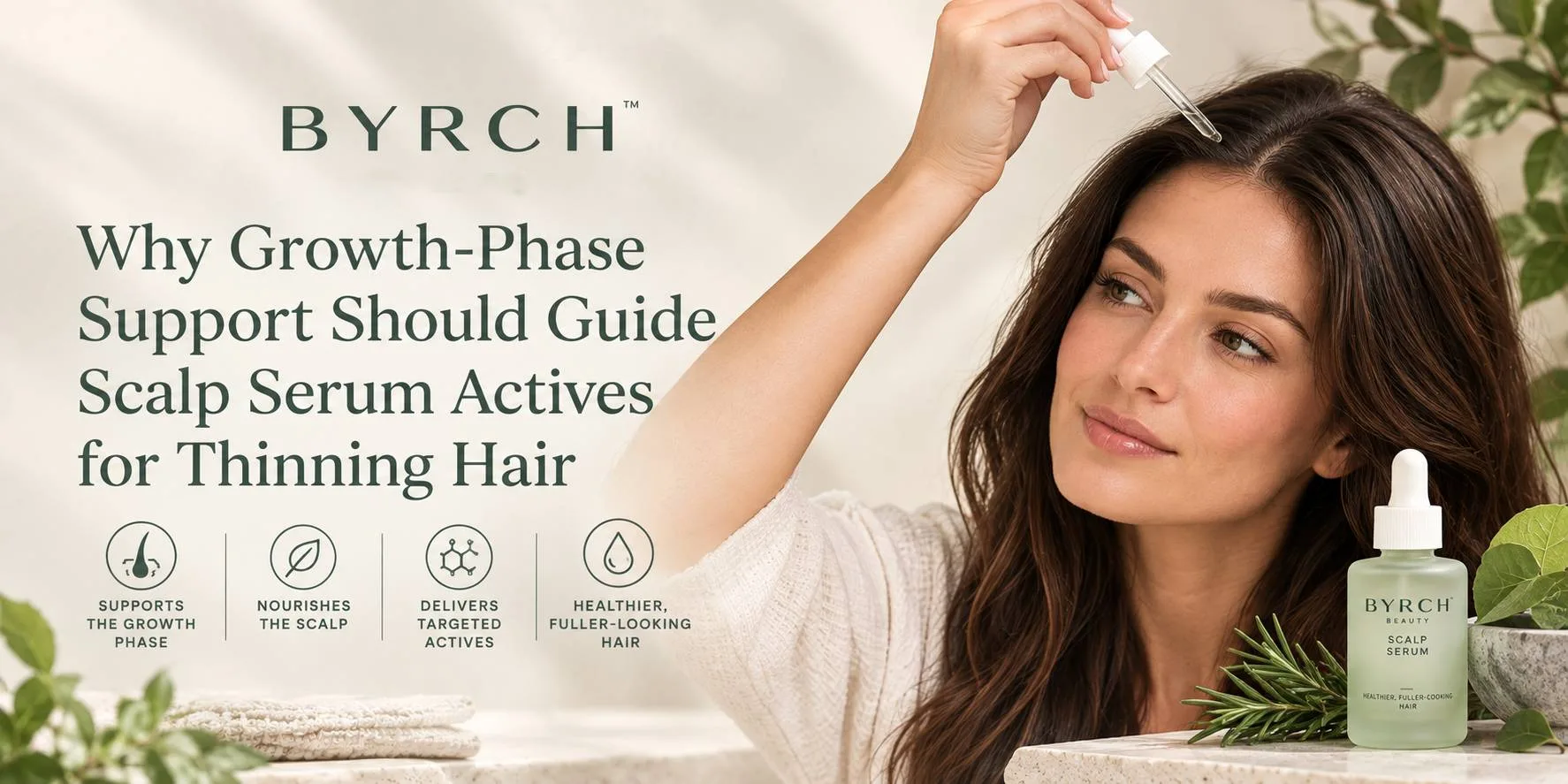
Byrch Beauty includes both complexes in The Scalp Serum and describes their roles through scalp support, follicle anchorage, and fuller-looking hair. This gives consumers specific ingredients to examine instead of an unexplained botanical claim.
Still, combining scalp serum actives does not establish that their benefits add together. Each complex brings its own research, while the complete formula introduces another question: how does that particular combination perform during use?
Read Ingredient Evidence in Its Original Context
Consider a serum that contains an ingredient from a clinical study. The ingredient name matches, but the published research used a particular concentration, application schedule, and formula base.
The new serum may differ in each respect. That does not make the research irrelevant. It does mean that the study cannot answer every question about the product.
An ingredient list confirms that a substance appears in the formula. It does not reveal every concentration or prove that consumers will reproduce the study’s findings.
This distinction deserves attention when discussing scalp serum actives. The brand’s science page acknowledges that its cited evidence concerns individual ingredients and that it has not conducted a clinical trial on the finished serum. That disclosure helps readers judge the research without confusing ingredient selection with product-level proof.
Give Supporting Ingredients a Defined Purpose
A featured complex does not account for the whole application experience. The surrounding formula affects how a serum spreads, feels, and fits into a routine.
Supporting ingredients have their own jobs:
- Glycerin: Attracts water and contributes to hydration.
- Tremella Extract: Adds moisture-supporting properties.
- Licorice Root Extract: Provides conditioning and soothing support.
- Vitamins C and E: Add antioxidant ingredients whose performance depends on the formulation.
These functions deserve clear descriptions. A consumer who notices less dryness has experienced a relevant benefit. That observation does not, on its own, demonstrate a change in the growth phase.
Texture also influences whether someone continues using a product. A leave-in serum may suit the intended routine, yet residue or discomfort can make regular application difficult. Comfort and evidence therefore belong in the same assessment.
Review Formulation Standards Alongside Personal Tolerance
Ingredient exclusions help consumers compare products, especially when they already know which substances they prefer to avoid. However, an exclusion list cannot establish universal suitability.
Byrch Beauty states that its serum excludes synthetic fragrance, parabens, sulfates, phthalates, and known hormone-disrupting ingredients, using EU cosmetic standards as a formulation baseline.
The phrase “hormone-conscious” describes those selection criteria. It does not establish that the product changes or corrects hormone levels. Sensitive-scalp positioning needs the same care: individual tolerance still depends on the complete formula.
For consumers, the useful information includes the ingredient list, application directions, product texture, and evidence behind the stated benefits. A broad “clean” label leaves many of those questions unanswered.
Choose a Serum With Clear Expectations
Growth-phase support should guide the assessment of scalp serum actives because it encourages closer examination of the research. It should accompany a review of hydration, comfort, and the finished formula.
The appropriate choice depends on the intended cosmetic benefit and the individual’s needs. A sound assessment keeps ingredient findings in context, distinguishes scalp care from medical treatment, and expects product descriptions to explain what the evidence supports.