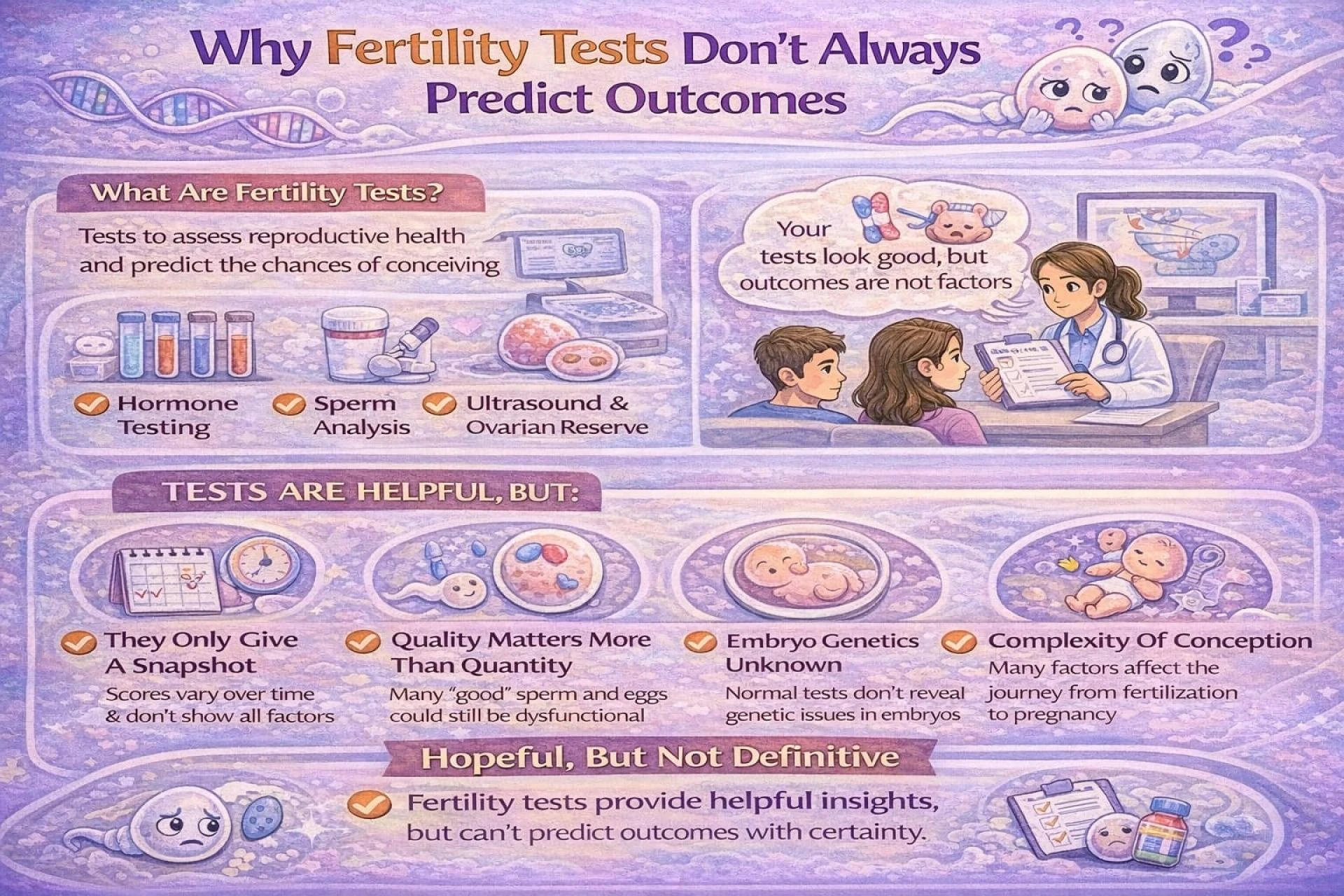
Fertility tests are often the first step in understanding why pregnancy isn’t happening. Blood tests, scans, and semen analysis can provide valuable information, but they don’t always tell the full story. Many people are surprised—and frustrated—when fertility tests look reassuring, yet conception still doesn’t occur.
This gap between test results and real-life outcomes is not a failure of medicine. It reflects the complexity of human reproduction, which depends on timing, coordination, and subtle biological interactions that are difficult to capture in standard tests.
Fertility Is a Process, Not a Snapshot
Most fertility tests offer a snapshot in time. Hormone levels are measured on a specific day. Scans show how the ovaries or uterus look at that moment. Semen analysis reflects sperm quality on a single day.
Pregnancy, however, is the result of a dynamic process unfolding over weeks. Egg development, ovulation timing, sperm maturation, implantation, and early embryo support must all align perfectly. A single normal result does not guarantee that this entire sequence will function smoothly in a given cycle.
“Normal Range” Doesn’t Mean Optimal
Fertility tests are interpreted using reference ranges. If your results fall within those limits, they are labeled normal. But these ranges are broad and designed to rule out major problems—not to predict individual success.
Two people can have identical hormone levels and very different fertility outcomes. Small differences in timing, receptor sensitivity, or tissue response can change everything, even when reports appear the same.
Normal does not always mean ideal for conception.
Egg Quality Is Largely Invisible
One of the biggest limitations of fertility testing is the inability to directly measure egg quality. Blood tests can estimate ovarian reserve, but they cannot assess how well an egg will fertilize or develop into a healthy embryo.
Egg quality is influenced by age, metabolic health, inflammation, stress, sleep, and long-term hormonal patterns. These factors leave subtle biological fingerprints that routine tests cannot fully detect.
This is why good reports do not always translate into pregnancy.
Sperm Tests Have Limits Too
Semen analysis focuses on count, motility, and morphology, but it cannot fully assess sperm DNA integrity or functional competence.
Sperm may appear normal but still struggle with fertilization or embryo development. Stress, illness, lifestyle factors, and oxidative damage can affect sperm quality weeks or months before testing—sometimes without obvious signs.
Like egg quality, sperm health is more complex than numbers alone.
Implantation Is Hard to Predict
Implantation is one of the most delicate steps in reproduction, and it is rarely measured directly.
The uterine lining may look normal on ultrasound, yet implantation can fail if hormonal timing is off, immune balance is disrupted, or blood flow is suboptimal. The implantation window is short and highly sensitive.
Most fertility tests do not evaluate this window in detail, making implantation issues easy to miss.
Hormone Timing Matters as Much as Levels
Hormones must rise and fall at the right time, not just reach the right level.
Ovulation may occur, but progesterone support may be insufficient or short-lived. Estrogen may rise but not sustain uterine receptivity. These timing mismatches often do not appear on basic reports.
Fertility depends on rhythm, not just quantity.
The Nervous System Is Rarely Tested
Stress, trauma, and chronic anxiety influence fertility through the nervous system, but this pathway is rarely measured in standard fertility testing.
Stress hormones interfere with ovulation timing, implantation, and early pregnancy support. Even when blood reports look normal, the body may still behave as if conditions are unsafe for reproduction.
This biological response is real, even if it doesn’t show up on paper.
Why Outcomes Vary Cycle to Cycle
A person may have one fertile cycle followed by several unsuccessful ones, despite similar test results. This variability reflects changes in egg quality, sperm health, stress levels, inflammation, and hormonal coordination.
Fertility tests cannot always predict these fluctuations, which is why outcomes may feel unpredictable and emotionally exhausting.
How Advanced Fertility Care Interprets Tests
Experienced fertility specialists use tests as tools, not verdicts. They look at patterns across cycles, response to treatment, and subtle clinical signs rather than relying on reports alone.
At a Trusted IVF centre in Bangalore, fertility tests are combined with close monitoring, individualized protocols, and real-time adjustments. The focus shifts from “Are the reports normal?” to “How is the body responding?”
This approach often reveals insights that routine testing misses.
Emotional Impact of Unpredictable Results
When fertility tests fail to predict outcomes, it can lead to confusion, self-doubt, and frustration. Many people feel invalidated when told everything looks fine while they continue to struggle.
Recognizing the limits of testing helps reframe this experience. The absence of abnormal results does not mean the absence of real challenges.
Final Thoughts
Fertility tests are valuable, but they are not crystal balls. They measure pieces of a much larger, interconnected system.
Pregnancy depends on timing, quality, communication, and biological readiness—factors that cannot always be captured in a report. When outcomes don’t match test results, it does not mean something was missed or ignored. It means fertility is more complex than numbers alone.
With deeper evaluation, personalized care, and patience, what tests cannot predict can still be understood—and supported.