The United Arab Emirates has built its global identity around architecture that pushes boundaries. From the shimmering towers of Dubai’s skyline to the government and commercial complexes rising across Abu Dhabi, Sharjah, and other emirates, buildings here are designed to impress. But behind every striking glass curtain wall or cladded exterior lies an engineering reality that most people never think about: the building envelope has to survive one of the harshest climates on earth. This is precisely why facade testing has become such a critical part of construction and building maintenance across the region, and why developers, consultants, and facility managers are paying closer attention to it than ever before.
Facade testing is not a cosmetic exercise. It is a scientific process that verifies whether a building’s outer skin can genuinely withstand heat, humidity, wind-driven rain, sandstorms, and the constant expansion and contraction caused by extreme temperature swings. In a country where summer surface temperatures on building exteriors can exceed 70 degrees Celsius, even a small design flaw in the envelope can lead to water ingress, energy loss, or long-term structural damage. That is why facade testing has moved from being an optional quality check to a non-negotiable requirement for any serious construction or renovation project in the UAE.
Understanding What Facade Testing Actually Involves
At its core, facade testing is the process of evaluating how well a building’s external envelope performs under real-world environmental stresses. It covers everything from curtain walls and cladding panels to windows, doors, balustrades, and sealants. The goal is to identify weaknesses before they become expensive problems, whether that means water leaking through a joint, air escaping through a poorly sealed frame, or a panel that cannot withstand wind pressure during a storm.
Rather than relying on a single inspection, facade testing typically combines several specialized methods, each designed to assess a different aspect of building performance. Some of the most widely used approaches include:
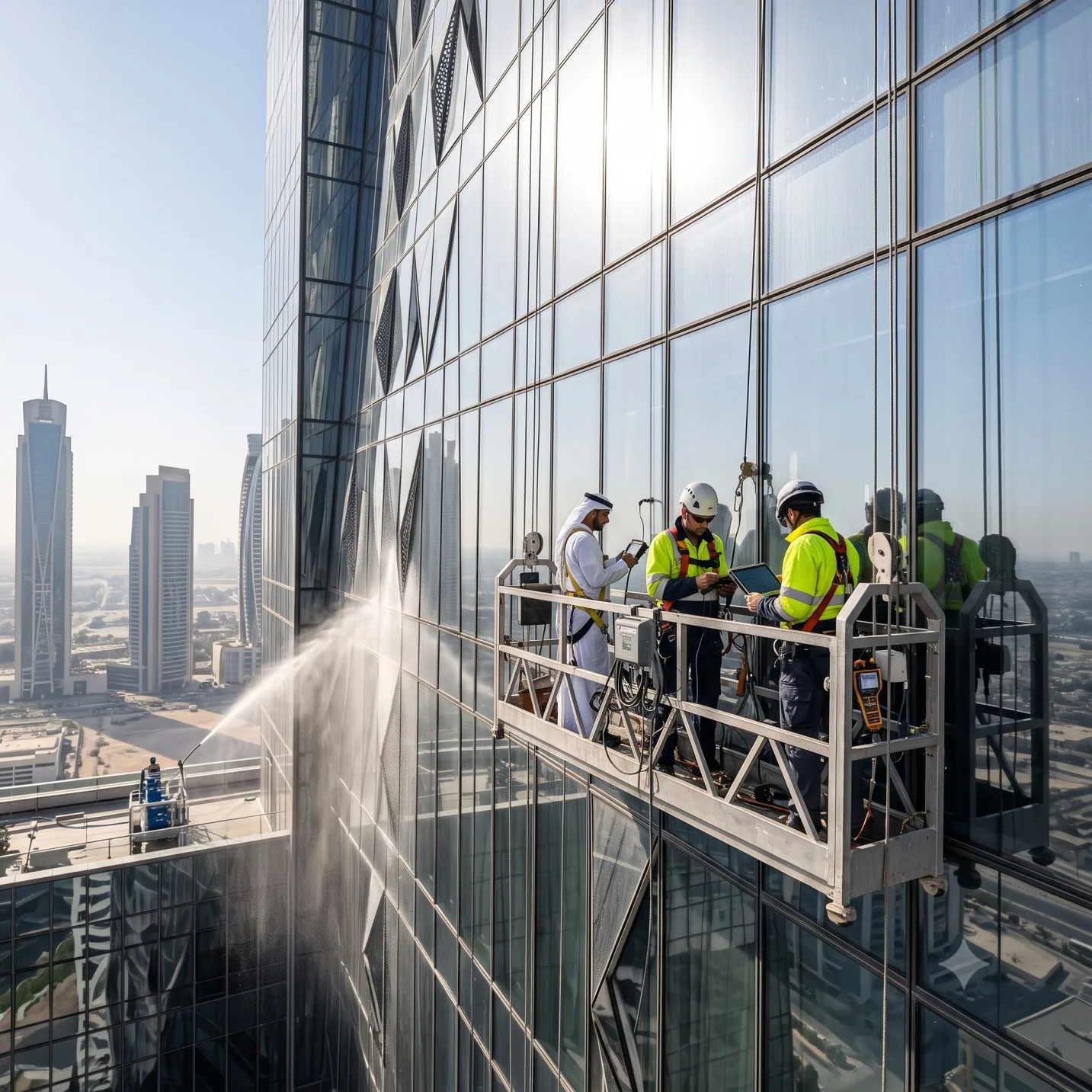
- Water infiltration testing, which uses controlled spray or hose methods to simulate rain and check whether moisture penetrates the facade system.
- Air leakage or blower door testing, which measures how airtight a building envelope is and highlights areas where conditioned air is escaping.
- Curtain wall testing, which assesses the structural performance, water tightness, and air tightness of glazed exterior wall systems under simulated wind and pressure loads.
- Anchor pull-out testing, which checks the load-bearing capacity of the fixings that hold facade panels and cladding systems in place.
- Smoke and gas ingress testing, which determines whether the building envelope can prevent smoke or harmful gases from entering occupied spaces during an emergency.
- Acoustic testing, which measures the sound insulation properties of facades and partitions, particularly important for buildings near busy roads or airports.
- Mock-up testing, where a full-scale sample of the facade system is built and tested under controlled conditions before full-scale construction begins.
Each of these tests plays a distinct role, and together they form a comprehensive picture of how a building envelope will actually perform once it is exposed to the elements, rather than how it is expected to perform on paper.
Why Facade Testing Matters So Much in the UAE Context
The UAE’s climate is unlike almost anywhere else in the world, and that reality shapes every decision around building design and compliance. Intense solar radiation, high humidity near the coast, sudden sandstorms, and wide daily temperature swings all place enormous stress on building materials. A facade system that performs perfectly in a temperate climate can fail within a few years if it was never properly validated for Gulf conditions. This is one of the main reasons facade testing has become such a priority for developers and consultants working in Dubai, Abu Dhabi, and across the wider GCC region.
Beyond climate, there is also a regulatory dimension. Authorities across the UAE have steadily tightened building codes, particularly after several high-profile facade fires drew attention to the dangers of non-compliant cladding materials. Regulatory bodies now expect developers to demonstrate, through documented facade testing, that their building envelopes meet fire safety, structural, and performance standards before occupancy certificates are issued. Skipping or rushing this process is not just a technical risk; it is a legal and financial one, since non-compliant buildings can face costly retrofits, delayed handovers, or even forced facade replacement.
There is also the matter of long-term asset value. A building with a well-tested, high-performing envelope uses less energy for cooling, suffers less water damage, and requires fewer repairs over its lifespan. Given how much developers invest in premium materials for UAE towers, it makes little sense to leave the actual performance of that envelope unverified. Facade testing essentially protects the investment that goes into the building’s exterior, ensuring that the materials and workmanship deliver the durability they were designed for.
The Practical Benefits of Investing in Facade Testing
For developers, contractors, and facility management teams, the value of facade testing extends well beyond regulatory compliance. When done properly, it delivers measurable benefits that affect a building’s safety, running costs, and reputation.
- It identifies design or installation flaws early, often before a building is even handed over, which is far cheaper to fix than discovering a leak years later.
- It reduces the risk of water damage to interiors, which can affect everything from finishes and electrical systems to indoor air quality and tenant health.
- It improves energy efficiency by confirming that the envelope is properly sealed, which directly reduces the load on HVAC systems in a region where cooling costs form a significant share of operating expenses.
- It supports green building certifications such as LEED, Estidama, and other GCC sustainability frameworks, many of which require documented evidence of envelope performance.
- It protects occupant safety by confirming that smoke, fire, and structural resistance requirements are genuinely met rather than assumed.
- It builds trust with buyers, tenants, and regulators, since a building with verified facade testing records is far easier to market, insure, and maintain.
For existing buildings, periodic facade testing is equally important. Facades age, sealants degrade, and anchor points can weaken over years of thermal cycling. Routine testing and inspection allow facility managers to catch deterioration before it becomes a safety hazard or an expensive emergency repair, which is particularly relevant for the large stock of towers built across Dubai and Abu Dhabi over the past two decades that are now reaching the age where envelope performance needs to be reassessed.
Choosing the Right Partner for Facade Testing
Because facade testing involves specialized equipment, trained technicians, and a detailed understanding of UAE and GCC building codes, it is not something that can be approached casually. The results need to be accurate, properly documented, and defensible to regulators, insurers, and clients alike. This is where working with an experienced testing and inspection partner makes a real difference.
Cornerstone Middle East has built its reputation in the UAE and wider GCC region around exactly this kind of specialized work. The company offers a full suite of facade and building envelope services, covering a comprehensive range of services designed to ensure the integrity, performance, and safety of building facades and envelopes, with advanced testing and inspection services tailored to meet the highest industry standards. Its scope spans curtain wall testing, water infiltration studies, air leakage and blower door testing, anchor pull-out testing, smoke and gas ingress testing, acoustic testing, and full-scale mock-up testing, giving clients a single point of contact for every aspect of facade testing rather than having to coordinate multiple specialist vendors.
What distinguishes Cornerstone Middle East in a competitive market is its combination of technical depth and regional experience. The company positions itself as combining cutting-edge technology with expert knowledge to deliver precise facade and building envelope solutions, with a certified team ensuring optimal performance and compliance. For developers managing complex high-rise projects or facility teams responsible for ageing towers, that combination of certified expertise and advanced equipment is exactly what is needed to make facade testing results reliable and actionable.
Just as importantly, Cornerstone Middle East frames its work around a broader philosophy of testing what genuinely matters for a building’s long-term performance, rather than simply ticking regulatory boxes. The company describes itself as going beyond checklists, testing and inspecting systems, buildings, and infrastructure to ensure they work, stay safe, and stand the test of time, giving contractors, consultants, and facility teams the clarity and confidence to move forward without surprises. That mindset is particularly valuable when it comes to facade testing, where the real goal is not just passing an audit but genuinely understanding how a building envelope will perform over decades of Gulf heat, humidity, and weather extremes.
Final Thoughts
As the UAE continues to build taller, more ambitious, and more architecturally complex structures, the importance of a properly validated building envelope will only grow. Facade testing has moved from being a specialist afterthought to a central part of how responsible developers, consultants, and facility managers protect their buildings, their occupants, and their investments. Whether a project is in the design phase, under construction, or already operating, investing in professional facade testing is one of the most practical steps available to ensure long-term safety, compliance, and performance. Working with an established provider such as Cornerstone Middle East gives project teams across Dubai, Abu Dhabi, and the wider GCC region access to the technical expertise and proven methodologies needed to get that testing right the first time.