
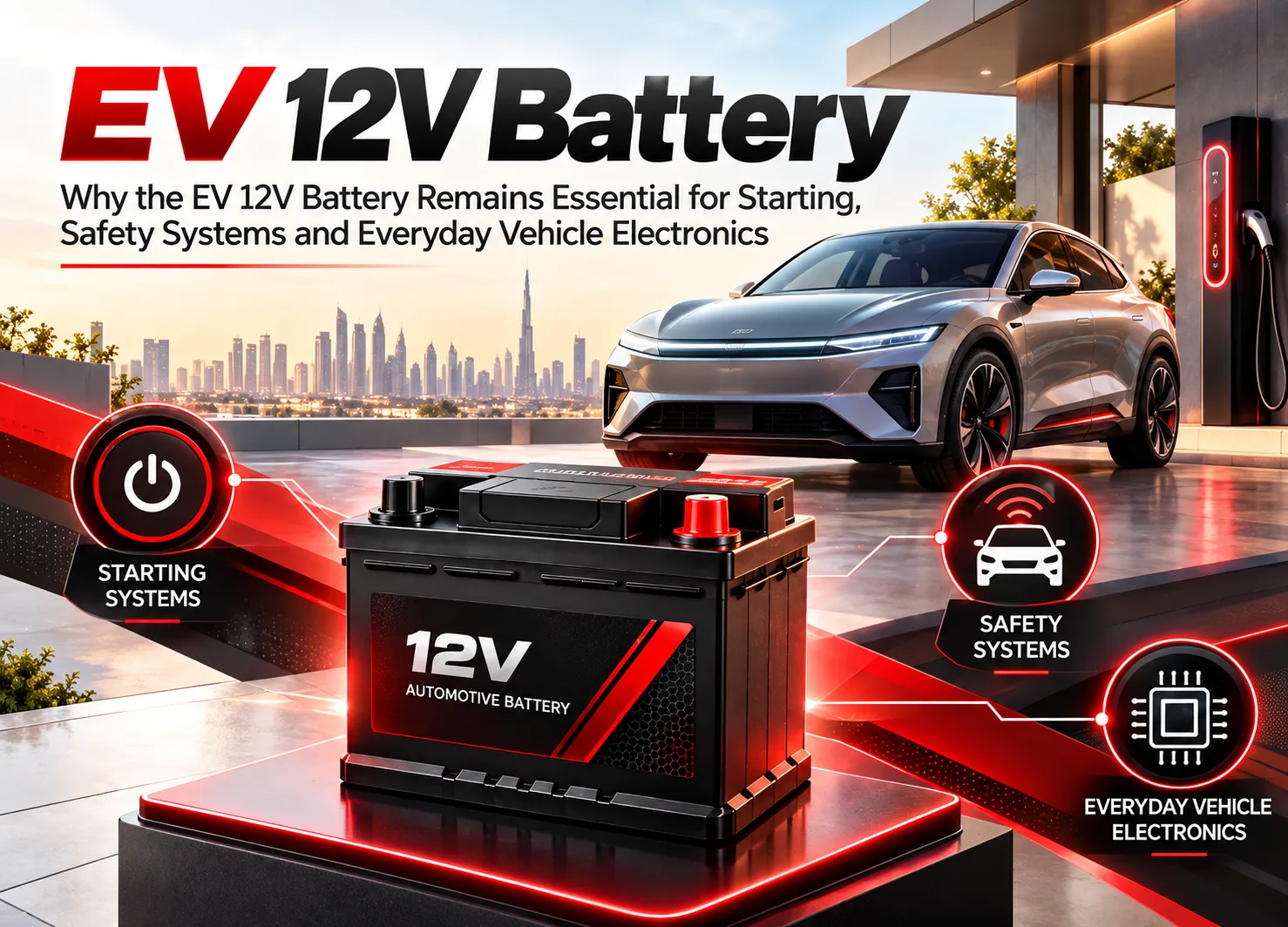
Electric vehicles are often discussed in terms of their large traction batteries, driving range and charging speed. A typical EV may carry a battery pack powerful enough to move the vehicle hundreds of kilometres, so it can be surprising to discover that many electric cars still depend on a much smaller low-voltage battery.
The EV 12V Battery plays a very different role from the main traction battery. Rather than powering the electric motor, it supports many of the electronic systems required to wake up, control and safely operate the vehicle.
As electric and hybrid cars become more technologically advanced, this smaller battery is becoming an increasingly important part of vehicle reliability.
Why Does an Electric Car Need a 12V Battery?
The high-voltage traction battery stores the energy used to propel an electric vehicle. However, many traditional automotive electronics still operate through a low-voltage electrical architecture.
The auxiliary battery may provide power to systems such as central locking, interior electronics, lighting, infotainment and control modules.
FORVIA HELLA notes that a stable low-voltage supply remains important in electric and hybrid vehicles because numerous safety and comfort systems continue to operate on the 12-volt network. Its new lithium-ion auxiliary battery is specifically being developed for this growing requirement.
The Small Battery Helps Wake Up the Big One
One of the most interesting functions of the auxiliary battery occurs before the vehicle is ready to drive.
The high-voltage traction system is normally isolated when the vehicle is switched off. Low-voltage electronics are needed to activate control systems and safely connect the high-voltage battery when the driver starts the vehicle.
This creates a situation that can initially seem confusing: an electric car can theoretically have plenty of energy remaining in its main battery but still experience problems powering up if its auxiliary battery cannot properly support the low-voltage system.
That is why diagnosing the correct battery is important rather than assuming the large traction pack is responsible whenever an EV fails to start normally.
EV Auxiliary Batteries Are Also Changing
Low-voltage automotive batteries are not standing still while traction batteries evolve.
Lead-acid technology remains common, but some manufacturers are increasingly exploring lithium-ion low-voltage batteries.
In July 2026, FORVIA HELLA announced its first integrated 12-volt lithium-ion battery pack for electric and hybrid vehicles. The company says the design combines lithium-ion cells with a battery management system and can reduce weight by around 20% compared with conventional solutions. Series production is expected to begin in 2027.
Tesla service documentation also shows that different vehicles may use lead-acid or lithium-ion low-voltage batteries, reinforcing the fact that the correct replacement procedure depends on the specific vehicle architecture.
Battery Management Is Becoming Smarter
Modern auxiliary batteries increasingly work together with software and battery management systems.
These systems may monitor factors such as voltage, temperature, state of charge and battery health. The objective is not simply to provide electrical power but to manage that power more efficiently throughout the battery's operating life.
FORVIA HELLA says its new system measures current, voltage and temperature to estimate both state of charge and state of health.
This illustrates how even seemingly simple vehicle components are becoming part of the broader shift toward software-controlled automotive systems.
A Weak 12V Battery Can Still Leave a Modern Vehicle Stranded
Drivers sometimes assume that battery problems will become less common as vehicles become more advanced. In reality, modern electronics can make battery diagnosis even more important.
A 2026 Which? investigation highlighted 12V battery faults among some relatively new hybrids and electric vehicles, showing that low-voltage battery problems can still leave technologically advanced cars unable to operate normally.
The correct response is not always immediate replacement. A weak auxiliary battery, charging-system issue or another electrical fault can produce similar symptoms.
For drivers who unexpectedly encounter starting or low-voltage problems, access to a mobile car battery service in the UAE can provide testing and roadside assistance before deciding whether battery replacement is actually necessary.
Why Proper Battery Diagnosis Matters More Than Ever
Modern vehicles contain many interconnected electronic modules.
Replacing a battery simply because a vehicle will not start may therefore overlook the real source of the problem. Technicians may need to evaluate the battery's condition, charging behavior and low-voltage system before determining the appropriate repair.
This is particularly important with hybrids and electric vehicles because the auxiliary battery may be charged through a DC/DC converter connected to the main traction battery rather than a conventional engine-driven alternator.
Replacement Is Becoming More Vehicle-Specific
Battery replacement is also becoming less universal.
Different electric and hybrid vehicles can use AGM, flooded lead-acid, lithium-ion or other low-voltage battery designs. Some models may also require software procedures after installation.
Tesla's service documentation, for example, includes specific procedures for identifying battery type and configuring the vehicle after certain low-voltage battery replacements.
This reinforces an important point: a battery that physically fits into a vehicle is not automatically the correct battery for its electrical architecture.
The Future of the EV 12V Battery
As vehicles become increasingly software-defined, manufacturers may gradually move toward new low-voltage architectures, lighter batteries and more intelligent power-management systems.
The familiar 12V battery may therefore evolve significantly, but the need for a reliable secondary power system is unlikely to disappear immediately.
Automotive manufacturers still need a dependable way to support essential electronics, activate high-voltage systems and maintain safety-related functions.
The future electric vehicle may look completely different from a traditional petrol car under the bonnet, yet one principle remains familiar: reliable electrical power is essential for reliable mobility.
The large traction battery may receive most of the attention, but the smaller auxiliary battery quietly demonstrates that sometimes one of the least visible components can still play one of the most important roles.