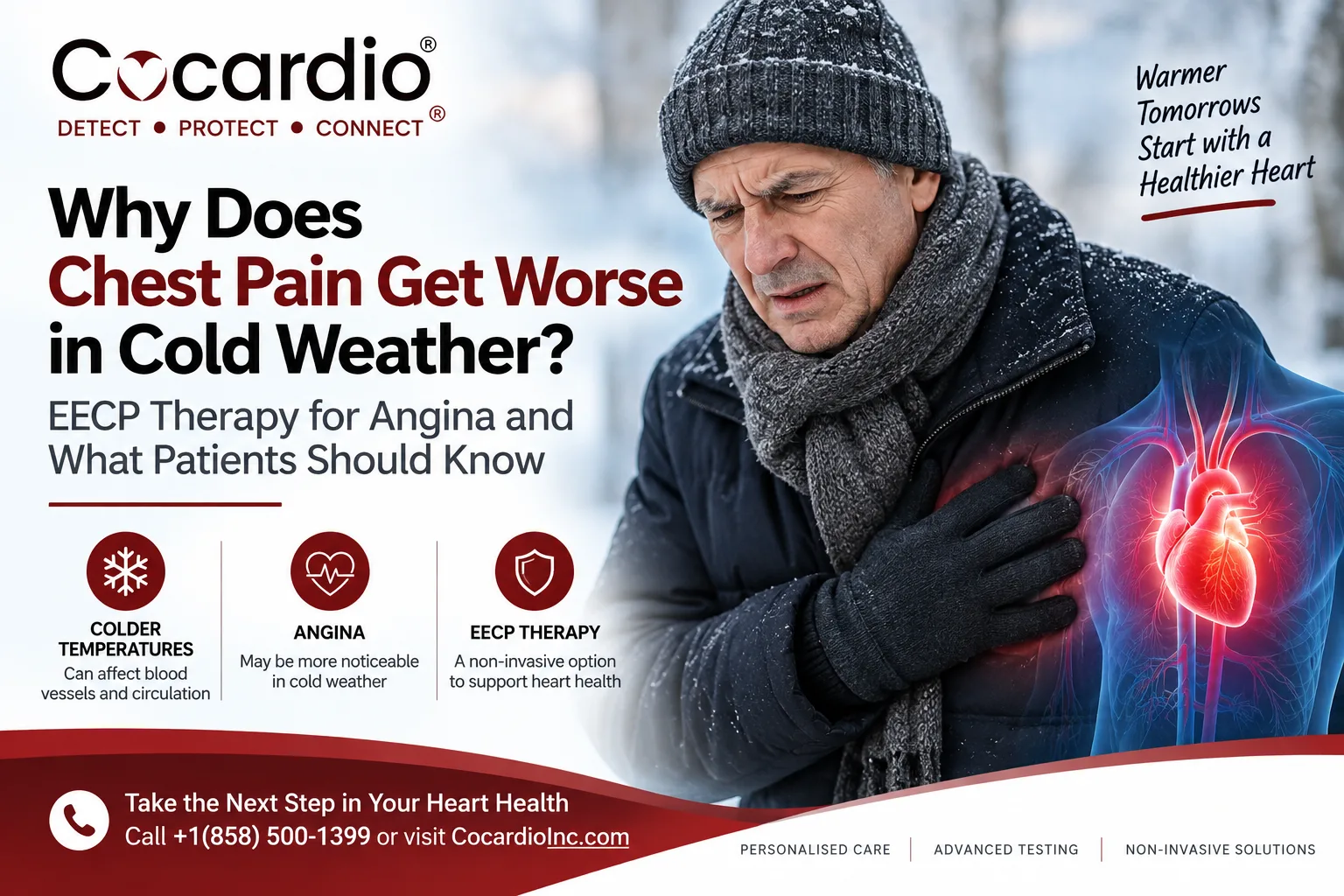
Chest pain that appears or feels worse in cold weather should be taken seriously, but the weather alone cannot tell you whether the cause is angina. CoCardio® explains that angina occurs when the heart muscle does not receive enough blood flow and that heart-related chest discomfort may be associated with reduced circulation, physical activity, or stress. For someone with recurring symptoms, the priority is appropriate medical evaluation before discussing longer-term options such as eecp therapy for angina.
Sudden, severe, or worsening chest pain—especially when accompanied by shortness of breath, fainting, nausea, or pain spreading to the arm or jaw—requires emergency medical care. CoCardio® does not provide emergency services, and its chest-pain services are designed to complement, not replace, standard cardiology or primary care.
Medical disclaimer — This article is for general educational purposes only and does not provide a diagnosis or replace emergency care, primary care, or cardiology care. Seek advice from a qualified healthcare professional before changing medications, treatment, diet, or lifestyle. If chest pain is sudden, severe, worsening, or accompanied by concerning symptoms, seek emergency medical care.
Why this matters
Symptoms such as chest pressure, shortness of breath, fatigue, or reduced exercise capacity can overlap across cardiac and non-cardiac conditions. CoCardio®’s supplied materials consistently frame evaluation, heart-function assessment, prevention, and external counterpulsation as complementary to standard medical care. The sections below keep that distinction explicit so that education does not become self-diagnosis.
Cold-weather chest pain still needs a medical explanation and eecp therapy for angina
Cold weather may coincide with symptoms, but a symptom pattern is not a diagnosis. The supplied CoCardio® material supports a more careful starting point: chest pain can come from cardiac and non-cardiac sources, and overlapping symptoms make evaluation important. Heart-related chest pain may reflect reduced blood flow to the heart muscle, strain during activity or stress, or structural and valve-related changes.
That distinction matters because people can be tempted to explain recurring discomfort as “just the cold.” If the same pressure, heaviness, or tightness returns during outdoor activity, walking uphill, rushing, or other exertion, it deserves medical attention. CoCardio® describes angina as chest discomfort that can occur when the heart muscle is not receiving enough blood flow, especially with physical activity or stress.
Because the supplied sources do not provide a specific cold-weather mechanism, this article does not claim that cold exposure itself is the confirmed cause of a patient’s symptoms. The useful clinical question is whether the symptom pattern reflects a circulation problem, another heart issue, or a non-cardiac cause.
- Do not diagnose the cause from timing or circumstance alone.
- Track whether symptoms are new, changing, recurrent, or linked with exertion.
- Escalate urgent symptoms rather than waiting for a routine appointment.
What angina can feel like and why coronary blood flow matters
Angina is commonly described by CoCardio® as pressure, tightness, or heaviness in the chest, sometimes triggered by exertion or emotional stress and sometimes improving with rest. It is not the same thing as a heart attack, but it is a warning sign that circulation to the heart may be compromised.
Coronary artery disease can narrow or block arteries that supply the heart. CoCardio® notes that reduced coronary blood flow may lead not only to chest pain but also to shortness of breath, fatigue, low stamina, or reduced exercise tolerance. That wider symptom picture is useful when discussing recurring discomfort with a clinician.
For people already diagnosed with coronary artery disease, a page focused on eecp for coronary artery disease prevention can provide additional context about CoCardio®’s prevention-first, circulation-focused approach. The supplied material also makes clear that CoCardio® works alongside existing cardiology care rather than replacing it.
How heart function testing and consultation fit into the evaluation
Once urgent causes have been ruled out, the next step is to understand what the heart is doing. CoCardio® describes Heart Function Testing as an echocardiogram, a non-invasive ultrasound used to assess pumping strength, valves, heart structure, and signs of strain or dysfunction.
A root cause consultation can then be used to review the broader picture, including symptoms, risk factors, testing, and whether the chest discomfort may be circulation-related. The goal is not to assume every cold-weather episode is angina. It is to create a clearer basis for deciding what should happen next.
This consultation-led approach is particularly relevant when symptoms are recurring, unexplained, or concerning even after urgent problems have been excluded. CoCardio® also notes that some individuals seek evaluation after being told prior testing was “normal” but they remain concerned.
Where eecp therapy for angina may fit after evaluation
For appropriate patients with stable angina, CoCardio® describes CoCardio Boost™ using external counterpulsation as a non-invasive option that may help improve blood flow to the heart muscle, reduce angina symptoms, and increase exercise tolerance. Candidacy is determined through consultation and heart-function assessment rather than by symptoms alone.
An eecp treatment discussion should therefore happen after the patient’s condition and safety have been evaluated. Someone searching for EECP therapy near me may be looking for a nearby treatment center, but proximity should not replace appropriate candidacy screening. Likewise, questions about EECP therapy cost are best addressed after the patient understands whether the therapy is relevant to their situation.
The phrase ecp therapy is also commonly used in CoCardio®’s materials for external counterpulsation. The supplied guide How EECP may help patients with coronary artery disease and persistent angina can be used as an additional educational resource for patients who want to understand how this circulation-focused option is positioned.
When chest pain needs urgent care instead of an office visit
Any new, severe, escalating, or unexplained chest pain needs caution. CoCardio® specifically advises emergency medical care for sudden, severe, or worsening chest pain, particularly when it occurs with shortness of breath, fainting, nausea, or pain that spreads to the arm or jaw.
Do not wait for a routine consultation or an EECP appointment when symptoms suggest an emergency. If urgent causes have already been ruled out and the problem is recurring or unexplained, then a prevention-first evaluation may be appropriate.
For non-emergency questions about recurring angina symptoms and whether a circulation-focused evaluation is appropriate, call CoCardio® at +1(858) 500-1399.
Illustrative patient scenario
Illustrative example: A patient with known coronary artery disease notices recurring chest pressure while walking outdoors on colder mornings. The useful next step is not to decide that cold weather itself is the diagnosis. The patient should report the pattern to a clinician, review whether urgent causes have been excluded, and discuss whether heart-function testing or longer-term stable-angina management is appropriate.
Common mistakes to avoid
- Assuming cold weather is the diagnosis rather than a circumstance in which symptoms occur.
- Ignoring a change in chest-pain severity, frequency, or associated symptoms.
- Treating EECP as emergency care; it is not.
- Choosing a therapy based on location or price before candidacy is evaluated.
- Stopping prescribed cardiac treatment without speaking with a qualified clinician.
Key takeaways
- Angina can reflect reduced blood flow to the heart muscle and should be evaluated.
- Cold-weather timing alone does not establish the cause of chest pain.
- Sudden or worsening chest pain with concerning associated symptoms requires emergency care.
- For appropriate stable-angina patients, external counterpulsation may be considered after consultation and testing.
FAQ
Can cold-weather chest pain be angina?
It can occur in a person with angina, but the supplied CoCardio® sources do not establish cold exposure itself as the cause. Recurring pressure, tightness, or heaviness should be medically evaluated.
What symptoms make chest pain an emergency?
CoCardio® advises emergency care for sudden, severe, or worsening chest pain, especially with shortness of breath, fainting, nausea, or pain spreading to the arm or jaw.
What is eecp therapy for angina?
CoCardio® describes external counterpulsation as a non-invasive option for appropriate patients with stable angina that may support coronary blood flow, reduce symptoms, and improve exercise tolerance.
How do I know whether EECP is appropriate for me?
Candidacy should be determined through consultation and heart assessment. CoCardio® states that CoCardio Boost™ is selected carefully to ensure appropriateness and safety.
Conclusion
The main lesson is to treat recurring heart-related symptoms as information that needs interpretation, not as a diagnosis you can make from a trigger or symptom intensity alone. CoCardio®’s supplied materials support a consultation-led approach that combines symptom review, heart-function assessment, prevention, and circulation-focused options for appropriate stable patients. For non-emergency questions about whether an evaluation is appropriate, call +1(858) 500-1399.
Medical disclaimer — This article is for general educational purposes only and does not provide a diagnosis or replace emergency care, primary care, or cardiology care. Seek advice from a qualified healthcare professional before changing medications, treatment, diet, or lifestyle. If chest pain is sudden, severe, worsening, or accompanied by concerning symptoms, seek emergency medical care.