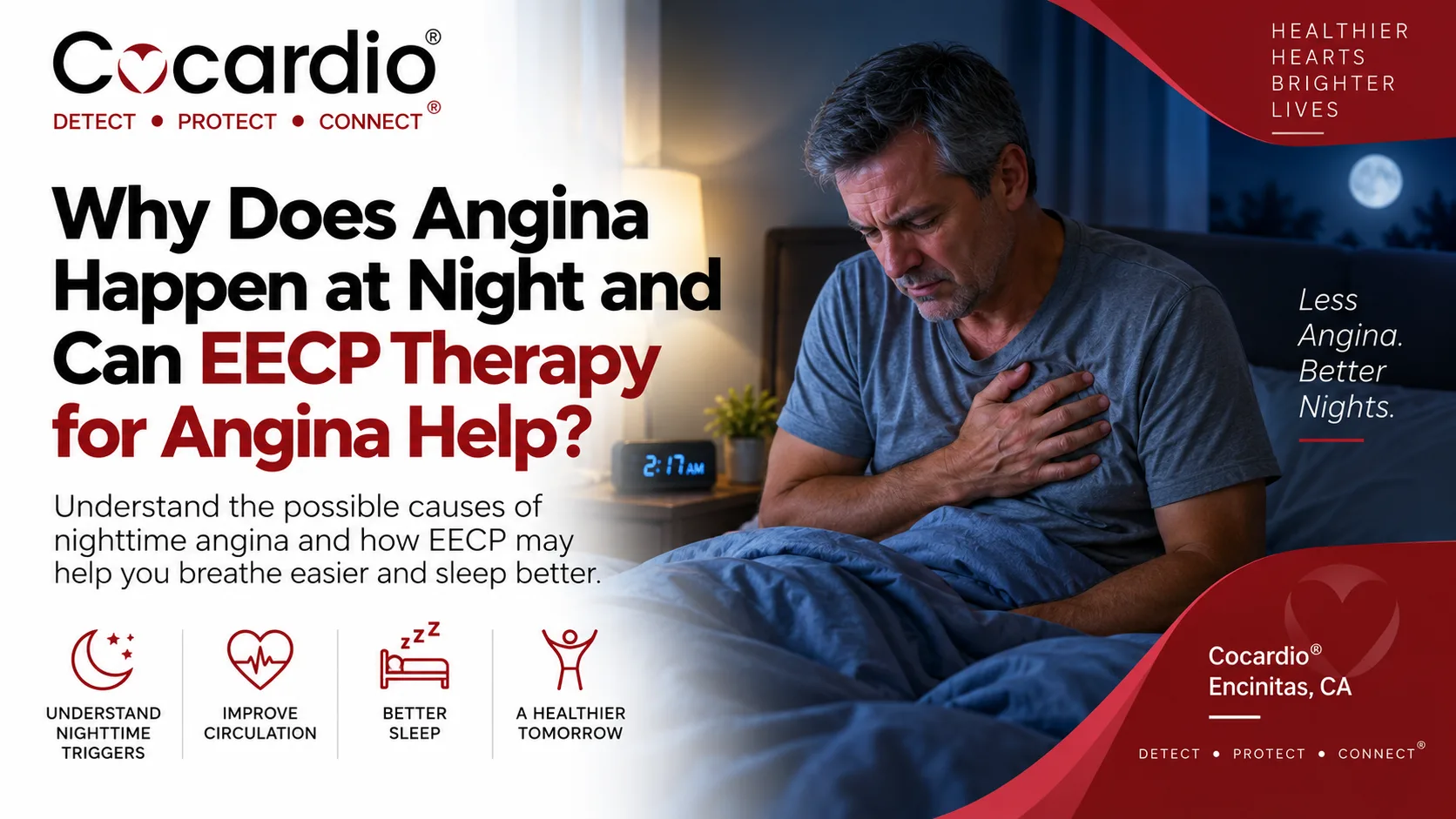
Angina does not always appear during exercise or a busy day. Some people notice chest pain, tightness, heaviness, or discomfort when they are resting or trying to sleep, which can make nighttime symptoms particularly unsettling. Angina occurs when the heart muscle does not receive enough oxygen-rich blood for its needs, but several different factors can contribute to symptoms that appear after dark. For people with diagnosed chronic angina, understanding the pattern of symptoms can help guide a more informed conversation about options such as EECP therapy for angina.
If chest pain is new, severe, worsening, or accompanied by shortness of breath, sweating, nausea, fainting, or pain spreading to the arm, back, neck, or jaw, seek emergency medical care immediately. Recurring nighttime chest discomfort should not simply be assumed to be a harmless part of existing heart disease. Once urgent causes have been evaluated, a cardiovascular professional can look more closely at what may be contributing to the symptoms. In Encinitas, CoCardio® provides a prevention-focused setting for people seeking to better understand their cardiovascular health.
Why Can Angina Symptoms Appear at Night?
When you lie down, changes in blood distribution and the cardiovascular system's workload can affect how the heart responds. Nighttime symptoms may also be influenced by blood pressure changes, heart rate, sleep quality, stress, meals, medications, and the underlying severity of cardiovascular disease. In some patients, coronary artery spasm can also cause angina at rest, including during nighttime or early-morning hours. This is why the timing of chest discomfort can provide useful information but cannot, by itself, identify the cause.
Could Eating Before Bed Affect Chest Discomfort?
A large or heavy meal increases the body's demand for blood flow during digestion, and some people with coronary disease report angina after eating. Lying down soon after eating can also trigger acid reflux, which can cause chest discomfort that may feel similar to heart-related symptoms. Because heart-related pain and digestive symptoms can overlap, self-diagnosing nighttime chest pain can be risky. A medical evaluation is important when symptoms are recurrent, changing, or unexplained.
What Is EECP Therapy for Angina?
EECP therapy for angina is a noninvasive treatment that uses inflatable cuffs placed around the lower body. The cuffs inflate and deflate in synchronization with the heartbeat, with the goal of improving circulation and reducing the heart's workload. It is most commonly considered for appropriately selected people with chronic stable or refractory angina, particularly when symptoms remain troublesome despite conventional care. Screening is necessary because the treatment is not appropriate for every patient.
A typical course of eecp treatment involves a series of scheduled sessions rather than a single appointment. During treatment, the patient remains awake while the cuffs repeatedly inflate and deflate according to the cardiac cycle. Some appropriately selected patients report fewer angina symptoms and improved exercise tolerance after completing a treatment course. Individual responses vary, so realistic goals should be established before beginning therapy.
As a featured speaker, Dr. Pratiksha Gandhi brings her expertise in preventive cardiology and her commitment to helping people better understand the connection between heart health and brain health. Founder of CoCardio®, Dr. Gandhi is an author, speaker, and educator who promotes evidence-based lifestyle approaches alongside standard medical care. Her educational work focuses on empowering individuals to understand cardiovascular risk and take proactive steps toward better long-term health and wellness.
Can EECP Treatment Stop Nighttime Angina?
Eecp treatment should not be viewed as an emergency treatment or a guaranteed way to eliminate nighttime chest pain. Its role is generally focused on improving symptoms and functional capacity in selected patients with chronic angina. If nighttime symptoms are new or becoming more frequent, the first priority is determining why that change is occurring. Treatment decisions can then be made in the context of the person's diagnosis, current medications, previous procedures, and overall cardiovascular condition.
This is also why searching for EECP therapy near me should be about more than finding the closest provider. Appropriate patient screening, clinical oversight, and an understanding of the person's existing cardiovascular care matter. At CoCardio® in Encinitas, the process begins with understanding the individual rather than assuming every episode of chest discomfort has the same cause. EECP is complementary care and does not replace emergency services, prescribed medication, a cardiologist, or medically recommended procedures.
What Else Should Be Evaluated?
A root cause consultation can provide an opportunity to review symptoms, risk factors, lifestyle patterns, health history, and current cardiovascular care in greater context. Depending on the individual, factors such as blood pressure, cholesterol, blood sugar, sleep, stress, physical activity, smoking history, and family history may deserve attention. Looking beyond one symptom can help create a clearer picture of cardiovascular risk. This can be particularly valuable when someone wants to take a more proactive role in long-term heart health.
People interested in aging and cardiovascular risk can also explore Is Your Heart Older Than Your Actual Age?. Biological-age concepts may offer additional context about health and aging, but they do not diagnose coronary artery disease or determine whether someone needs EECP. Clinical symptoms and established cardiovascular testing remain important. The goal is to combine useful information rather than rely on one measurement.
What About ECP Therapy and Treatment Costs?
You may also encounter the term ecp therapy when researching external counterpulsation. ECP and EECP are closely related forms of counterpulsation therapy, and suitability depends on individual screening. If you are comparing providers, ask how candidacy is evaluated, how sessions are structured, and what follow-up is available. Those questions can be more useful than choosing a treatment based on convenience alone.
Questions about EECP therapy cost are also understandable because treatment usually involves multiple sessions. Costs can depend on the treatment plan and services involved, so it is better to obtain information relevant to your circumstances rather than rely on a generic online estimate. CoCardio® can explain its current treatment options and payment information during your inquiry. You can then decide whether you want to proceed with an evaluation.
Take the Next Step With CoCardio® in Encinitas
If chronic angina continues to interfere with your sleep, activity, or quality of life, it may be worth discussing whether EECP therapy for angina is appropriate for you. CoCardio® in Encinitas provides individualized evaluation and eecp treatment within a broader heart-health approach. Treatment is not a substitute for your prescribed medications or established medical care, but it may provide an additional option for appropriately selected patients. The first step is finding out whether you are a suitable candidate.
Complete the CoCardio® consultation form to tell the team about your symptoms and heart-health concerns. You can also call +1(858) 500-1399 to connect with CoCardio® in Encinitas. Do not wait for a routine consultation if you are experiencing new, severe, or worsening chest pain; seek emergency care instead. For stable, previously evaluated symptoms, a consultation can help you better understand your next steps.