The Durable Medical Equipment (DME) industry is evolving rapidly. Providers are under increasing pressure to improve operational efficiency, reduce claim denials, accelerate reimbursements, and deliver a better patient experience. In this environment, one of the most critical workflows for success is patient intake.
Patient intake is the foundation of every DME transaction. It is where patient demographics, insurance information, prescriptions, authorizations, and medical documentation are collected and validated. When this process is slow or error-prone, the consequences can be severe—delayed care, denied claims, administrative burden, and lost revenue.
This is where dme patient intake software becomes a game-changing solution.
Modern intake software enables DME providers to streamline onboarding, automate documentation, verify insurance eligibility in real time, and reduce costly manual work. As the industry becomes more digital, businesses that embrace patient intake automation gain a clear competitive advantage.
In this article, we’ll explore what DME patient intake software is, how it works, key benefits, essential features, and why solutions like NikoHealth are helping providers modernize operations.
What Is DME Patient Intake Software?
DME patient intake software is a specialized technology solution designed to simplify and automate the patient onboarding process for durable medical equipment providers.
The software helps collect, organize, verify, and manage critical patient information required before equipment can be delivered or billed. This typically includes:
- Patient demographics
- Insurance details
- Physician orders
- Prescriptions
- Medical necessity documentation
- Prior authorizations
- Payment information
- Delivery preferences
Rather than relying on paper forms, spreadsheets, faxes, emails, and manual follow-up calls, DME providers can centralize everything in one digital workflow.
The goal is simple: improve speed, accuracy, compliance, and profitability.
Why Traditional DME Intake Processes Create Problems
Many DME providers still rely on outdated workflows involving faxed referrals, paper documentation, manual data entry, and disconnected systems.
These processes create multiple challenges.
1. Delayed Order Processing
Manual intake slows everything down. Staff may spend hours or even days collecting missing information before an order can move forward.
Patients needing critical equipment such as CPAP machines, wheelchairs, oxygen supplies, or mobility aids may face unnecessary delays.
2. High Risk of Human Error
Manual entry increases the likelihood of:
- Typing errors
- Missing documentation
- Incorrect insurance details
- Duplicate records
Even small mistakes can result in claim rejections.
3. Increased Claim Denials
Incomplete or inaccurate intake data often leads to denied claims. Missing prescriptions, incorrect HCPCS coding, or invalid insurance information can cause revenue loss.
4. Administrative Overload
Staff members spend excessive time on repetitive tasks like:
- Chasing missing forms
- Verifying eligibility
- Calling providers
- Managing paperwork
This reduces productivity and increases burnout.
5. Poor Patient Experience
Patients expect fast, seamless service. Delays, repeated requests for information, and inefficient communication can negatively impact satisfaction and trust.
How DME Patient Intake Software Works
A modern intake platform digitizes and automates the entire intake lifecycle.
Here’s a typical workflow.
Step 1: Referral Intake
Orders and referrals enter the system through multiple channels:
- Digital forms
- Referral portals
- Fax integrations
- EHR integrations
- Uploaded documents
The software centralizes incoming requests automatically.
Step 2: Data Capture
The platform extracts key information from documents, forms, and referrals.
This includes:
- Patient information
- Provider details
- Diagnosis codes
- Equipment requests
- Insurance data
Automation significantly reduces manual entry.
Step 3: Insurance Verification
Eligibility checks are performed in real time to confirm:
- Active coverage
- Deductibles
- Co-pays
- Authorization requirements
- Coverage limitations
This prevents issues later in billing.
Step 4: Documentation Validation
The system ensures required documentation is complete before processing continues.
Examples include:
- Signed physician orders
- CMNs
- Prescriptions
- Supporting clinical notes
Missing items are flagged immediately.
Step 5: Workflow Routing
Once validated, the order moves to the next stage:
- Authorization
- Scheduling
- Inventory allocation
- Delivery coordination
- Billing
This creates a seamless operational workflow.
Key Benefits of DME Patient Intake Software
Implementing intake software delivers measurable improvements across operations.
Faster Intake and Order Processing
Automation dramatically reduces onboarding time.
Instead of spending hours manually reviewing paperwork, teams can process referrals much faster.
This means:
- Faster approvals
- Faster deliveries
- Better patient outcomes
Speed matters in healthcare.
Improved Data Accuracy
Automated validation reduces human error.
Clean data at intake leads to:
- Better compliance
- Fewer billing mistakes
- More reliable reporting
Accurate information strengthens the entire revenue cycle.
Reduced Claim Denials
Claim denials are expensive.
By ensuring complete documentation and verified insurance upfront, providers reduce rejection rates significantly.
This improves:
- Revenue collection
- Cash flow
- Operational efficiency
Better Staff Productivity
Manual intake tasks consume valuable time.
Automation frees staff to focus on higher-value activities like:
- Customer service
- Patient support
- Relationship building
- Revenue optimization
This improves morale and efficiency.
Enhanced Patient Experience
Patients benefit from:
- Faster onboarding
- Less paperwork
- Better communication
- Faster equipment delivery
A smoother experience builds trust and loyalty.
Stronger Compliance
The DME industry is heavily regulated.
Software helps providers stay compliant with:
- Documentation requirements
- Payer rules
- Authorization policies
- Audit readiness
This reduces risk and improves confidence.
Must-Have Features in DME Patient Intake Software
Not all software solutions are equal.
When evaluating a platform, providers should prioritize the following features.
Digital Forms and Document Management
The software should allow digital collection and storage of:
- Forms
- Prescriptions
- Insurance cards
- Medical documentation
Centralized access improves visibility.
Real-Time Eligibility Verification
Immediate insurance validation reduces delays and billing risk.
This is essential for efficient operations.
Workflow Automation
Automation should eliminate repetitive tasks such as:
- Status updates
- Notifications
- Routing
- Follow-up reminders
This boosts efficiency.
Integration Capabilities
The software should integrate with:
- EHR systems
- Billing systems
- Delivery apps
- Inventory management platforms
Seamless data flow improves performance.
Reporting and Analytics
Data-driven insights help providers monitor:
- Intake efficiency
- Approval timelines
- Denial rates
- Staff productivity
Visibility supports smarter decisions.
Secure Cloud Access
Cloud-based systems enable staff to work from anywhere while maintaining security and accessibility.
Why Automation Matters in the Future of DME
The healthcare industry is moving toward digital-first operations.
DME providers face growing complexity due to:
- Changing payer rules
- Higher patient expectations
- Increasing competition
- Rising operational costs
Manual workflows simply cannot keep up.
Automation allows providers to scale without increasing administrative burden.
Organizations investing in digital transformation today are positioning themselves for long-term success.
NikoHealth and Modern DME Intake Management
One company helping DME providers modernize intake workflows is NikoHealth.
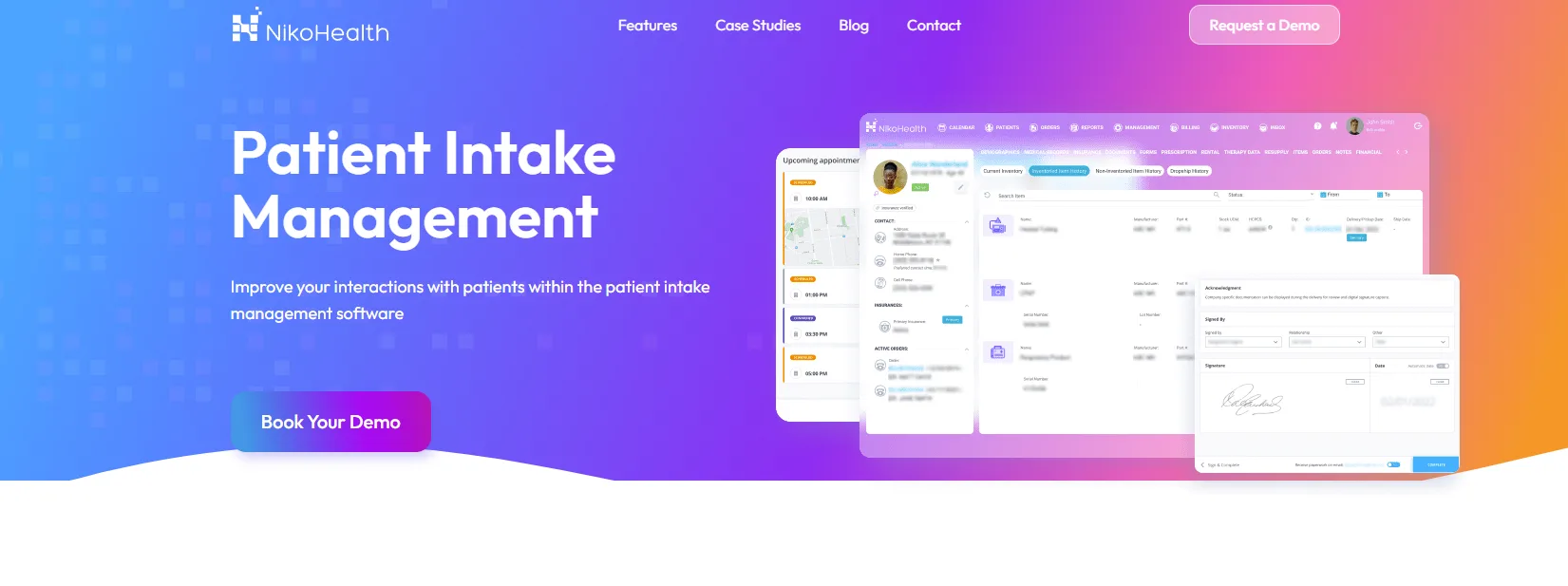
NikoHealth offers an all-in-one cloud-based platform built specifically for HME and DME operations. Its platform combines patient intake, billing, inventory, order management, delivery workflows, and reporting in one unified system.
For patient intake, NikoHealth helps providers manage:
- Patient demographics
- Insurance verification
- Prescription tracking
- Documentation management
- Authorization workflows
- Financial data
This centralized approach reduces manual touchpoints and improves visibility across teams.
A major advantage of NikoHealth is workflow connectivity. Intake does not exist in isolation—it directly connects to billing, delivery, scheduling, and revenue cycle management.
This creates a seamless operational environment where data flows efficiently from intake to reimbursement.
For growing DME providers, this type of integrated platform can significantly improve productivity and profitability.
Choosing the Right DME Patient Intake Solution
Selecting the right software requires careful evaluation.
Consider these questions:
- Does it reduce manual work?
- Can it automate eligibility checks?
- Does it improve claim accuracy?
- Can it integrate with existing systems?
- Is it scalable for business growth?
- Does it improve patient satisfaction?
The right platform should support both current needs and future expansion.
Technology investments should deliver measurable ROI.
Final Thoughts
Patient intake is one of the most important processes in the DME business. It affects patient satisfaction, operational efficiency, compliance, billing accuracy, and overall profitability.
Traditional manual workflows create unnecessary delays, errors, and administrative burden.
That’s why investing in dme patient intake software has become essential for modern providers.
With the right solution, DME organizations can:
- Accelerate onboarding
- Reduce denials
- Improve cash flow
- Enhance patient experiences
- Scale efficiently
As the industry continues to evolve, automation will become a necessity rather than a luxury.
Companies like NikoHealth are helping providers move beyond outdated workflows and embrace smarter, faster, and more connected operations.
For DME providers looking to stay competitive, modern patient intake software is no longer optional—it’s a strategic investment in long-term success.