A damaged product gets detected at the final inspection stage.
A shipment issue is discovered after dispatch.
A packaging error is noticed only when the customer complains.
A production deviation is identified after hundreds of units are already processed.
Technically, the defect was detected, but the loss had already happened.
This is the biggest gap in how many industries still approach quality today. Businesses celebrate better inspection systems, smarter cameras, and faster alerts yet the real question often remains unanswered:
If operational quality is not improving, is defect detection alone actually enough?
The answer is increasingly becoming no.
Across manufacturing, logistics, warehousing, and industrial operations, companies are now realizing that identifying defects after they occur is no longer the benchmark for operational excellence. The real competitive advantage lies in preventing those defects from happening in the first place. And that shift is redefining how AI-powered computer vision solutions are being used across industries.
Detection Tells You There Is a Problem. Prevention Stops the Loss
Traditional quality systems are inherently reactive. A process is executed, a defect occurs, and only afterward do inspection teams identify the issue. Corrective action follows later often after the defect has already propagated through production, increasing rework, waste, delays, and operational risk.
This approach may help maintain minimum quality standards, but it still comes with
operational damage:
- Rework and scrap
- Delayed production cycles
- Material wastage
- Shipment losses
- Customer dissatisfaction
- Downtime and inefficiencies
- Increased operational costs
In many industries, especially high-volume manufacturing and logistics environments, even small process deviations can create massive downstream impact. That is why businesses are moving beyond simple automated defect detection and focusing on prevention-driven operations. Because detecting a problem after the damage is done is not the same as avoiding the damage altogether.
How Physical AI Is Transforming Industrial Operations
Industrial AI is evolving beyond inspection and passive monitoring. Today, Physical AI systems continuously monitor workflows, operational behavior, process adherence, and execution consistency in real time across factories, warehouses, logistics, and industrial plants.
But many AI deployments still stop at detection. The system identifies an issue, generates an alert, and creates a report.
Operationally useful. Strategically incomplete.
Because detecting a defect after production, a loading error after dispatch, or a workflow deviation after disruption does not prevent losses.
The real value of AI lies in closed-loop execution control where every detected anomaly triggers immediate corrective action. Processes can be paused, operators alerted, progression blocked, and deviations corrected before they propagate downstream.
This shifts AI from passive observation to active operational enforcement.
And that is where prevention becomes far more valuable than detection.
Prevention Creates Operational Intelligence
Defect prevention is not simply meant for avoiding mistakes. It is about building systems that continuously improve process quality. A prevention-focused AI system does more than identify visible defects. It actively monitors operational behavior, process deviations, workflow adherence, and execution consistency in real time. This changes how industries operate.
Instead of reacting after failures occur, businesses can:
- Identify process deviations early
- Prevent repetitive operational errors
- Improve SOP compliance
- Standardize execution across teams
- Reduce dependency on manual supervision
- Improve accountability and traceability
- Minimize downtime and operational waste
This approach transforms AI from an inspection tool into an operational intelligence layer. And that difference directly impacts profitability.
Why This Shift Matters Across Manufacturing and Logistics
The challenge with manual operations is inconsistency.
Two operators may perform the same task differently.
Two facilities may follow different execution standards.
Small workflow deviations may go unnoticed for hours or days.
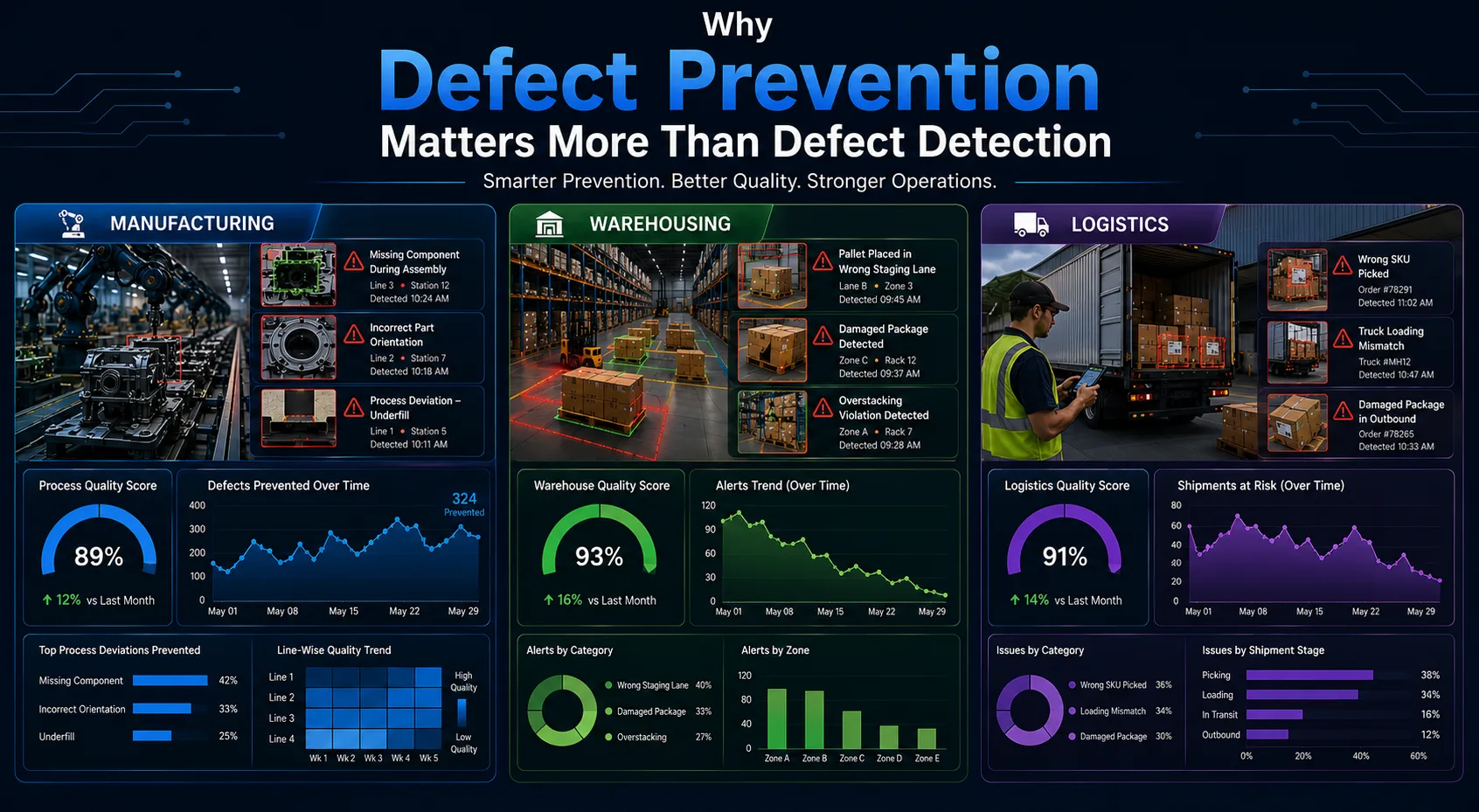
Over time, these inconsistencies become quality issues, inefficiencies, and financial losses. In manufacturing, this may result in faulty products or production delays.
In logistics, improper loading, handling, or packaging can damage shipments before they even reach customers. In warehousing, poor process adherence may create inventory mismatches, damaged goods, or dispatch errors. The problem is not always the defect itself. The problem is the lack of visibility before the defect occurs. This is exactly why prevention-led AI systems are becoming critical.
How Assert AI Is Approaching the Problem Differently
Many companies today offer AI-based inspection systems. Very few focus on whether operations are actually improving over time.
Assert AI takes a different approach by using computer vision solutions to improve process quality and operational execution itself. Its AI vision platform monitors workflows in real time, identifies operational deviations early, and helps organizations reduce recurring quality failures before they scale.
With Assert AI, organizations can:
- Improve operational consistency
- Monitor process adherence continuously
- Reduce repetitive defects and errors
- Minimize rework and wastage
- Improve traceability and accountability
- Enable faster corrective action
- Build scalable quality systems across facilities
The focus is not just on seeing defects faster. The focus is on preventing those defects from becoming recurring operational problems. And that is where real transformation happens.
The Future Will Belong to Prevention-Driven Businesses
As industries scale, operational complexity will only increase. Businesses will handle larger production volumes, faster delivery expectations, and tighter quality standards than ever before. In that environment, reactive operations will become increasingly expensive.
The companies that succeed will not be the ones with the most inspection reports. They will be the ones with the fewest operational failures.
That is why the future of AI in manufacturing and logistics is not just about smarter detection. It is about smarter prevention powered by intelligent computer vision solutions and next-generation physical AI systems.
Because operational excellence does not come from identifying what went wrong. It comes from building systems that stop things from going wrong in the first place.