Education is not limited to completing a textbook or preparing for an examination. It is a lifelong process that encourages students to discover new ideas, improve their abilities and understand the world around them. In today’s changing environment, children need to develop the habit of learning continuously rather than depending only on what they study in the classroom. This is why continuous learning has become an important part of modern education.
The CBSE education system supports the development of knowledge, practical skills, creativity and independent thinking. A student who continues learning beyond regular lessons can become more confident, adaptable and prepared for future challenges. For parents searching for the best CBSE schools in Bangalore, understanding the importance of continuous learning can help them identify a school that supports both academic achievement and overall development.
What Is Continuous Learning?
Continuous learning means developing knowledge and skills regularly through classroom lessons, practical activities, reading, observation, discussions and personal experiences. It encourages students to remain curious and understand that learning does not stop after a test or school year.
For example, a child who learns about plants in science may begin observing trees at home, growing a small garden or researching how plants support the environment. Similarly, a student learning about space may read books, watch educational videos or explore the topic through a project.
This approach helps children become active participants in their education. Instead of waiting for teachers to provide every answer, students learn to ask questions and find information independently.
Builds Strong Academic Understanding
Continuous learning helps students strengthen their understanding of academic subjects. Revisiting concepts regularly allows children to remember important information and identify areas where they need more practice.
In the CBSE curriculum, students are introduced to concepts in a structured manner. Each class builds on the knowledge gained in earlier years. When students continue practising and revising, they develop a stronger foundation in subjects such as mathematics, science, languages and social science.
For instance, a student who understands basic mathematical operations can gradually learn fractions, algebra and advanced problem-solving. Regular practice makes the transition between different levels of learning easier and more comfortable.
The top CBSE schools in Bangalore encourage students to understand concepts deeply instead of focusing only on memorising answers for examinations.
Encourages Curiosity and Independent Thinking
Curiosity is one of the strongest qualities of a successful learner. Children who are encouraged to ask “why,” “how” and “what if” questions are more likely to explore subjects with interest.
Continuous learning creates opportunities for students to follow their curiosity. They may read additional books, participate in educational competitions, conduct experiments or explore topics outside the syllabus.
This process also develops independent thinking. Students learn how to collect information, compare ideas and form their own conclusions. These skills are useful in academics as well as everyday life.
A supportive school environment can help children understand that asking questions is not a weakness. Instead, it is an important part of discovering new knowledge.
Develops Problem-Solving Skills
The world presents new challenges every day. Students need to learn how to think clearly, understand problems and find practical solutions. Continuous learning helps develop these abilities by encouraging students to explore different situations.
Project-based learning, puzzles, experiments and real-life activities can help children improve their problem-solving skills. A classroom project on waste management, for example, may encourage students to identify common problems, research possible solutions and prepare an awareness campaign.
Through such experiences, students learn that mistakes and challenges are part of the learning process. They become more patient and willing to try different approaches instead of giving up quickly.
Supports Learning Beyond the Classroom
Continuous learning does not happen only during school hours. Children can learn from books, family conversations, nature, technology, museums, educational visits and everyday experiences.
Parents and teachers can support this process by encouraging students to read regularly, observe their surroundings and discuss new ideas. A visit to a science centre can make scientific concepts more interesting, while a visit to a historical place can help students understand the past more clearly.
The best schools in Bangalore often combine classroom teaching with activities that encourage children to connect academic knowledge with real-life situations.
Improves Confidence and Communication
As students learn new things, they become more confident in expressing their ideas. Continuous learning gives children regular opportunities to participate in discussions, presentations, debates and group activities.
A student who reads about a topic and shares the information with classmates develops both knowledge and communication skills. Similarly, preparing a project teaches students how to organise information and explain it clearly.
Confidence grows when children realise that they can understand unfamiliar topics and complete new tasks. This confidence can positively influence their classroom participation, relationships and future academic choices.
Encourages Adaptability and Future Readiness
Technology, careers and society continue to change. Students may eventually work in fields that are different from the careers available today. Developing a continuous learning habit can help them adapt to these changes.
Students who are comfortable learning new skills may find it easier to understand new technologies, explore different subjects and respond to changing situations. They become more open to improvement and less dependent on familiar methods.
This is especially important for children preparing for higher education and professional life. Academic knowledge provides a foundation, but adaptability and the willingness to learn help students continue growing.
Promotes Creativity and Innovation
Continuous learning gives students the freedom to explore ideas and discover new interests. Reading, art, music, coding, writing, science projects and creative activities can help children develop imagination.
When students are exposed to different subjects and experiences, they begin to make connections between ideas. A child interested in science may explore robotics, while a student who enjoys language may develop an interest in storytelling or journalism.
These experiences encourage innovation and help students recognise their individual strengths. Schools that provide a variety of activities can make learning more engaging and meaningful.
Role of Teachers and Parents
Teachers and parents play an important role in developing a continuous learning mindset. Teachers can encourage students to ask questions, participate in activities and explore topics beyond the textbook. They can also provide constructive feedback that helps children understand how to improve.
Parents can support learning by creating a positive reading environment at home, discussing school experiences and encouraging children to explore their interests. It is important to focus on effort and progress rather than only marks.
When children receive encouragement from both school and home, they are more likely to develop a positive attitude towards learning.
Choosing a School That Encourages Continuous Learning
Parents comparing the top 10 CBSE schools in Bangalore should consider how each school supports learning beyond the regular syllabus. A school that offers projects, laboratories, libraries, clubs, sports, creative activities and educational visits can provide students with varied learning experiences.
Families looking for good CBSE schools in Bangalore or top-rated CBSE schools in Bangalore can also explore the school’s teaching methods, student support systems and opportunities for independent learning. Parents considering CBSE schools in Bilekahalli should look for an environment where students are encouraged to remain curious, practise regularly and develop confidence in their abilities.
Continuous Learning at Presidency School Bangalore South
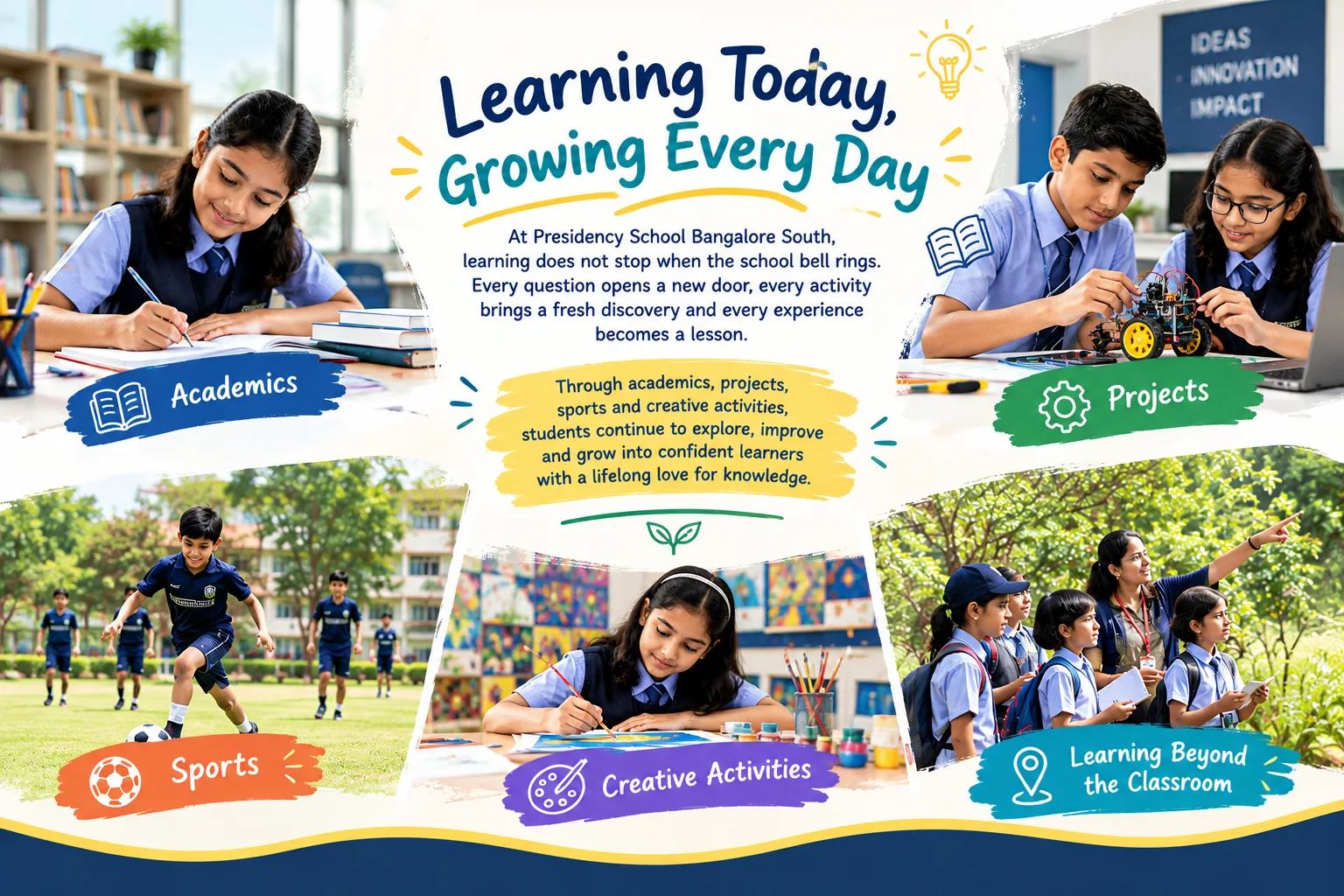
Presidency School Bangalore South encourages continuous learning through its CBSE curriculum, practical activities, projects, sports and co-curricular programmes. Students are motivated to explore new ideas, strengthen their skills and learn from everyday experiences, helping them develop curiosity, confidence, creativity and a lifelong interest in learning.
Conclusion
Continuous learning is an important part of CBSE education because it helps students develop strong academic foundations, curiosity, creativity, communication and problem-solving skills. It teaches children that education is not limited to classrooms or examinations but is a process that continues throughout life.
For parents choosing among the best CBSE schools in Bangalore, a school that encourages continuous learning can help children become independent, adaptable and confident learners. By developing the habit of exploring new ideas and improving their skills, students can prepare themselves for academic success and the opportunities of the future.