A newly constructed industrial system can appear complete while still containing debris, rust, mill scale, moisture, oils, or construction contaminants capable of affecting startup. That is why critical infrastructure cleaning services should not be viewed merely as a final field task.
Before a system is introduced to operating conditions, engineers must determine what requires cleaning, how contaminants can be removed, and what cleanliness level the equipment and process demand.
The distinction becomes important when evaluating critical infrastructure cleaning services for complex facilities. A process line, boiler circuit, lubrication system, or heat exchanger may have different flow characteristics, materials, access limitations, and equipment sensitivities. A method that works effectively on one circuit may not automatically translate to another.
Cleaning Starts With Understanding the System
The first engineering question is straightforward: What is being cleaned?
System drawings, piping configurations, equipment specifications, metallurgy, diameters, dead legs, bends, valves, instruments, and access points can all influence the cleaning approach. A long process line with multiple changes in direction may require a different strategy from a compact circuit with sensitive downstream equipment.
The second question is: What contaminant is present?
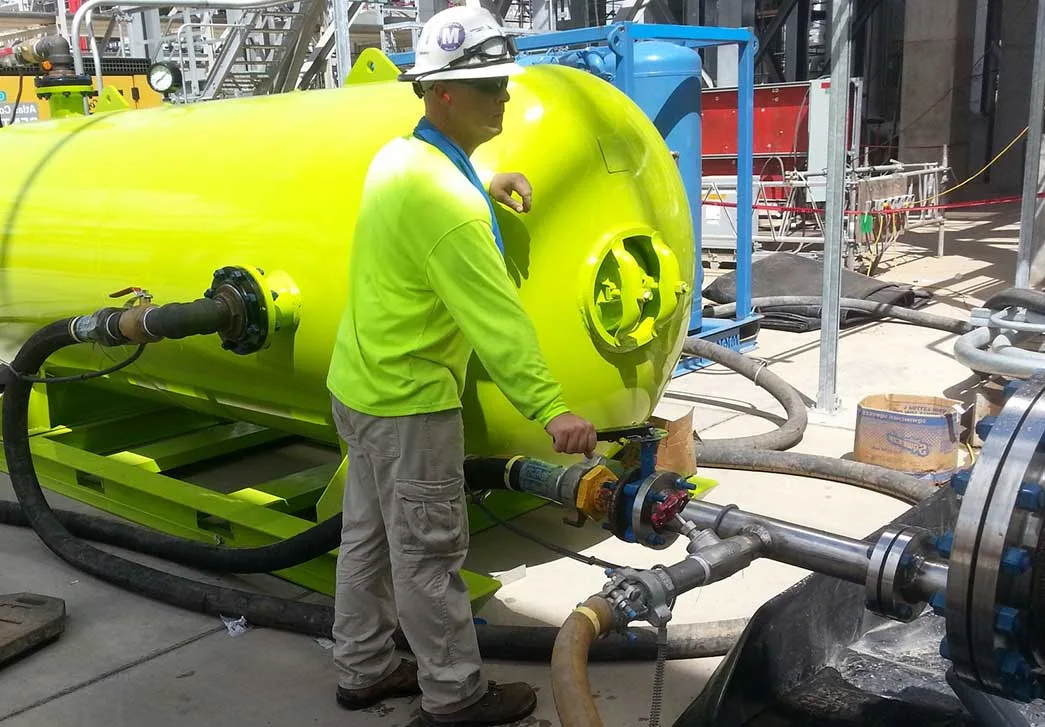
Construction debris, loose rust, water, oil, mill scale, waxes, varnishes, and other residues do not respond identically to the same cleaning force. For example, chemical cleaning may be appropriate for particular deposits in boilers, heat exchangers, or hydrotested piping, while air blowing may be designed to remove loose debris and liquids from process piping.
The objective is not simply to move material through the system but to select a method capable of addressing the actual contamination.
Five Engineering Questions Before Selecting a Cleaning Method
1. What is being cleaned?
The system boundary needs to be clearly defined. Engineers must understand which components are included, which must be isolated, and where temporary connections may be necessary.
2. What contaminant is present?
The type, quantity, adhesion, and location of contamination determine the cleaning mechanism. Treating all contamination as equivalent can result in unnecessary effort or incomplete removal.
3. What does the system configuration allow?
Flow paths, pipe diameter, bends, elevation changes, restricted access, valves, equipment connections, and potential choke points can determine whether a proposed cleaning method can actually achieve the required conditions. Engineering teams may need to model flow scenarios and plan temporary equipment around those constraints.
4. What cleaning force is required?
Velocity, turbulence, pressure, chemistry, drying capacity, and mechanical action can all contribute to cleaning performance. For critical systems, the selected force must be sufficient without creating unacceptable risks to components or the surrounding work environment.
5. How will the result be verified?
Cleaning is not complete simply because the planned operation has finished. Verification can involve visual inspection, cleanliness criteria, target evaluation, sampling, drying measurements, or internal camera inspection, depending on the system and specification.
Why Engineering Planning Matters Before Startup
The engineering stage connects the cleaning method to the actual facility. Specialized industrial cleaning providers may develop flow scenarios using project models, identify choke points, determine temporary equipment requirements, and develop procedures around the facility's schedule and cleanliness specifications.
This approach can also reduce adjustments during hot commissioning. If the cleaning circuit, temporary connections, equipment selection, and flow requirements are considered before execution, commissioning teams have fewer unknowns to resolve when the system approaches operation.
For example, oil systems serving turbines or compressors can be particularly sensitive to particulate and moisture contamination. A cleaning strategy therefore has to consider both contaminant removal and drying. Specialized approaches can combine high-velocity flushing with drying processes, while vacuum dehydration may address water, gases, and particulate contamination in certain fluid systems.
Similarly, camera inspection can help determine whether cleaning is required, refine the selected methodology, and provide visual confirmation of internal pipe conditions. Verification therefore becomes part of the engineering decision rather than an afterthought.
From Cleaning Activity to System Readiness
Treating cleaning as an engineering decision is crucial because startup relies on system readiness rather than just construction completion. EPC teams and commissioning engineers should focus on understanding the system, identifying contaminants, establishing cleaning conditions, designing temporary arrangements, executing methods, and verifying results.
Experienced providers like ICCI exemplify this approach through services such as air blowing, chemical cleaning, and camera inspection. The key is to match the cleaning method to the system, rather than choosing the most complex option.
Ultimately, critical infrastructure cleaning services become most effective when engineering judgment precedes field execution. When system configuration, contamination, flow requirements, metallurgy, access, temporary equipment, and verification criteria are considered together, cleaning becomes part of commissioning strategy rather than simply another construction activity.
That distinction can help technical teams approach startup with greater control over cleanliness, schedule, and system readiness.