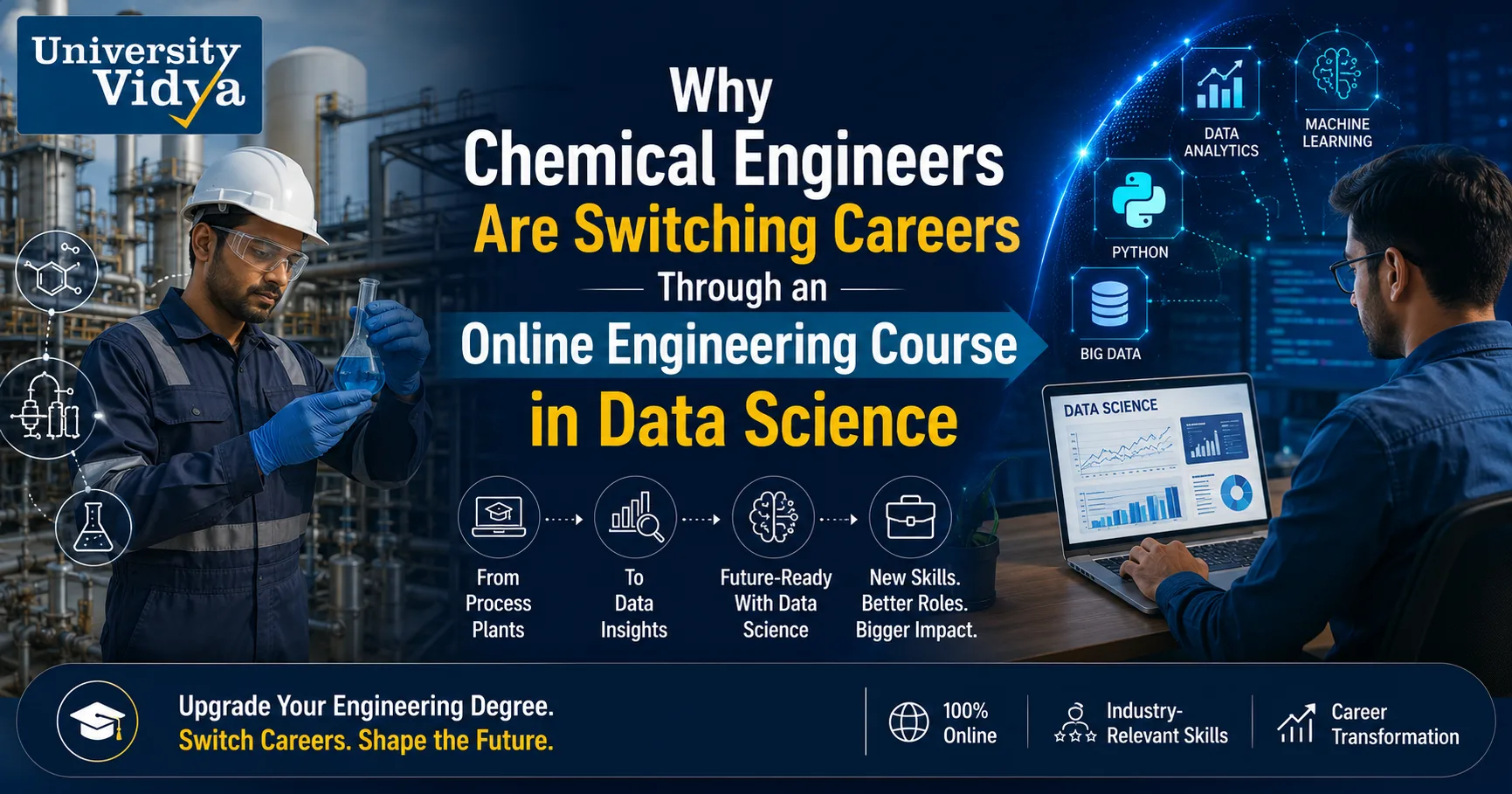
For decades, a career in chemical engineering meant a lifetime spent in oil refineries, pharmaceutical plants, or remote manufacturing facilities. Today, however, a massive shift is occurring across the global industrial landscape. A growing number of these professionals are pivoting into the tech sector, utilizing a specialized Online Engineering Course to master data science and artificial intelligence.
This transition is not a random trend; it is a highly calculated and strategic career move. In this comprehensive guide, you will discover exactly why chemical engineers are leaving the plant floor for data-driven roles. Furthermore, we will explore how modern digital education is making this lucrative leap entirely possible.
The Crossroads: Why Traditional Engineering is Evolving?
The traditional process industries are heavily regulated, incredibly capital-intensive, and notoriously slow to embrace rapid change. As a result, many mid-career process engineers experience a frustrating plateau in both salary and professional growth. They quickly realize that their foundational Online B.Tech or traditional undergraduate degree might not be enough to unlock future-proof leadership roles in a digital economy.
Meanwhile, the global tech sector offers exponential career growth, remote work flexibility, and highly lucrative compensation packages. Companies are desperate for professionals who can analyze massive datasets to optimize business operations. This stark contrast in industry momentum is prompting a mass exodus toward data analytics, machine learning, and software engineering.
Why Data Science is the Perfect Match for Process Engineers?
At first glance, mixing chemicals and writing code might seem worlds apart. Why are process engineers so uniquely successful when they pivot to the IT and data sectors? The answer lies in their inherent, rigorous analytical training.
Data science and chemical engineering actually share a deep, fundamental reliance on statistical modeling and complex system optimization.
A Mastery of Applied Mathematics
Chemical engineers spend years solving complex differential equations, mass balances, and thermodynamics problems. They are entirely comfortable dealing with abstract numbers and building predictive mathematical models. Transitioning from predicting chemical reaction yields to predicting consumer behavior using data algorithms is a surprisingly natural cognitive shift.
Systems-Level Analytical Thinking
Process engineers are rigorously trained to view massive, interconnected manufacturing plants as a single, cohesive system. They understand how a tiny tweak in one variable can drastically impact the final output. This macro-level analytical skill translates perfectly into designing complex neural networks or managing enterprise-level big data pipelines.
How Distance Learning is Bridging the Gap?
Quitting a stable, lucrative job in a petrochemical plant to attend a full-time coding bootcamp is highly impractical. The financial risk is simply too high for established professionals with adult responsibilities. This is where the evolution of digital education becomes a total game-changer.
By enrolling in specialized Online Engineering For Working Professionals, ambitious individuals can learn Python, SQL, and machine learning during their off-shifts. These asynchronous programs allow them to build a robust data portfolio without ever sacrificing their current industrial salary. They can apply their new coding skills to their current plant operations, proving their value immediately.
Elevating Credentials for the Tech Industry
For those looking to truly dominate the competitive tech industry, a simple short-term certification might not be enough. Many forward-thinking engineers are opting to pursue a rigorous Online M.Tech in Data Science or Artificial Intelligence. This advanced credential signals to tech recruiters that the candidate possesses both rigorous academic training and real-world execution skills.
Holding a master's degree in a tech-focused discipline completely erases the stigma of being an "outsider" transitioning from a different industry. It proves technical depth and a high level of dedication to the new craft. However, choosing the right academic program is absolutely critical to your success.
Navigating the Transition: What to Look For?
Navigating the massive maze of digital education providers can be deeply overwhelming for a busy working professional. You need absolute assurance that your chosen university is accredited, updated, and highly respected by top-tier tech companies. Enrolling in an unapproved diploma mill will waste your time and severely damage your resume.
Leveraging a trusted educational advisory platform like University Vidya simplifies this complex, high-stakes process. Such platforms help candidates compare authentic, UGC-approved programs, ensuring their investment of time and money yields actual career results. They match your specific career goals with the perfect university curriculum.
Actionable Steps for a Seamless Career Pivot
If you are a chemical engineer looking to make the jump into data science, preparation is key. Follow these structured steps to begin your transition safely and effectively:
- Audit Your Mathematical Skills: Brush up on linear algebra, calculus, and advanced statistics, as these form the absolute backbone of machine learning.
- Start with Python: Before applying for formal degrees, spend a month learning the basics of Python to ensure you actually enjoy writing code.
- Apply Data to Your Current Job: Volunteer to analyze plant sensor data or optimize supply chain spreadsheets using your new coding skills.
- Consult Academic Experts: Speak with educational counselors to map out a clear, accredited degree pathway that fits your busy shift schedule.
Securing a Future-Proof Tech Career
The rapid migration of chemical engineers into data science is a powerful testament to the evolving nature of global industries. By leveraging their deep mathematical prowess and complex problem-solving skills, these professionals are securing future-proof, highly lucrative careers in tech.
The barrier to entry has never been lower, thanks to highly accessible and respected virtual degree programs. If you are feeling stagnant, underpaid, or overworked in your current industrial role, now is the time to explore your options. Take control of your trajectory today, research accredited digital programs, and start building the bridge to your new career in data science.