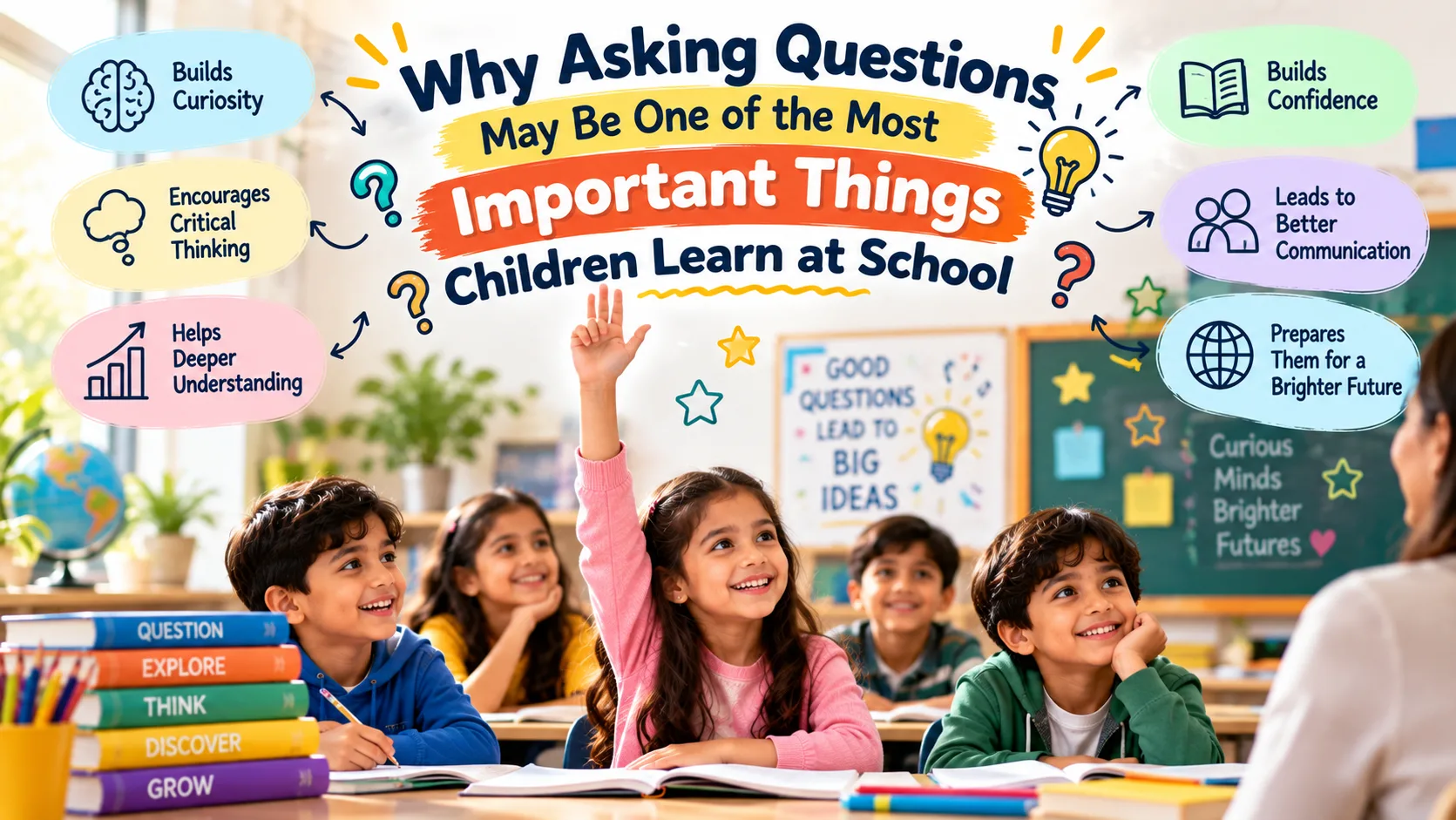
A child who asks "Why?" can sometimes test a parent's patience.
Why is the sky blue?
Why does this happen?
Why can't we do it differently?
But curiosity is not a problem to be removed. It is an important part of learning.
Children who feel comfortable asking questions are more likely to explore ideas, identify things they do not understand and look for explanations.
This is why encouraging curiosity can be an important part of primary schooling in Faridabad and the later stages of education.
Questions Show That Children Are Thinking
A question does not always mean that a child knows nothing about a topic.
Sometimes it means they are connecting different pieces of information.
For example, a child learning about rain might ask:
"If clouds are made of water, why don't they fall down?"
That question shows the child is already thinking about how clouds, water and gravity may be connected.
A teacher can use such questions to take the lesson further.
Children Can Become Less Comfortable Asking Questions
Young children often ask questions without hesitation.
As they grow older, some become more cautious.
They may worry:
- "What if my question sounds silly?"
- "What if everyone already understands this?"
- "What if the teacher thinks I wasn't listening?"
- "What if my classmates laugh?"
A classroom where questions are welcomed can help children overcome these concerns.
Parents Can Model Curiosity at Home
Parents do not need to know every answer.
In fact, saying "I don't know—let's find out" can teach children something valuable.
It shows that not knowing is not a failure.
You can also encourage children to investigate everyday questions.
If they ask why a particular plant grows differently, for example, you could look at the plant together and discuss possible reasons.
The aim is to keep curiosity alive.
Asking Better Questions Is a Skill
Not all questions help learning equally.
Children can gradually learn to move from simple questions to deeper ones.
For example:
"What is this?"
can become:
"Why does this happen?"
and eventually:
"What would happen if we changed this?"
That final type of question encourages prediction and experimentation.
Questions Can Improve Problem-Solving
Suppose a child is struggling with a maths problem.
Instead of immediately giving the solution, a parent or teacher might ask:
What information do we already have?
What are we trying to find?
Is there another way to approach the problem?
These questions guide the child towards solving the problem themselves.
Over time, children can begin asking similar questions internally.
Middle School Students Need Questions Too
As children move into middle school in Faridabad, subjects often become more detailed.
Students may encounter concepts that cannot be understood simply by memorising definitions.
They need to understand relationships, causes, processes and applications.
Encouraging questions can help students move from:
"What do I need to remember?"
towards:
"How does this actually work?"
That shift can make learning more meaningful.
Questions Are Useful During Secondary School
The same habit becomes even more valuable during secondary schooling in Faridabad.
Students may need to understand complex topics, prepare for examinations and make decisions about future studies.
They should feel comfortable asking teachers for clarification when something is unclear.
A student who quietly carries a misunderstanding for weeks may struggle later when new lessons depend on that earlier concept.
Asking early can prevent that problem.
Technology Makes Questions Even More Important
Children can now find answers to many questions within seconds.
But having an answer is not the same as understanding it.
Students still need to ask:
- Is this information reliable?
- Where did it come from?
- Does the evidence support it?
- Are there different explanations?
- How can I use this information?
This is particularly relevant to Future-Ready Education in Faridabad, where students are growing up alongside rapidly changing digital tools.
The ability to question information may become just as important as the ability to find it.
What Parents Can Ask During a School Visit
Parents can learn a lot by asking how a school treats student questions.
Useful questions include:
- Are students encouraged to ask questions during lessons?
- How do teachers respond when students make mistakes?
- Are classroom discussions encouraged?
- Do students work on open-ended problems?
- Are children given opportunities to investigate topics independently?
The answers can provide insight into the school's learning environment.
Don't Give Children the Impression That Every Question Needs an Immediate Answer
Sometimes children need to investigate.
If a child asks something and an adult immediately gives the answer every time, the child may learn to depend on adults for information.
Instead, parents can occasionally respond:
"What do you think?"
or:
"How could we find out?"
This turns the question into an opportunity for exploration.
Curiosity Can Support Lifelong Learning
School eventually ends, but learning does not.
People continue learning new skills throughout their lives.
They may need to understand new technology, adapt to changing work environments or solve unfamiliar problems.
A person who is comfortable asking questions and investigating answers is better prepared for that process.
Final Thoughts
Good education is not only about giving children answers.
It is also about helping them become comfortable asking thoughtful questions.
When children can question, investigate, make mistakes and try again, they become active participants in learning rather than simply receivers of information.
Sometimes a child's "Why?" is not an interruption to learning.
It is where the learning begins.