
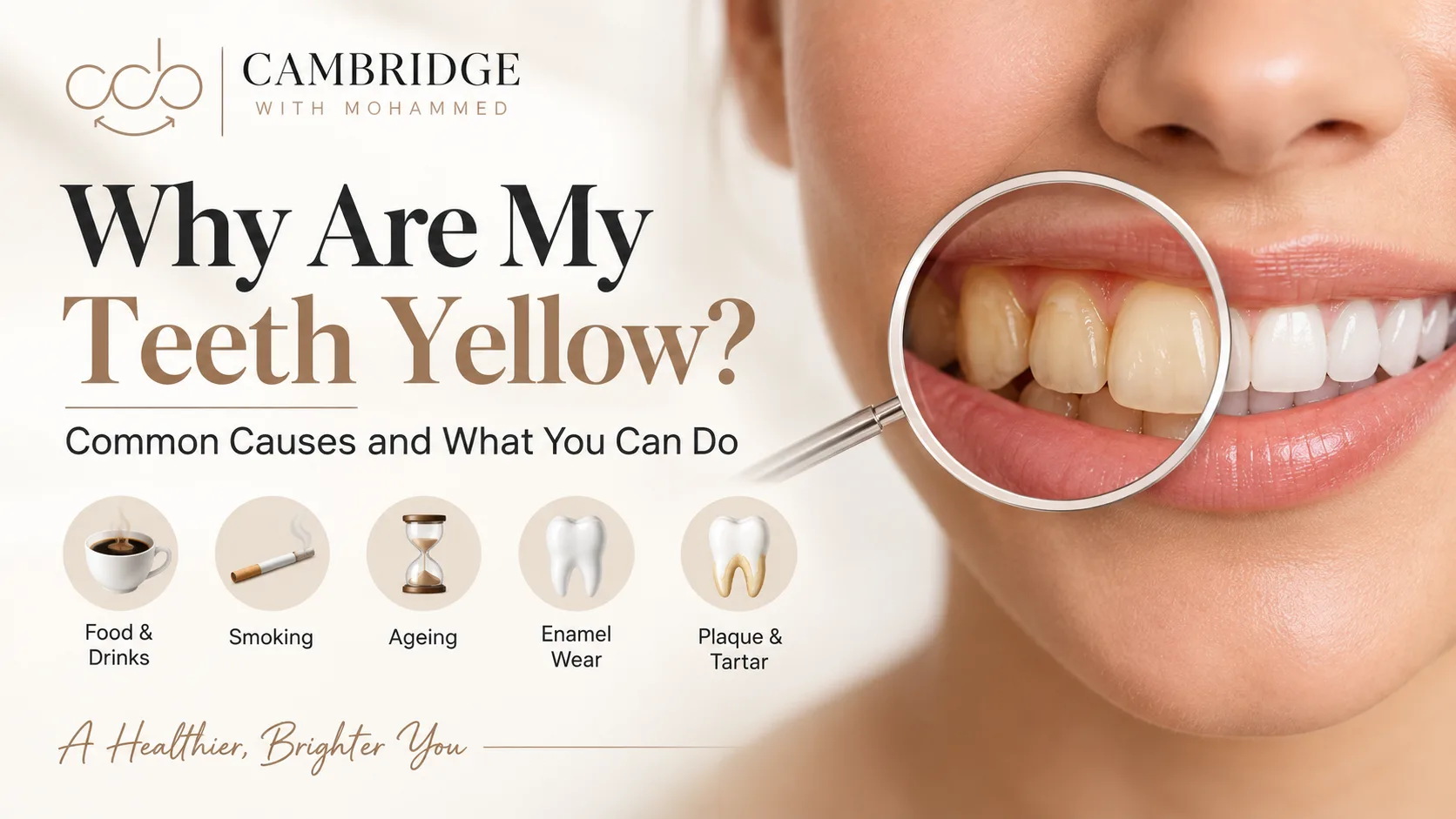
If you have ever looked closely at your smile and wondered, “why are my teeth yellow?”, you are certainly not alone. Teeth are not naturally bright white for everyone. In fact, healthy teeth often have a slight yellow, cream or ivory tone because the enamel is naturally translucent and the dentine underneath has a warmer colour.
Still, there is a difference between naturally off-white teeth and teeth that have become noticeably darker or more yellow over time.
Sometimes the reason is simple. A morning coffee, years of tea drinking, smoking, or certain foods can gradually leave stains behind. In other cases, yellowing may be related to enamel thinning, ageing, dental plaque or changes that started much earlier in life.
The good news is that yellow teeth do not automatically mean unhealthy teeth. But a change in colour is worth understanding, particularly if it happens suddenly or is accompanied by sensitivity, pain or other dental symptoms.
So, why are my teeth yellow?
There is rarely one single answer.
Tooth colour is influenced by genetics, age, enamel thickness, diet, oral hygiene and certain lifestyle habits. Some people naturally have teeth that appear more yellow because their enamel is thinner or their dentine is naturally darker.
Other people notice their teeth becoming yellower gradually.
Here are some of the more common reasons.
1. Your natural tooth colour may be slightly yellow
This is probably the first thing worth knowing.
Healthy natural teeth are not necessarily paper-white. Enamel is translucent rather than completely opaque, which means the colour of the dentine beneath it can show through. Dentine is naturally yellowish.
If your enamel is relatively thin, that underlying colour can be more visible.
So, if you have always had slightly cream-coloured teeth and there has been no significant change, this may simply be your natural tooth shade.
There is nothing inherently unhealthy about that.
2. Your teeth may be picking up stains from food and drinks
Certain foods and drinks contain pigments called chromogens, which can attach to the tooth surface and contribute to staining over time.
Coffee and tea are two of the most common examples. Red wine, cola, dark berries, curry, soy sauce and some strongly coloured foods can also contribute.
It is not necessarily about having one cup of coffee and suddenly developing yellow teeth. It is the repeated exposure over months and years that can gradually make a difference.
And sometimes the staining is more obvious because the person has naturally lighter teeth to begin with.
3. Smoking and tobacco can cause significant staining
Tobacco is another common cause of yellow or brown tooth discolouration.
Nicotine and tar can stain the surface of teeth, and persistent tobacco use can make those stains progressively darker. They can also build up around areas that are harder to clean properly.
Smoking affects much more than tooth colour, of course. It is associated with gum disease, bad breath and other oral health problems.
If yellowing is accompanied by bleeding gums, persistent bad breath or gum recession, it is worth arranging a dental examination rather than treating the colour alone.
4. Plaque and tartar can make teeth look yellow
Sometimes the issue is not the tooth itself.
When plaque is allowed to remain on the teeth, it can accumulate and eventually harden into tartar or calculus. Tartar can have a yellowish, brownish or darker appearance, particularly around the gumline.
This is one reason regular brushing and professional dental cleaning matter.
You may brush your teeth every day and still develop tartar because hardened calculus cannot simply be brushed away at home. A dental professional can assess it and remove it safely.
If your teeth look yellow mainly around the gumline, plaque or tartar could be part of the explanation.
5. Your enamel may have become thinner
This is an important one because it can happen gradually and may not be obvious at first.
Enamel is the hard outer layer of the tooth. Underneath it is dentine, which has a naturally yellowish colour.
As enamel becomes thinner, more of the dentine can show through. The result can be teeth that appear more yellow even when there is relatively little surface staining.
Enamel can wear down for several reasons, including acidic foods and drinks, acid reflux, aggressive brushing and certain habits that repeatedly expose the teeth to acid or mechanical wear.
If you also experience increased tooth sensitivity, particularly with cold drinks or foods, speak to your dentist.
6. Age naturally changes the appearance of teeth
Teeth often become darker or more yellow as we get older.
It is partly because enamel gradually becomes thinner with age, allowing more dentine to show through. Years of exposure to foods, drinks and other staining substances can also accumulate.
This is why someone may notice that their smile looked considerably brighter in their twenties than it does later in life.
Age-related colour changes are normal, although that does not mean you have to live with staining if it bothers you. A dental professional can discuss appropriate cosmetic options depending on the condition of your teeth.
Could poor brushing be causing yellow teeth?
It can contribute, particularly when plaque builds up.
Brushing twice a day with fluoride toothpaste helps remove plaque and food debris from the tooth surfaces. Cleaning between the teeth is important too because a toothbrush cannot reach every area.
But there is a common misconception here: brushing harder does not necessarily make teeth whiter.
In fact, aggressive brushing with excessive pressure can contribute to enamel wear and gum recession over time.
A gentle technique, a suitable toothbrush and consistent oral hygiene are much more useful than scrubbing your teeth as though you are trying to remove a stubborn stain from a kitchen surface.
What about yellow teeth despite brushing every day?
This is quite common.
Good oral hygiene does not guarantee naturally white teeth.
You could brush properly, floss regularly and have healthy gums while still having teeth that are naturally cream-coloured. Your genetics and the thickness of your enamel play a role in tooth colour.
Brushing mainly helps keep your teeth clean and your mouth healthy. It does not necessarily change the natural underlying colour of your teeth.
If the colour has changed noticeably despite good oral hygiene, a dental examination can help determine whether the issue is surface staining, tartar, enamel wear or something else.
Can certain medications cause yellow or discoloured teeth?
Some medications can affect tooth colour, particularly when teeth are developing during childhood.
For example, tetracycline antibiotics can cause intrinsic tooth discolouration when they are taken during certain stages of tooth development. Other conditions or exposures during tooth formation can also affect the colour or appearance of teeth.
This type of discolouration is different from surface staining.
It originates within the tooth rather than simply sitting on the outside, so ordinary brushing or a routine cleaning may not remove it.
A dentist can assess the pattern and likely cause of intrinsic staining before recommending treatment.
Can dehydration make teeth look yellow?
Not directly in the same way that coffee or tobacco can stain teeth, but dry mouth can affect oral health.
Saliva helps protect teeth, wash away food particles and maintain a healthy environment in the mouth. When saliva production is reduced, plaque can accumulate more easily, potentially contributing to staining and other dental problems.
Dry mouth can have several causes, including certain medications, dehydration and some medical conditions.
If you regularly experience a dry or sticky mouth, it is worth mentioning it during a dental appointment.
Why do my teeth look yellow near the gums?
Yellowing near the gumline deserves a closer look.
It may simply be tartar or plaque accumulation. But the natural tooth structure can also make this area appear slightly darker because enamel may be thinner toward the neck of the tooth.
If you notice a hard yellow deposit that does not disappear with brushing, do not try to scrape it off with a sharp object. Professional cleaning is safer and more effective.
If the area is accompanied by bleeding, swelling, tenderness or gum recession, a dental examination is particularly important.
Are yellow teeth unhealthy?
Not necessarily.
Tooth colour by itself is not a reliable measure of dental health.
A person can have naturally yellowish teeth with excellent oral health. Another person may have very white-looking teeth while having cavities, gum disease or other dental problems.
This is why it is useful to separate tooth colour from tooth health.
If your teeth have always been slightly yellow, there may be no underlying problem at all. If they have recently changed colour, however, it makes sense to investigate why.
What can you do about yellow teeth?
The right approach depends on the cause.
If staining is caused by plaque or tartar, professional cleaning may make a noticeable difference. If the teeth have surface stains from coffee, tea or tobacco, professional whitening may be considered after your dentist checks that your teeth and gums are healthy.
For some people, tooth whitening is enough.
For others, especially where there is intrinsic discolouration, enamel wear, irregular tooth colour or cosmetic concerns that cannot be addressed through whitening alone, treatments such as composite bonding or veneers may be discussed.
The important point is not to jump straight into a cosmetic treatment without understanding why the teeth look yellow in the first place.
Should you try home remedies for yellow teeth?
Be careful with internet advice.
You may come across recommendations involving lemon juice, vinegar, charcoal, baking soda or other abrasive substances. They can sound harmless because they are common household ingredients.
But acidic substances can contribute to enamel erosion, while excessive abrasion can wear the tooth surface.
Once enamel is lost, the body cannot simply grow it back.
If you want a brighter smile, it is much better to discuss evidence-based options with a dental professional than experiment with harsh DIY whitening methods.
When should you see a dentist?
If you are asking yourself “why are my teeth yellow?”, an appointment may be worthwhile if the change is new, uneven or becoming more noticeable.
You should particularly seek professional advice if yellowing occurs alongside:
- Tooth sensitivity
- Toothache or discomfort
- Bleeding or swollen gums
- Bad breath that persists
- Visible tartar
- Gum recession
- White, brown or dark patches
- A single tooth becoming noticeably darker
- Changes following an injury to a tooth
A dentist can examine the teeth and gums and work out whether the colour is natural, caused by external staining, related to enamel changes or associated with another dental issue.
A brighter smile does not always mean a perfectly white smile
It is easy to get caught up in the idea that healthy teeth should be brilliantly white. Real teeth are more varied than that.
Some are ivory. Some are cream. Some are naturally warmer in tone. And, yes, some become stained over time.
If you have been wondering why are my teeth yellow, start with the cause rather than the colour alone. Look at your oral hygiene, dietary habits, smoking or tobacco use, age, enamel condition and any recent changes.
For personalised advice, a dental assessment with Mr Mohammed Talha Deliwala can help determine whether your tooth colour is simply natural or whether staining, enamel wear or another issue is contributing to the appearance.
A healthier smile is not necessarily the whitest smile in the room. It is one that is properly cared for, understood and treated appropriately when something changes.