A decade ago, adventure bikes in India were a curiosity, often purchased by a limited group of enthusiasts who overlooked the issues of limited service networks, high running costs, and hostile roads that were not suitable for long-travel suspension. That picture has changed considerably today as adventure bikes are the fastest-growing motorcycle segment in India. The reasons behind this are not just trends, but are rooted in how modern buyers choose to ride their bikes.
What Is Driving Adventure Bike Sales in India
A significant transformation took place in India’s road infrastructure over the last few years. Highway networks were expanded, more growth of weekend touring culture grew, and the confidence among riders became noticeable on mixed terrains. All these have collectively created conditions to accelerate the sales of adventure bikes.
Retro and neo-retro bikes accounted for over 80% of the 350cc–500cc premium category. However, the mid-capacity adventure segment has expanded significantly with rising demand at an estimated rate of 15% annually in the motorcycle segment in India.
However, it is not just a single rider profile that is driving the growth of this segment. Rather, it encompasses riders who want to upgrade from smaller machines or those who are urban professionals looking for weekend escape routes and even experienced tourers who are replacing dedicated road bikes for more versatile options. What’s common in all of them is that they want machines that handle everything comfortably over single-purpose motorcycles.
The Infrastructure Argument
The improving road network has not only facilitated riding adventures, but has made the same accessible in ways which were unimaginable before. For example,
- The Bharatmala project added thousands of kilometres of highways connecting many remote destinations.
- Earlier, Himalayan routes were only accessible to highly experienced bikers with purpose-built machines, but today, regular traffic from mid-capacity adventure bikes is visible
- There is a strong demand for versatile bikes capable of handling city traffic and weekend escapes, and adventure bikes sit precisely at this intersection.
- With better and improved fuel availability at major touring spots, bikers became less anxious on their long rides.
The consequence is a rider base that is profound enough to invest in a machine capable of covering all of these aspects.
What a Mid-Weight Adventure Bike Must Deliver
The adventure bike segment has reached a point where buyers are no longer captivated by capability alone. Because they have done their research, watched the long-distance ride reports and reviews and have spoken directly to owners. So, they have a strong knowledge base, and for the same reason, they want a machine that delivers on every terrain- on tarmac, on gravel, on a mountain pass, and on a Monday morning commute.
The Specification That Actually Matters
Not all bike specifications translate to real-world advantage on Indian roadways. The ones that do contain the following-
- Suspension Travel: Minimum 150mm front and rear — enough to absorb broken tarmac and light off-road terrain without bottoming out
- Seat Height Adjustability: Critical for Indian riders across a wide range of heights, a fixed high seat position eliminates a significant portion of potential buyers
- Engine Character: Midrange torque matters more than peak power — tractable, accessible grunt that works in slow technical terrain as well as highway cruising
- Weight: Sub-200kg kerb weight is increasingly the benchmark, and lighter machines are simply more manageable across the full range of conditions adventure riding demands
- Electronics: Cornering ABS and multiple riding modes are no longer premium additions; they are baseline expectations in this segment
Why Mid-Displacement Has Won the Argument
For years, the extremes with large and small displacement machines dominated the adventure segment in India, and these were meant for serious tourers and beginners, respectively. There was no room for the middle group, and today, that has changed decisively.
The premium bike market of India is projected to grow by a CAGR of 6.30% and is expected to reach a value of USD 21.2 billion by 2030, with mid-displacement adventure bikes as one of the primary growth drivers.
Mid-weight machines broadly fall in the range of 350cc and 500cc. These are compact, lightweight and genuinely manageable off-road. Simultaneously, these are powerful enough to sustain highway riding, and the prices are also accessible to target a wider base of buyers than litre-class adventure machines ever could.
The Model That Defines This Conversation
Not every manufacturer has the potential to come up with a mid-weight adventure formula. The ones who did share something in common- they didn’t simply scale down a larger bike. They engineered a smaller machine with the same intent, geometry philosophy, and real-world testing rigour as their flagship models.
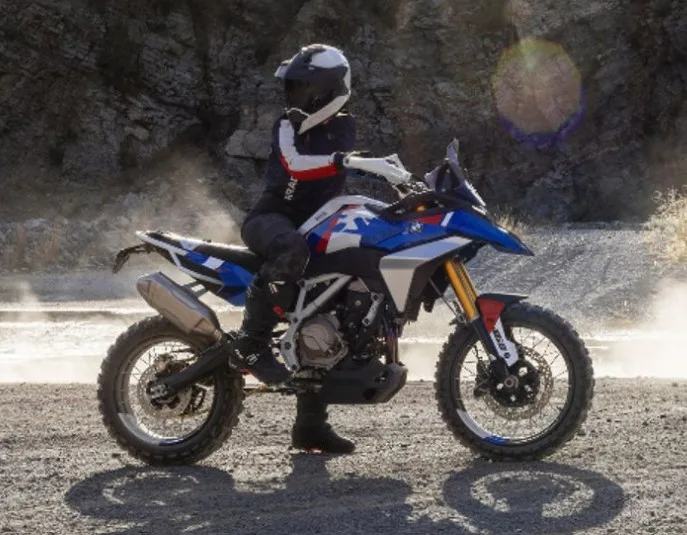
The BMW F 450 GS is one of the most considerable models that has these combinations. This bike is powerfully engineered for the full spectrum of adventurous riding, urban daily use or even for extended touring across mixed terrains.
If you are a rider evaluating your first adventure bike purchase or are keen to upgrade from a smaller machine, you can consider the mid-displacement segment, representing the complete and compelling answer the market has today.
Final Thoughts
Adventure motorcycling in India is no longer a fringe pursuit. India’s riding culture is now inclined towards machines that are genuinely versatile, technically accomplished, and capable of matching the ambition of a rider base that is exploring further and riding harder than any previous generation. The segment's growth is not a marketing narrative; it is a reflection of real purchasing decisions made by informed riders who know exactly what they want from a motorcycle and are no longer willing to settle for less.